avatarNikolaos Skordilis

Free AI web copilot to create summaries, insights and extended knowledge, download it at here

2008

Abstract

er, you have not heard about it, but I also doubt many of you know the significance of that ridiculously costly piece of high art and technology.</p><p id="00bc">The purpose of this article is to illuminate you, no pun intended. So let me list <b>2</b> of the reasons the James Webb is a really big deal:</p><p id="ae93"><b>1.It was designed to out-Hubble Hubble. </b>The Hubble space telescope has delivered some exquisite images of the universe like the one below. However, apart from having long exceeded its design life and requiring a successor, it has limitations because it cannot peer into dust clouds and due to its small primary mirror.</p><p id="db10">JWST has a <i>far</i> larger primary mirror (273 sq ft / 25.4 m²), it can work with wavelengths ranging from orange to mid infrared, and it has much more advanced and sensitive instruments.</p><figure id="bf71"><img src="https://cdn-images-1.readmedium.com/v2/resize:fit:800/1*dr3cBeGkqj9A689g3GJjQw.jpeg"><figcaption>Credit: NASA, ESA/Hubble and the Hubble Heritage Team | Public Domain</figcaption></figure><p id="3550">2. <b>It will allow scientists to look for habitable exoplanets.</b> An exoplanet is simply a planet outside our solar system. The only planet in the universe known to support life is Earth. We’ve looked in the rest of our solar system and so far everything has turned out to be more sterile than a semiconductor fab clean room; which are far more sterile than the operating rooms of the best hospitals.</p><p id="56fa">Our current ground and space telescopes are not sensitive enough to peer into the atmosphere of an exoplanet in order to look for bio-signature gases. But JWST <i>is</i>. One of its design goals is this. Not necessarily to answer the question ‘Are we alone or not?’ in terms of other intelligent life, but whether life -even microbial life- is super rare in the universe or not. At the moment we only have a sample of 1. Perhaps JWST will provide a few more.</p><figure id="be1f"><img src="https://cdn-im

Options

ages-1.readmedium.com/v2/resize:fit:800/1*kyyuX5VlGgAJaX4wvUMCYg.jpeg"><figcaption>Credit/source: <a href="https://www.nasa.gov/image-feature/goddard/2017/james-webb-space-telescope-mirror-seen-in-full-bloom">NASA/Desiree Stover</a> | Public Domain</figcaption></figure><p id="01c7">The James Webb was successfully launched on December 25 of 2021, it was successfully parked at its intended <a href="https://en.wikipedia.org/wiki/Lagrange_point">L2 Lagrange point</a> orbit, which is approximately 1,500,000 km (930,000 mi) from Earth, and since then it’s been undergoing deployment, testing and alignment. Its ‘first light’, i.e. its first images, are expected to be delivered in a bit over 16 days from the time I publish this article. NASA maintains a countdown page <a href="https://www.jwst.nasa.gov/content/webbLaunch/countdown.html">here:</a></p><figure id="7de7"><img src="https://cdn-images-1.readmedium.com/v2/resize:fit:800/1*0udoPref_zGbVM1NCcvW2g.jpeg"><figcaption></figcaption></figure><p id="f91a">Do you think the JWST will find signatures of life in exoplanets? If it does, and its data are peer-reviewed and conclusively verified, how do you imagine the knowledge that our planet is not the sole host of life is going to be perceived by the public?</p><p id="180e">All my non fiction articles:</p><div id="446a" class="link-block"> <a href="https://skordilis.medium.com/list/27a59e44316b"> <div> <div> <h2>My Non Fiction</h2> <div><h3>All my non fictional articles and essays</h3></div> <div><p>skordilis.medium.com</p></div> </div> <div> <div style="background-image: url(https://miro.readmedium.com/v2/resize:fit:320/0*2e0669ff894b347012846198377462b2c6547ac6.jpeg)"></div> </div> </div> </a> </div><p id="9045"><a href="https://skordilis.medium.com/subscribe">Get my stories in your inbox 📬</a></p></article></body>

SPACE | TELESCOPES | ASTRONOMY | SCIENCE

Why the James Webb Telescope Is a Big Deal
Credit/source: NASA | Public Domain

I was recently awarded a second Top writer status, after one for Poetry. The second one was for Space. I thought that was code for space science fiction, or sci-fi in general, but after looking up the tag I realized that it was usually intended for non fictional articles about space.

It appears that I got it because I wrote no less than four sci-fi short stories focused on space this month, and the last one, Love in the Time of Cyborgs, turned out to be quite popular:

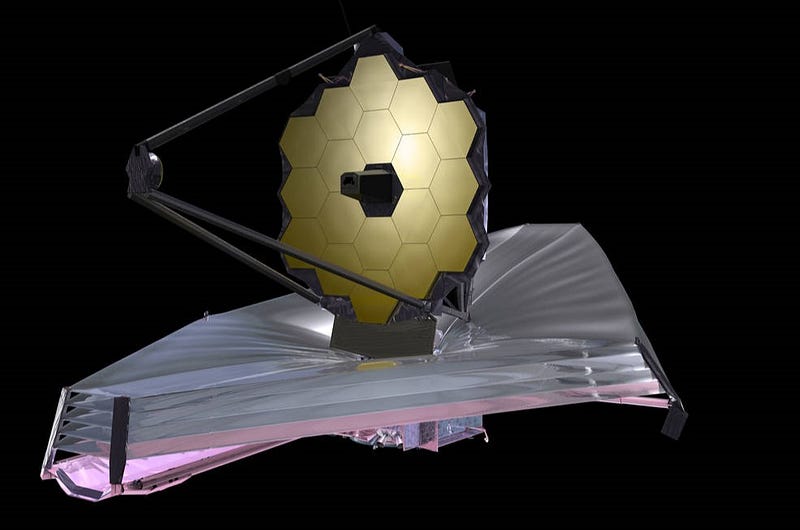
Nevertheless, now that I got that badge I need to honor it. And what better way to honor it than write an article about the James Webb Space Telescope, the latest, greatest, shiniest, costliest and most sensitive space telescope mankind has ever launched?

I doubt, unless you have been sleeping under a social media boulder, you have not heard about it, but I also doubt many of you know the significance of that ridiculously costly piece of high art and technology.

The purpose of this article is to illuminate you, no pun intended. So let me list 2 of the reasons the James Webb is a really big deal:

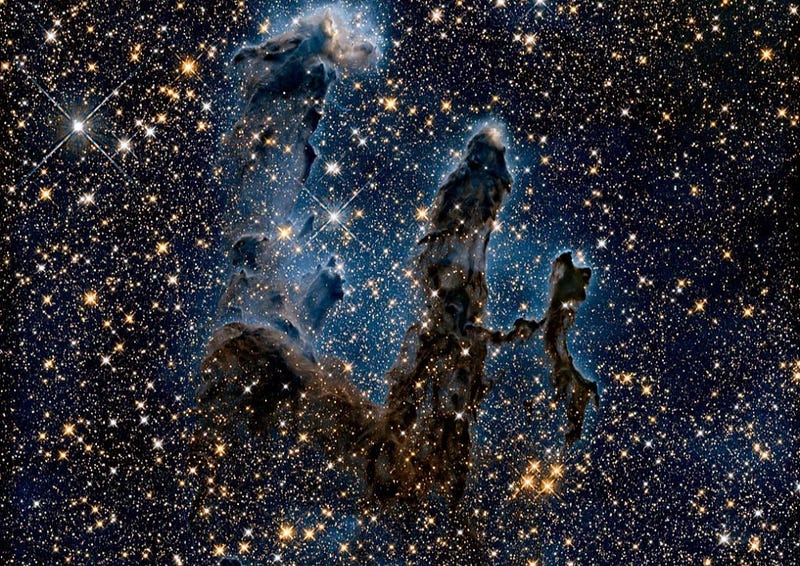
1.It was designed to out-Hubble Hubble. The Hubble space telescope has delivered some exquisite images of the universe like the one below. However, apart from having long exceeded its design life and requiring a successor, it has limitations because it cannot peer into dust clouds and due to its small primary mirror.

JWST has a far larger primary mirror (273 sq ft / 25.4 m²), it can work with wavelengths ranging from orange to mid infrared, and it has much more advanced and sensitive instruments.
Credit: NASA, ESA/Hubble and the Hubble Heritage Team | Public Domain

2. It will allow scientists to look for habitable exoplanets. An exoplanet is simply a planet outside our solar system. The only planet in the universe known to support life is Earth. We’ve looked in the rest of our solar system and so far everything has turned out to be more sterile than a semiconductor fab clean room; which are far more sterile than the operating rooms of the best hospitals.

Our current ground and space telescopes are not sensitive enough to peer into the atmosphere of an exoplanet in order to look for bio-signature gases. But JWST is. One of its design goals is this. Not necessarily to answer the question ‘Are we alone or not?’ in terms of other intelligent life, but whether life -even microbial life- is super rare in the universe or not. At the moment we only have a sample of 1. Perhaps JWST will provide a few more.
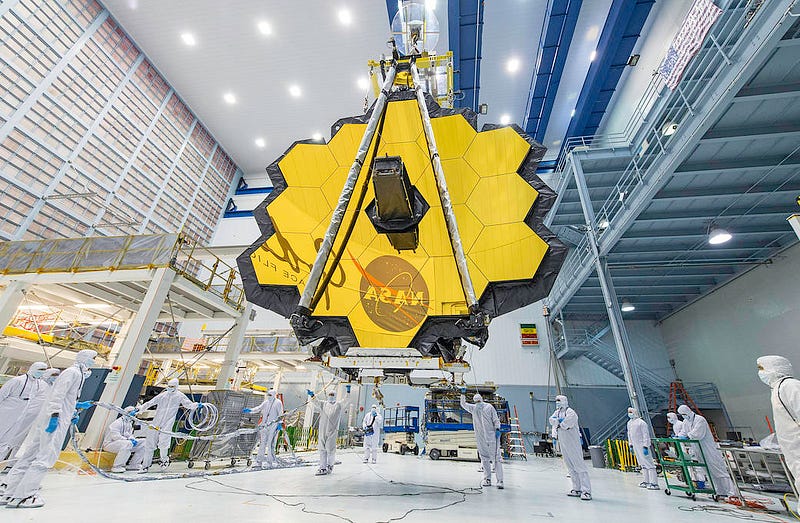
Credit/source: NASA/Desiree Stover | Public Domain

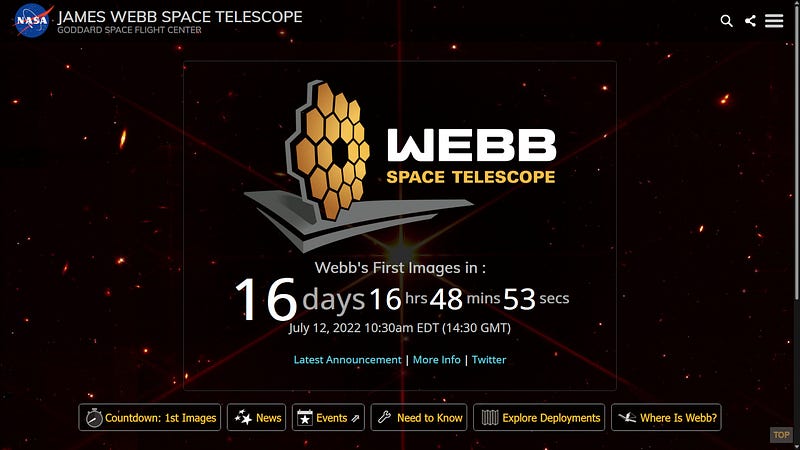
The James Webb was successfully launched on December 25 of 2021, it was successfully parked at its intended L2 Lagrange point orbit, which is approximately 1,500,000 km (930,000 mi) from Earth, and since then it’s been undergoing deployment, testing and alignment. Its ‘first light’, i.e. its first images, are expected to be delivered in a bit over 16 days from the time I publish this article. NASA maintains a countdown page here:
Do you think the JWST will find signatures of life in exoplanets? If it does, and its data are peer-reviewed and conclusively verified, how do you imagine the knowledge that our planet is not the sole host of life is going to be perceived by the public?

All my non fiction articles:

Get my stories in your inbox 📬

Space
Astronomy
Science
Life
Geeky
Recommended from ReadMedium