
Probing Evolution
Why The First Microbes May Have Descended From Other Planets
9 compelling arguments from 35 biologists and physicists.

A team of 35 biologists and physicists across disciplines, from diverse countries, collaborated on a 2018 review paper published in Progress in Biophysics and Molecular Biology. Let’s decode (and re-structure) what this controversial academic paper has to offer.
Why Life May Not Have Begin On Earth
[1] The earliest evidence of life on Earth dated back 3.83 billion years ago. This period coincides with the meteor showers Earth faced 3.8 to 4 billion years ago — that would have wiped out all present life forms.
[2] The Earth’s climate 4 billion years ago was blazing hot that it can degrade simple organic molecules. And life is essentially carbon-based because organic carbon molecules are needed to form stable bonds that hold the basic building blocks of life — e.g., amino acids and DNA — together.
[3] Biological units — e.g., amino acids and DNA — need to assembly correctly to form a single living cell. And the probability of such occurrence is 1 in 10⁴⁰⁰⁰⁰. Not to mention that this single formed cell must also be capable of further evolution.
It “appears to require overcoming an information hurdle of superastronomical proportions, an event that could not have happened within the time frame of the Earth except, we believe, as a miracle,” the researchers say. “All laboratory experiments attempting to simulate such an event have so far led to dismal failure.”
These reasons for the improbability that life began on Earth led to the emergence of the panspermia theory (pan means ‘all’ and sperma means ‘seed’) — also called the theory of cosmic life.
Panspermia theory posits that life exists in the cosmos. And that microbes capable of withstanding conditions of outer space — such as extremophiles — have descended onto the Earth.
“The first microbes were most likely delivered to the planet along with impacting comets and meteorites,” they say.
Why Life May Have Begin On Other Planets
[1] “Perhaps the most important astronomical data relevant to the theory of cosmic life to emerge in the past decade are the detections of habitable exoplanets — planets outside of our solar system,” the researchers wrote. The predicted number of habitable exoplanets in the universe that can support life on Earth currently stands at 10²² — yes that’s 23 zeroes. “The prospects for genetic exchanges between life-bearing Earth-like planets cannot be ignored,” the researchers add. Genetic exchanges mean that they might be capable of cellular reproduction.
[2] Microbial material not of earthly origin has been discovered. An example is the microbes-like entities that are found in the stratosphere — the Earth’s 2nd atmospheric layer. Scientists posit that these entities probably “are incoming to Earth from space, possibly transported by small comets.”
Carbon-containing meteorites that fell on Sri Lanka in 2012 harbours fossilized microbes. Any possibilities of microbial or rock contamination have already been ruled out.
Another uncanny coincidence in Kerala, Sri Lanka in 2012 is the red rain event — in which red-pigmented organisms were identified as the cause. And all available evidence shows that these red-pigmented organisms are not from Earth. “As far as the Kerala red rain is concerned, there is a mysterious microorganism that has defied identification so far. We have not been able to convincingly extract any DNA from them and Prof Louis has maintained that there is no DNA, but it can multiply at very high temperatures under high-pressure conditions,” says Professor Chandra Wickramasinghe, Director of the Astrobiological Center at the Buckingham University.
[3] Viruses are known to be drivers of evolution — “virolution” — owing to its ability to inject its genetic material into the genomes of any organism, thereby changing how infected cells produce proteins. That’s why viruses are referred to as “dense information-rich control systems.”
In 2014, during a rocket mission to outer place, a group of researchers from Switzerland and Germany attached plasmid DNA onto the rockets’ surfaces. The rockets came back later with “a significant fraction of DNA remained viable and infective — a clear indication that extraterrestrial viruses can indeed arrive at the Earth in viable form,” they said in a statement.
It is, therefore, possible that viruses from comets can “add new DNA sequences to terrestrial genomes and drive further mutagenic change…,” they continue. An example of this is retrovirus sequences that suddenly appeared in the genomes of chimpanzees and gorillas across the world, independently and simultaneously 3–4 million years ago.
A second example is the complex genomes of marine organisms like the octopus that cannot be explained by conventional evolutionary mechanisms — such as horizontal gene transfers, random mutations or duplicative expansions. Octopuses have 33,000 more protein-coding genes than humans, yet they first appeared 500 million years ago. Their genomes seem “to be borrowed from a far distant future in terms of terrestrial evolution” or a “sudden great leap forward,” they say.
“It is then logical to surmise, given our current knowledge…, the new genes and their viral drivers most likely came from space.”
[4] Even bacteria can survive harsh environmental conditions beyond that is needed to survive on Earth — they are called extremophiles. Desulforudis audaxviator, for example, lives in 2.8km deep in the South African gold mine. This bacterium gets its energy from ionizing radiation — indicating that “they would thrive on the energy derived from galactic cosmic rays that reach the interstellar or interplanetary frozen bodies,” the researchers wrote.
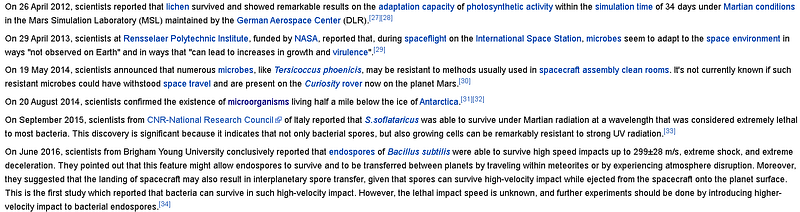
“Bacteria and viruses embedded in grains of rock, carbonaceous material or ice, are protected effectively from radiation damage and can remain fully viable for millions of years under space conditions. Microorganisms including virions deep frozen within cometary bodies could remain viable indefinitely, and certainly for cosmological timescales,” they continue.
[5] Cambrian explosion occurred 542 million years ago that resulted in mass extinction and, yet, the widespread emergence of new species. It “led to a sudden emergence of essentially all the genes that subsequently came to be rearranged into an exceedingly wide range of multicelled life forms — Tardigrades, the Squid, Octopus, fruit flies, humans — to name but a few.”
“Natural selection acts only by taking advantage of slight successive variations; she can never take a great and sudden leap, but must advance by short and sure, though slow steps…,” Charles Darwin wrote in the Origin of Species.
If Darwinian evolution cannot explain the sudden appearance of genes essential for numerous life forms, what can?
“It was argued therefore that new genes for evolution must logically be supplied by the ingress of extraterrestrial virions and other microorganisms,” they opined.
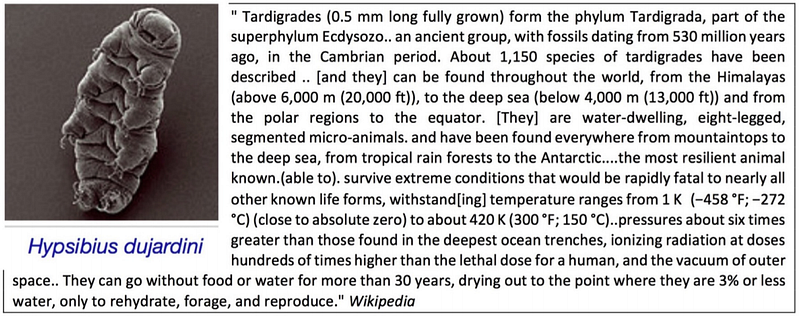
[6] Tardigrades are micro-animals that are virtually indestructible by any means known to humans. And they first appear with the Cambrian explosion. Scientists say that the biological features of tardigrades don’t fit into the conventional Darwinian evolution as there is no evolutionary pressure on Earth that might necessitate indestructible attributes as the main aim is to simply pass on genetic material. “These properties are incompatible with known purely terrestrial ‘natural selection’ conditions,” the researchers wrote.
“A plausible evidentiary case for proof of Cosmic Panspermia could rest entirely on this one [tardigrade] example,” they add. “However…there are many other living examples like this (space-hardy bacterial species and their spores), the Tardigrades being an extreme case which appears to prove the rule.”
“In our considered view, the totality of the multifactorial data and critical analyses…leads to the bare minimum yet plausible scientific conclusion,” the team of 35 biologists and physicists finally arrive at a consensus.
“ — that life was seeded here on Earth by life-bearing comets.”


