
Why the Fight for Sexual Literacy Is a Bid for a Safer World
Our work as sex educators and pleasure activists has the power to ignite change far beyond people’s bedrooms

Isn’t that a sex thing? asked a high school friend when I showed her pictures from a recent Shibari performance.
— You don’t have sex on stage, do you? she continued before I had a chance to respond.
— No, no, it is an erotic art form, but that doesn’t mean it IS sex.
I can’t count the times I’ve been met with similar reactions, not only related to my rope practice but in response to my sex-writing, my art, and my nude and erotic photo collaborations. This reception is rampant when most people are presented with anything perceived as erotic:
—I see sensuality, nudity, or something else that reminds me of sex, ergo, it must BE sex.
Of course, Shibari (and bondage in general) can be incorporated into sexual play. Nude photography could be made a component of foreplay and lead to sex. So can a candle-lit dinner or glass of wine. But are they sex?
There’s no clear yes or no answer to this. Rather, it depends on how we define sex, which, in my opinion, is subjective and situation-dependent: Massaging a partner’s feet isn’t sex to most but could be to the foot fetishist. Feeding chocolate-covered strawberries to your lover in bed could be sex. Spoon feeding your toddler or elderly relative clearly isn’t.
These examples seem obvious when put bluntly, yet the nuances are often lost in real life.
I was recently discussing this with two friends over a candlelit dinner with wine—which, to make a point, did not lead to sex despite all of us being libidinous and sexually open-minded.
One of my guests, a photographer who creates artistic nudes, was fretting over the number of spectators who naively draw the conclusion that he must be having sex with the people in his photos: Do you fuck all of your models? Is this a type of porn? Why are you doing this, if not for sex?
My other guest, a fellow rope artist and kink educator, nodded and brought up similar recurring questions: Is this some form of foreplay? Do you get off doing that? If it’s not sex, then what’s the point?
The concept of getting undressed for art, in the name of self-expression, or because one enjoys the liberating act of being naked and vulnerable in the company of others—and having it end there—seems incomprehensible to many. What’s the point of eroticism if it’s not leading to coitus? This is the real question I hear behind their words.
During our conversation, the three of us kept coming back to how impoverished this understanding of sexuality and the erotic is; what an enormous loss to hold such limiting views, and imagine all the wonderful things we’d miss out on! We deemed ourselves fortunate that at a point we had departed from the prosaic perceptions we were raised with to step into libertinism.
If you look up the word libertine in the thesaurus, by the way, it paints a fitting caricature of this polarity: On one side you’ll find synonyms such as immoral, good-for-nothing, degenerate, debauched, freak, and pervert. On the other side, you find more agreeable associations, like lush, sensualist, epicurean, bon vivant, cyprian, and pleasure-seeker.
Our conversation brought up a piece written a few months back by a fellow voluptuary: The wise and wonderous Mysterious Witt published a spot-on article about the two antipodes, asking whether you’d rather be a sexual sophisticate or a sexual oaf.
Not only did she provide me with useful new vocabulary to speak about the topic, but she also inspired me to ponder the two extremes extensively.
To summarize, her essay tells the story of a former date who proved to be an oaf after he was unwilling to even entertain the idea of exploring alternative sex parties. While Witt, in her own words, was “going to so many of these parties that what most people considered alternative no longer felt alternative [to me]. It just felt normal.” Her date, on the other hand, was freaked out and judgmental, concluding he’d either feel too uncomfortable, too aroused or both.
In the same way that Witt had moved from the countryside to the city and become cosmopolitan, she’d also explored the previously unknown areas of her sexuality to become a sexual sophisticate, a term she came up with to describe “someone who’s pushed themselves out of their comfort zone to move beyond society’s teachings about sex. Evolved beyond seeing sex as embarrassing, dirty, or shameful, they’ve educated themselves and now view sex in a positive, healthy way.”
The oaf vs. the erudite
I, too, as someone who grew from an ignorant place to now feeling “normal as a sexually alternative individual,”—which has much to do with the company I keep of other like-minded sexual sophisticates—often find myself befuddled when running into judgemental oaf-mentality. At the same time, I can look back and empathize by observing how my own thinking has developed from rigid to flexible, and my understanding of the erotic, from crude to nuanced.
These are, in my opinion, the real traits that separate the sexual erudite from the ignorant. (Or the debauched from the virtuous, depending on your stance).
While the oaf sees something that reminds them of sex, and immediately assumes it is sex, the sophisticate acknowledges that nothing is inherently sex and is dependent on context and preferences. While the oaf draws a straight line directly from A to B, the sophisticate is able to observe, free of judgment, and see a plethora of potential options and outcomes.
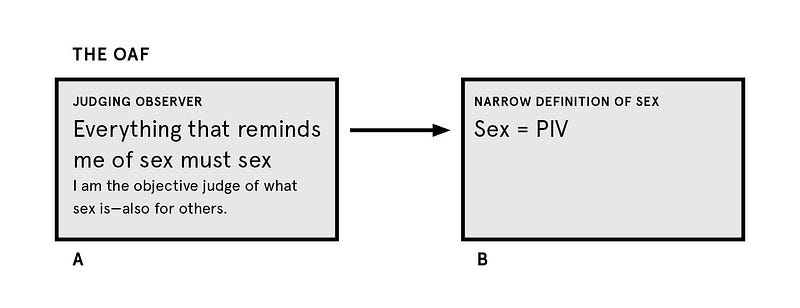
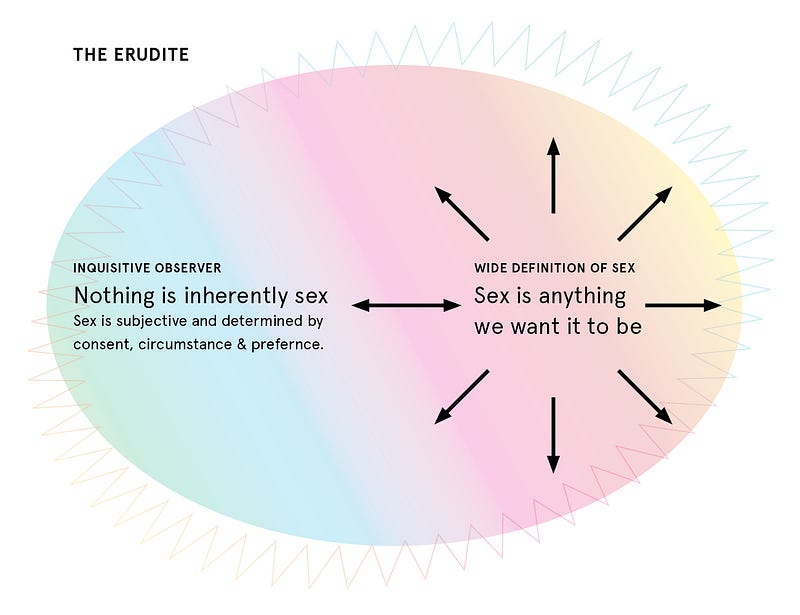
The oaf’s view of sexuality is linear, and black and white, while the sophisticate has adapted a multicolored perspective and has learned to read between and around the lines.
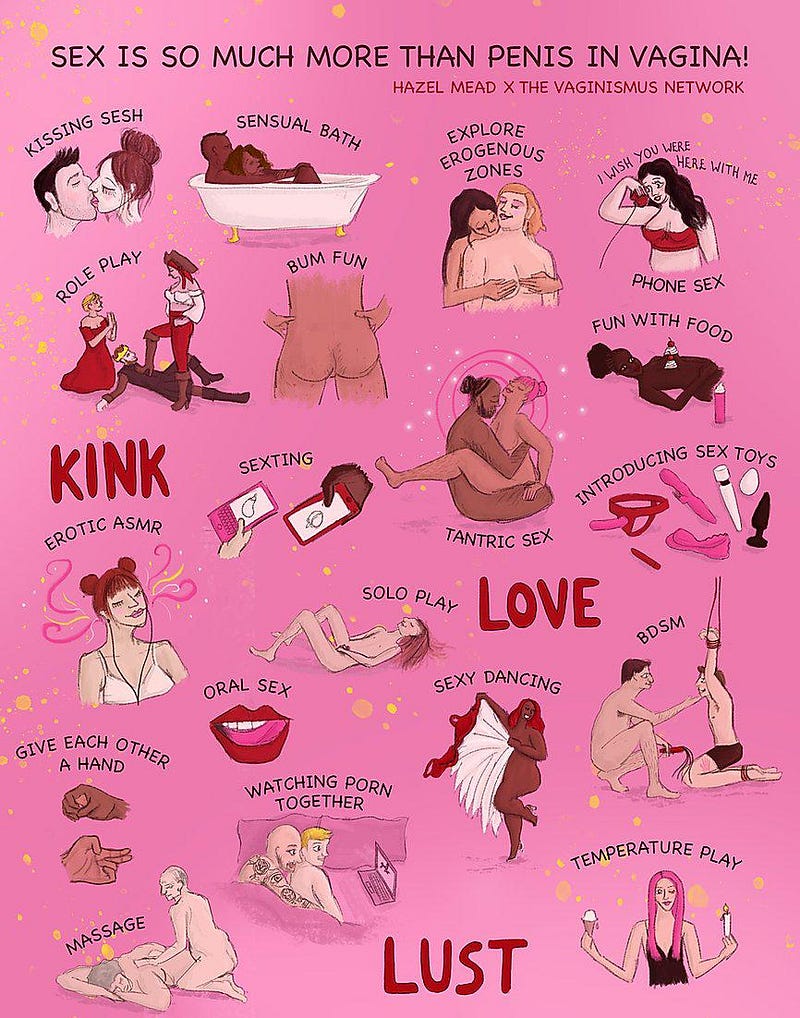
Further, when the oaf thinks of sex, they’ll generally go directly to PIV (penis in vagina, or other penetration). To the connoisseur, sex can be so much more and is not restricted to a simple act.
The oaf’s sexual imagination appears to lack creativity compared to that of the sophisticate.
Funny, but not funny!
The rigidity of the oaf’s mind can sometimes lead to humourous exchanges, such as in the case of a recent commenter on my Instagram account who could not wrap his head around how Shibari could be a sexual practice (but mustn’t be):
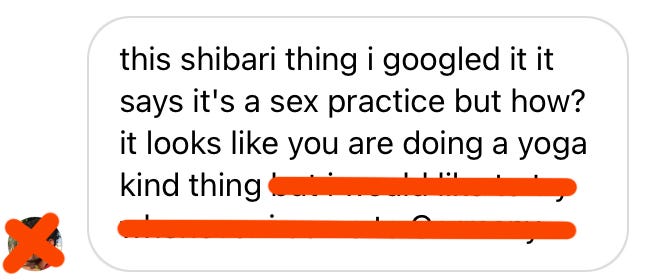
This message, which doesn’t strike me as judgemental per se, had me giggling. Since sex to him clearly equals coitus, what he’s really asking is, yes, but how do I penetrate? (And surely, that could propose a challenge when your target is contorted and dangling a few feet up in the air…)
Jokes aside, there’s a darker aspect to the simpleton’s straight-lined assumptions. Sexualizing those who never agreed to be sexualized and slut-shaming others who decide to express their sexuality, rob us (and women especially), of our sovereignty and autonomy over our bodies. The objective judgment of what sex is and isn't upholds rape culture and victim-blaming; she looked that way, she must have asked for it.
This view doesn’t take consent into consideration but is derived from the onlooker's outside perceptions; based on signifiers established by a patriarchal society designed to oppress and control women’s sexualities.
Consent isn’t just sexy, it’s what separates sex from assault
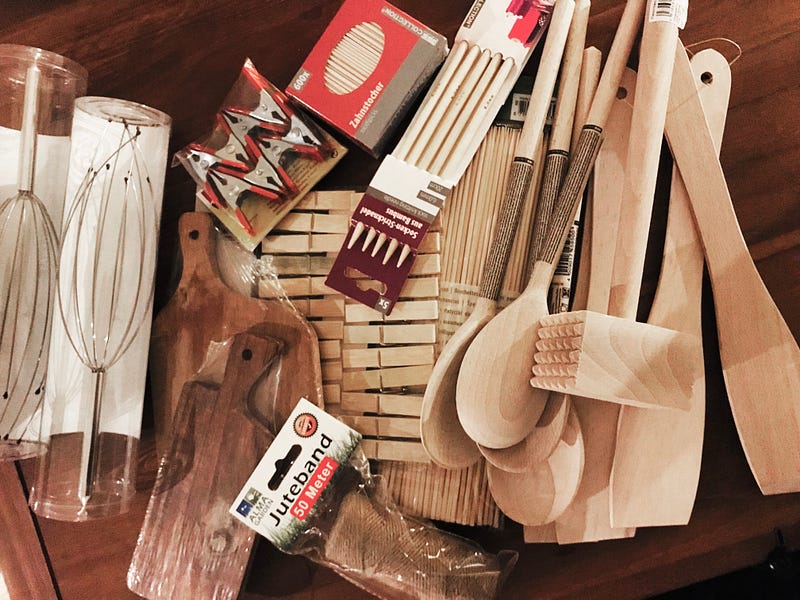
You can take the sexually sophisticated kinkster to a hardware store or kitchen supply aisle and watch them come out with bags full of potential sex toys, whereas the simpleton would simply see kitchen stuff. Still, recognizing the potential for clothing pins to become nipple clamps or wooden ladles to be suitable spanking tools doesn’t mean we’ll automatically get randy hanging the laundry, or that you’re not safe having us stir the pots in the kitchen without the risk of getting asked to bend over. This is, again, because the determining factors are not the objects or signifiers themselves, but circumstance, setting, and consent.
Comparing the two antheses in a different scenario, such as at a sex party, the oaf is the one who’ll get involved and start touching without asking first. When called on their behavior and told to back off, they’re likely to turn sour and say something along the lines of, we’re at a sex club, this is how it is—what did you expect?
The sophisticate, on the other hand, will watch respectfully from a distance and ask before getting involved—What you’re doing looks hot and beautiful, may I join?—And, if given a no, will respect it and gracefully move on. While expectations may differ vastly from a dinner with friends to a sex party, what is significant is that the erudite’s approach and baseline remain the same: Seeing sex or something that alludes to it, does not equal an invitation to engage.
This further means that if the oaf was equipped with the same erotic imagination as the sophisticate, without maintaining the required boundaries, the world would be an even more dangerous place.
In conclusion
Since the mind of the sexually illiterate, aka the oaf, is rigid and confined while lacking boundaries, the process of gaining sexual literacy is one where the mind simultaneously expands to become more flexible and advantageous, while establishing firmer boundaries and higher awareness of others and our surroundings.
When evolving into sexual sophistication, we become aware of the vast richness of the erotic. Our imaginations start to flourish and we can begin to see endless opportunities for sensual pleasures wherever we look—without needing to act on them.
Therefore, as pleasure activists and advocates for sex positivity, our work is about much more than trying to help others have a hotter time between the sheets. While this is surely essential too, promoting sexual literacy plays a crucial role in fighting society’s outdated patriarchal creed and making the world a safer and better place.

© Ena Dahl 2021