
Why The CoronaVirus Pandemic Is a Trolley Problem
Would you kill 1 person to save 5?
Imagine yourself standing next to some train tracks. You see coming in the distance a train accelerating down the tracks towards five workers who cannot spot it and will not do in time to save themselves. You, conscious of the situation, see a lever you can pull to divert the train into a second track where only one worker, as oblivious as the others, is doing his job…
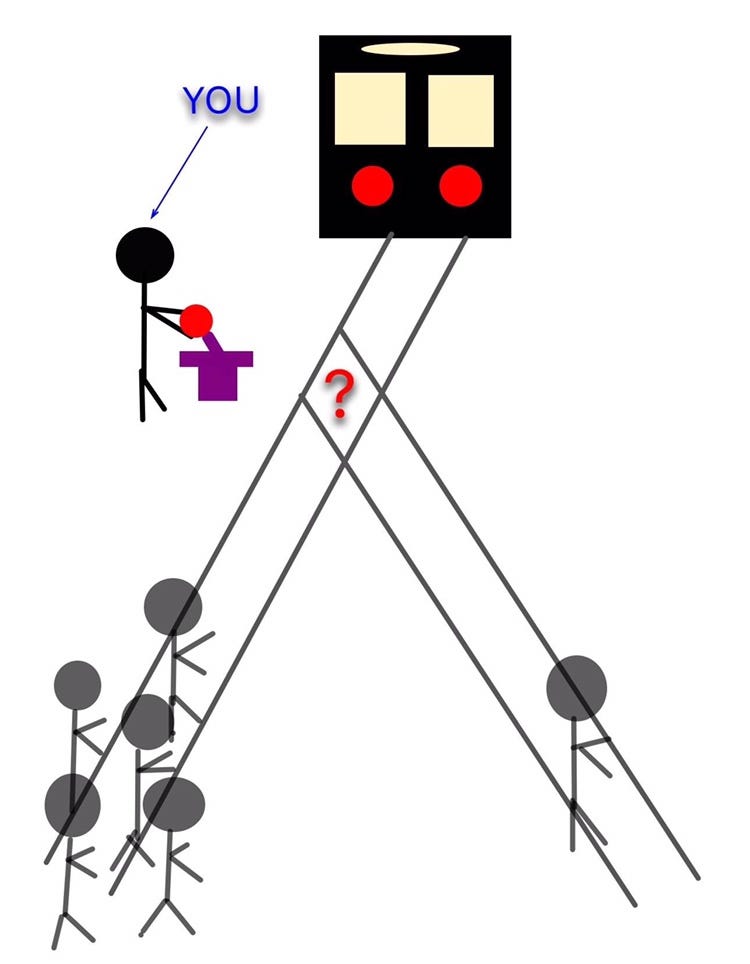
Would you try and save 5 people at the price of 1 innocent man’s life? Is there a right answer?
The trolley problem is one of the greatest moral and ethical thought experiments suggested and developed by philosopher Philippa Foot in 1967.
It relates to many of our day-to-day decisions and I’ll show you how it can be applied here in the context of the Coronavirus pandemic.
In that situation, you can play the role of different personas.
1) You’re a doctor and see rushing into the hospital, first, an 80-YO lady desperately needing an oxygen mask, followed by three middle-aged patients also in critical conditions. There are only 3 places left at the hospital…What do you do?
As I’m pretty sure a lot of you are familiar with, many European countries were faced with that extremely difficult decision and seeing the available options; there’s statistically a better chance of saving 3 lives when choosing the 3 younger patients than with the old lady being one of the chosen.
Some may think in that case that the statistics chose since all of the patients arrived at the same time and ethical issues may be justified. However, numerous variations of the trolley dilemma were made to model other situations.
Now imagine you are watching while passing over a bridge, the train accelerating towards the 5 workers. You see walking by a big guy who, if pushed right in front of the train would stop it, and therefore, you would have saved 5 people.
This version of the dilemma is different since you’re implicating a third, truly innocent party whose fate changed from life to death.
I believe this case resembles that of hospitals choosing to take the masks off old aged patients and offer them to newly admitted younger ones. The equation is no longer the same here! The old patient had a good chance of surviving, was admitted first into the hospital, BUT, their fate just changed and they were forced into a situation as a scapegoat.
2) You’re a person in charge (in an executive position in a country for example):

Would you approve of a similar decision to the alleged report of shooting North Korea’s first confirmed case?
What if such a call was made for South Korea’s patient 31 who attended several crowded events while being infected and caused a huge spike in the number of cases which increased by thousands. Would taking her life to save that of many others the morally good decision to take here?
It’s not an easy question and there are many more parameters that could get into the equation…What if you’re the doctor at the hospital and you need to take YOUR mother off the oxygen mask; What would you do?