
Why the Citizenship Amendment Bill is against the ideals of Secularism
Let us first state that it is our opinion as demographic dividends of the country and we are thereby enforcing our right granted by Article 19 of the Constitution on the aforementioned topic which may resonate among some people who read this.
The upper house (dated. 11/12/2019) passed the Citizenship Amendment Bill and has been assented by the President of India thereby making it a law on dt. 13/12/2019.
Before delving into the CAB, the Preamble to the Constitution must be taken as a reference point to decipher the complications and further discrimination against a particular religious group. So, the Preamble to the Constitution maintains that India is a “secular” country, based on the premise that all religious faiths are accepted and recognized in our country, maintaining religious pluralism. Even though multi-faceted definitions and perceptions surround the meaning of secularism in India, tolerance towards the different religious practices in the country has been a well-acknowledged fact across the globe. However, in recent times, the colours of diversity and secularism have been fading and these problems are aggravating by each passing day. We as demographic dividends must take a view of this. Even the Article 5–11, which defines Indian citizenship, and who is an Indian? doesn’t discriminate based on religion.
The Citizenship Bill which was passed by the Lower House on the midnight of 10/12/2019 and subsequently by the Upper House on 11/12/2019 has received flak from all quarters, with the UN taking note of it and the Federal US Commission calling for sanctions of Home Minister Amit Shah.
What’s the ruckus all about?
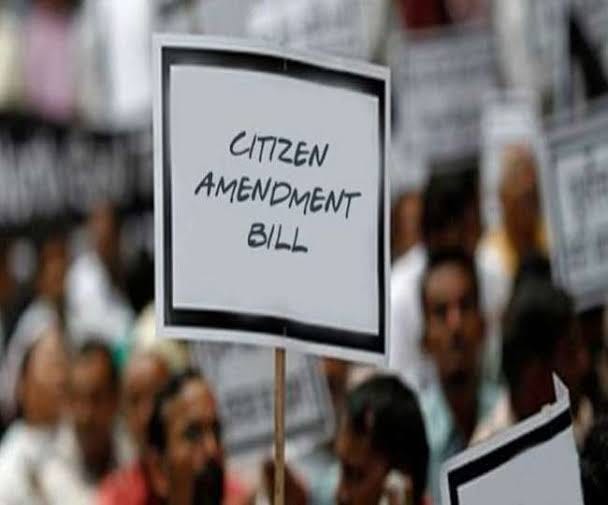
The lexicon of The Bill states that it will amend the Citizenship Act of 1955 thereby granting eligibility for citizenship for illegal migrants practising the religious faiths of Hinduism, Sikhism, Buddhism, Jainism, Zoroastrianism and Christianity from nations of Afghanistan, Bangladesh, and Pakistan. It rules out one major Religion- Islam. The reason the government provided is the aforementioned religious groups flee their respective countries to liberate themselves from persecution in Muslim majority-nations and people practising Islam don’t require protection in these countries. But if providing a safe haven for the minority groups is the grounds for passing CAB, then it excludes the Ahmedia Muslim sect and Shia Muslims that face discrimination in Pakistan and many other ethnic communities. The Bill eliminates these groups because they are a subset of Islam. It also excludes the mention of atheists, who face discrimination in these countries. The bill if it was in good intention, then it should have also intended to include Christians of Bhutan and Hindu Tamils of Sri Lanka and Myanmar who have been facing discrimination in respective countries. But this is the clear cut case of tying the bell on Muslims of India by calling them outsiders coming from Islamic Republics. Apart from that it also excludes the need to help Rohingyas who fled Myanmar to countries like Bangladesh, India, Pakistan, etc.
This indeed asserts that preferential treatment is given to certain religions while excluding one major religion, which directly contradicts Article 14 of the Indian Constitution which grants the fundamental right to equality to all people irrespective of faith. But the government maintains it doesn’t violate this Article. And the Home Minister went on to defend the Bill by claiming the Bill wouldn’t have been necessary if the partition of India was not on the grounds of religion thereby blaming the parties that opposed it. This claim is invalid and ignorant of the history of the formation of the country. Even if this premise is considered as the logic for CAB, the inclusion of Afghanistan makes no sense. All the founders of our nation were committed to a secular state and the Constitution was sculpted keeping it in mind.
The CAB will facilitate more than 5 lakh Bengali Hindus from Bangladesh excluded from the National Register of Citizens(NRC) to be legal citizens on India while 7 lakh Muslims would be making their way to tribunals. If these Muslims fail to prove themselves as citizens of India, they can be subject to deportation.
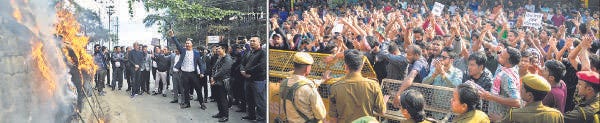
CAB will also facilitate a massive inflow of migrants from the aforementioned nations following the faiths mentioned before. The influx of the Bangladeshi migrants would be concentrated more on the North-Eastern states due to their proximity to them(which would be a significantly huge figure). Hence, the Bill has triggered massive protests over the past few days in these regions. In response, the government suspended the internet for 2 days in Tripura due to protests and extended the internet ban for another 24 hours. (Deja Vu?).
Except for the 3 North-Eastern states of Arunachal Pradesh, Mizoram, and Manipur(due to the Inner Line Permit System), all other states in India are compliant to CAB. The houses of various BJP and AGP leaders including that of CM Sarbananda Sonowal were put on fire.
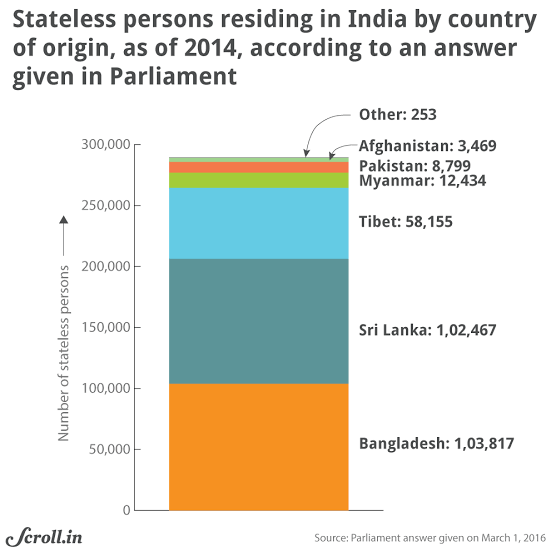
The NRC implemented in Assam is extremely flawed and has left out thousands of legal Indian citizens in the state from the list. It is to be noted that the government has plans to implement NRC on a national scale which is currently limited to Assam. If implemented across the country, it can render millions of Indians without the proper paperwork stateless. The situation will bring in a lot of chaos and confusion within the citizens. And through CAB, the government can deport these stateless people, comprising mostly of Muslim citizens(as stated by our Home Minister). To put things in context, this would statistically be the largest mass deportation in human history. If one believes this to be an exaggeration, statements provided by our Home Minister on illegal citizens can be looked upon in the below link.
Already Punjab, West Bengal, and Kerala have taken a public stance against NRC.
If we approach a broader narrative, this Bill paints the ever-increasing Saffron inquisition which is tainting our multi-coloured diverse culture. The CAB alters the very fabric of secularism in our country, and subsequently our democracy by leaving out Islam. Period.
Even today, India doesn’t have a refugee policy as India is not signatory nor a party to 1951UN Refugee Convention.
Views of our PM
Our PM views it as a landmark judgment and talks about compassion and brotherhood. This displays the hypocrisy of the people at the top hierarchical level of our country.
While the views of our PM are a no-brainer for the average Indian layman, the gravity of the issue must be looked upon by every citizen of India.
If we calculate the amount of time taken by the PM to tweet about the gory Hyderabad incident, which erupted the entire nation and the above tweet which our PM tweeted in moments right after the Bill was passed, it does provide an insight to the priorities set by our government. (PS: The former tweet doesn’t exist).
India doesn’t have a refugee deport policy with the Republic of Bangladesh, which makes India responsible for the stateless people and Bangladesh has declined from taking back the immigrants, leaving India to put them in detention camps.
Impact on the Economy
An influx of millions from Bangladesh, Pakistan, and Afghanistan would certainly be an exponential increase for the vote bank of BJP but would be a downward spiral for the economy.

The economy is already in bad shape. The current slowdown is the third slowdown since 1996 (India’s quarterly GDP data is available from 1996) and will be the longest in the past 23 years if the next quarter’s GDP is worse than 4.5%.
If an ever-increasing population coupled with migrants are inhabiting a developing economy, which is already on target to become the most populous country in the world it doesn’t require much thought to decipher the proportionality between the economy and population.
The rural poverty rate in the country has shot by 4% since 2012 and the unemployment rate stands at 7.2%, which are perturbing indicators. Instead of focusing on fixing these issues, the government has passed a Bill that can potentially cause massive unrest in the nation and taint India’s secular image across the globe.
We as a democratic nation are continually moving south both on economical and humanitarian grounds. Segregating people on the grounds of religion is a clear recipe for disaster. With the CAB, NRC, and the upcoming controversial Data Bill, our secularism is at stake, and we as Indians must take note of it with the utmost seriousness.
Disclaimer: We are a platform which allows all views to be represented without bias or discrimination. This piece is not to be judged upon as the final of MUNner’s daily or MEC MUN Society
Also Read
.
.
.
Follow us on medium for more for similar stories. Follow us on Social media to stay in the loop- Facebook| Instagram|Telegram Channel |Youtube|Twitter. We also invite guest writers to publish their material via this blog!