
Why The Charge of Privilege Doesn’t Solve Anything
It takes the responsibility away from the perpetrators of social injustice.
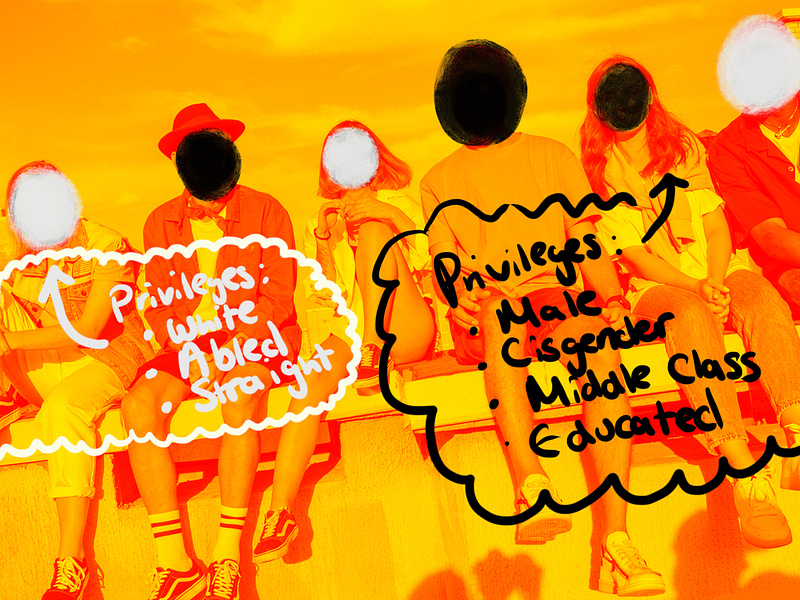
For a while now, I’ve taken the idea of privilege as obvious. After all, it seems intuitive right?
A White person will seldom experience institutional racism and hardly worry about being discriminated against due to their skin colour. Whereas I, a dark-skinned Muslim, has undergone countless discrimination just because of the way I look in today’s society.
So here, I am at a disadvantage compared to John Smith, whose resume might be considered over mine because his name is easier to pronounce. Arguably, he has privilege over me.
At the same time as a male, I don’t have to worry about the plethora of problems that women experience on an everyday basis – sexual discrimination, objectification, being followed home, slut-shaming, and so forth. This is my privilege as a male.
Male privilege can be loosely described as the advantages of being a male in a patriarchal society. It’s undeniable that I can walk down a street with a certainty that I won’t be raped or sexually assaulted.
So by this logic, am I to see myself as privileged? But also, at a disadvantage by being a Brown man?
What other factors contribute towards my advantageous position of privilege, and which variables put me in a disadvantaged, minority position?
Where is my position in this hierarchy of privilege, and how am I to see myself in the context of the wider world?
For the longest time, I thought this way. Pondering how much easier it would be if I were White, and didn’t have to experience the judgemental gaze wherever I go, feeling confusion and anger whenever I was treated differently compared to other White people.
Conversely, I realised I had to check my privileges despite my hardships. At the end of the day, I’m still a cisgender heterosexual man, and the benefits of not receiving homophobia or vigorously questioning my gender identity were ones that I felt a sense of guilty gratification for.
Yet over time, I’ve felt my views slightly shifting on this elusive concept of privilege.
I’ve come to find this type of thinking as exhausting, victimising, non-constructive, and without any clear end in working towards solving the very real issue of prejudice and societal inequality.
If anything, I think it actively encourages prejudice by grouping people together into groups rather than seeing people as individuals.
I think charging people with privilege is completely unnecessary, as it distracts from genuine conversations about prejudice and social inequality. So I’m going to be candid about why my views on privilege have changed, and you can feel free to disagree with me because more than anything, I want to open dialogues.
To preface, I don’t deny the real experiences of racism, sexism, and homophobia that I’ve just mentioned. I also don’t deny that, by being a minority in certain ‘groups’, that there are specific disadvantages and problems that people in the majority hardly have to experience.
My issues with the concept of privilege aren’t so much denying the existence of advantages that men and White people face, as much as it is arguing that charging people with privilege isn’t constructive to bridging the barriers necessary to dismantling real problems in our society.
White Fragility
I accepted the idea of privilege a while back, perusing through educational Instagram posts on how to be less socially problematic. My interest in race studies had peaked, due to my own negative experiences particularly in the English educational system, and so I decided to educate myself.
Soon enough, I picked up the best-selling book White Fragility by Robin DiAngelo. It included the subtitle ‘Why it’s so hard for White people to talk about race’, which immediately struck me as poignant. Indeed in my experiences, there is a hesitation for White people to openly discuss their implicit biases, and I thought it was courageous especially for a White woman to pen a book on this subject.
An education professor and diversity consultant, DiAngelo breaks down the familiar claims of White people dismissing what she believes is their responsibility towards addressing race – the all-too-familiar, “I don’t see colour”, or “I haven’t said anything outwardly racist, so how can I be”?
The concept of White fragility operates on this concept of White privilege – where she describes herself and other White people as being able to go through their lives without ever discussing race, and this being the most emblematic example of White privilege functioning in Western America.
In the beginning, I was persuaded by DiAngelo and thought it was honourable for her to take on this task of discussing race with White people, and quell their suspicions and assumptions with facts about racial disparities.
But as the book went on, it became clearer to me that she was almost trying to trigger a guilt complex within many of her White students.
As John McWhorter, a professor at Columbia University writes in his criticism of DiAngelo’s White Fragility, many of her claims are unsubstantiated and often harmful assumptions.
For example, a White person (in most cases) describes a ‘bad neighbourhood’ as a code for a ‘Black neighbourhood’. Which to be fair to DiAngelo, seems conceivable in the notoriously racist America. But it’s framed to be a sense in which they are absolutely and necessarily racist – without truly understanding why they are.
For DiAngelo, White people are almost always upholding systemic racism against minorities. because they see racial equality as threatening towards their position of power. They also do this most of the time without truly realising.
“One might ask just how a people can be poised for making a change when they have been taught that pretty much anything they say or think is racist and thus antithetical to the good.”
The book began with seemingly good intentions and progressed into a disturbing kind of Catholic atonement – where a White person is naturally born a ‘racist sinner’, and no matter how much they try and educate themselves about racism against minorities, they can never do any better.
As McWhorter simply puts it:
“What end does all this self-mortification serve?”
Granted, DiAngelo should be commended for attempting to address a real issue of racism in the West where many White people would ignore or perpetuate the problem. But her claims can be considered infantilising towards Black people, rather than helping them.
And this is where my ideas on privilege began to shift.

It infantilises and undermines the power of minorities
Privilege implicitly advocates the notion that the majority (in this case, White people) always have something over the minority. Yet no matter how hard we all try to dismantle this social inequality, the privilege (and lack of privilege) will always remain.
Not only does this type of thinking immediately deem the minorities as helpless and in a position of dependency on the majority, but it is also insulting towards empowered minorities, rendering their efforts fruitless.
In other words, what is the use of this empowerment if every person of colour, woman, and gender non-conforming individual will always be in a compromised position compared to their oppressors?
Can a Black person ever have a better life than a White person? Or are they always doomed, helpless in a position of subjugation to every White person they ever meet?
Is a woman always necessarily in a vulnerable position, despite having a managerial job over many men, and voracious self-esteem which threatens many people she meets?
Again, I understand the concept of privilege is trying to highlight the real disadvantages that certain groups experience in society. But it perpetuates an ‘Us-vs-Them’ dichotomy which I believe harms both sides in the arrangement and fails to bridge a gap necessary to have conversations about these problems.

It perpetuates victim mentality and privilege guilt
The disadvantaged group, aware of its position in this losing battle, may come to identify themselves as a victim without any chance of escaping this toxic affliction. Rather than finding the unique beauties afforded to one for being Brown, it’s easy to see becomes comfortable with this victim identity compared to a White person who has it easier in society.
This can very often lead to self-hatred because of the homophobia a gay person receives throughout one’s life, and directing hate towards all heterosexual men who’ve never had to experience anything of the sort throughout their lives.
But it doesn’t just disadvantage the group without privilege. It can also make the advantaged party feel guilty at their supposed advantages, which is unconstructive to solving these genuine problems of social inequality.
Obviously that doesn’t compare to expriences of sexism, racism, homophobia and transphobia. But it’s the majority party more than anybody else who need to discuss these issues amongst each other to make meaningful change.
I have many White friends who frantically educate themselves on race, carefully jumping through hoops to say the right things around me, and modestly reserve one’s opinions in fear of offending someone by appearing too confident in the privilege which has been afforded to them.
But we have to wonder – is this the outcome we want in achieving racial and gender equality? Must one group of people become tiresomely aware of their privilege, apologising for every brash assumption, and feeling anxious in all their actions?
At the end of the day, it’s clear that discussions about social inequalities are interested in one fundamental outcome – that everyone is treated for who they are despite external characteristics.
Though we have made one step forwards in raising the conversation by discussing privilege, there must be a point in which we progress towards recognising the genuine efforts towards those achieving this goal, rather than constantly identifying with a victim mentality, or operating within the firm grips of privilege guilt.
Not only that, but ‘privilege’ is a vague term. To truly entertain this concept, one must wonder what their privilege is in respect to others.
It’s unclear what privilege means when taking into account so many factors in an individual’s life
When researching privilege further, I stumbled across this tongue-in-cheek video where Darren Harriott lines up people from all kinds of different groups in order of how privileged they are. Despite the humour, I believe it illustrates a great point — how much can one categorise people based on their external identity, with respects to how privileged they are?
By and large, I’m not a fan of Jordan Peterson. I think he is pretty confused when discussing his criticisms in what he misunderstands to be the “post-modernist”, “neo-Marxist”, “tyrannical left-wingers”.
But I believe he makes good points about the danger of group thinking and identity politics in general, which explains why he has been receiving so much traction lately.
Aside from men who need advice on how to clean their room, I think he makes a good point that you can keep reducing one’s group characteristics until you accept one outcome – that the individual is the ultimate minority.
He also argues that thinking in terms of group identity is in itself racist because it is categorising people based on a particular characteristic – like White people – and charging with them particular behaviours rather than addressing White individuals who are racist and hold problematic views.
I have to agree — as not only is this a judgement of a group of people before truly assessing their moral characters, but it also shifts the responsibility away from the perpetrators responsible for having problematic views, and blames an entire group of people.
Indeed, very few walk the line of being totally privileged or totally disadvantaged.
Thinking purely in terms of intersectionality will have you believe that a disabled, Black, queer, working-class woman necessarily has a worse life than an abled, White, straight, cisgender, rich man. Which is something I accepted as a self-evident truth for the longest time, because of course one can only imagine the alienation such a woman would experience.
But to see people in this way, rather than as genuine individuals with names and complex stories, is prejudiced in itself. We are judging someone’s life only by their characteristics, and not listening to the experiences of the individual.
The abled, White, straight, cisgender, rich man may have witnessed his parents getting killed, migrated to a part of the world where he was alienated, never married, and diagnosed with an extreme mental impairment.
Just like the video from Darren Harriot, what immediately seems like an incredibly privileged life begins to change when we come to understand the individual more and more as a person. Which thinking in this way, usually fails to consider.
I’m also certain that nobody wants to be seen by a list of their external characteristics in this way, because it doesn’t capture the identity of an individual.
Finally, and most importantly:
It distracts from conversations about inequality
Many times, White people would not want to openly enquire about the experiences of racism that I’ve undergone for fear of offending me. Very often, they don’t want to address my lineage and ask curious questions about my origins despite it being an elephant in the room.
This seems like a way of covering their ass, but I suspect that some are too ashamed or scared to ask me. Either way, this lack of conversation is the very thing that is preventing a genuine change in dismantling these prejudices.
Likewise, I have charged White people with privilege and began discussions with an immediate animosity due to what I believed was their easier life in comparison to mine.
Though yes, they were largely unaware of the experiences of racism that Brown and Black people face in England, and perhaps it is true as it is angering that they can afford to be ignorant. But these discussions about privilege never end up being the insightful, in-depth and hopeful conversations I thought they could be.
I would be firm in making my point, and they would be defensive and deflective – often claiming that they were at no such advantage to me, and because I was educated, that I had nothing to be worried about.
I would argue that it wasn’t easy for me to get into this position, and the alienation experienced in higher academia made it harder for me to achieve those degrees compared to if I were White.
Whatever the case, I felt these discussions could easily happen without pointing the finger and accusing one of privilege. They could probably go a lot smoother without immediately accusing someone of something – it’s human nature to be defensive, which is not constructive in these very important discussions.
It’s probably why so many men get a poor understanding of feminism, not so much because most are unwilling to listen (though yes, many are), but they are unmotivated when they are immediately told by a White woman they always have it better compared to a woman due to their male privilege.
It’s clear to see how this doesn’t get us anywhere, and nobody on either side is very happy.
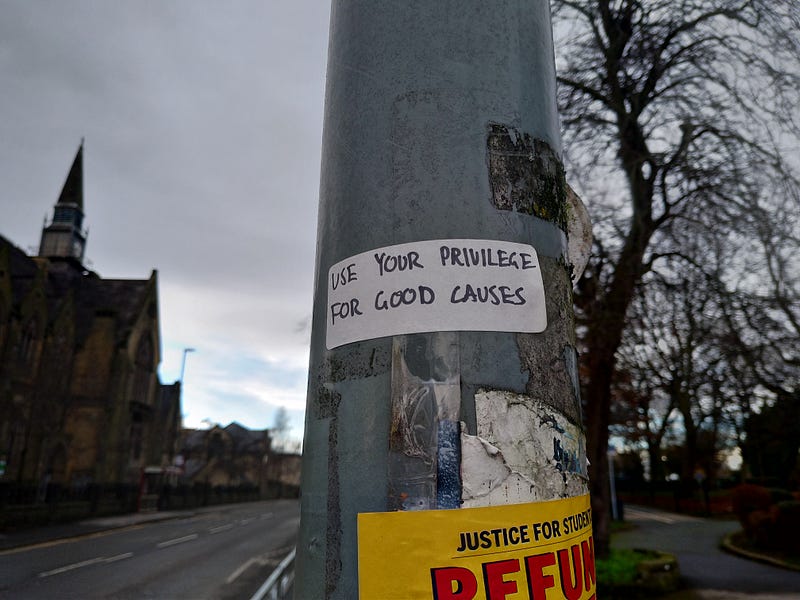
You can disagree with me. I want to be challenged.
It is undeniable that powerful racist and sexist people are the ones who most perpetuate social injustices – and this article isn’t to deny that systemic racism sometimes advantages those in ‘majority positions.
But we can’t say this happens from all those belonging to the majority, as it takes the responsibility away from the very perpetrators of these injustices. Let’s blame them, and educate those who are ignorant rather than make accusations.
Throwing around terms like male privilege or white privilege is not constructive towards solving genuine social injustices. If this isn’t the outcome that feminism and anti-racist movements want to achieve, then what are we trying to achieve?
I want to underline that although it is the responsibility of all to have these discussions to bridge the gaps of separation in society, the problem often always lies in the majority refusing to discuss these problems among themselves.
White people need to talk to other white people about race. Men need to talk to other men about sexism. There is no threat to their livelihood by doing this, and they stand nothing to lose.
But the charge of privilege seems to hurt everybody, and I think it could ultimately be worded more specifically.
For example, let’s factor into the discussion how a man will likely never have to experience sexual harassment in the workplace that can severely detriment their lives, rather than aimlessly shaming them as ‘trash’, or making them feel bad about their male privilege.
Conversely, many White people from sheltered backgrounds are likely to disagree that they are at any significant advantage when they have never listened to how racism manifests itself in Western society, especially in today’s day and age when job offerings claim to be more accepting of BAME and BIPOC applicants.
Rather than dismissing this as just another instance of White privilege, we ought to acknowledge this experience, but carefully explain the racism that Black and Brown people undergo, and how it is likely they will never experience this.
The tactfulness and tone of discussion go a long way, especially when we are claiming to bridge gaps between social borders.


