
BLACK PRIDE
Why The Black Community Should Proudly Support Black Queer Heroes
More people should be quoting Bayard Rustin
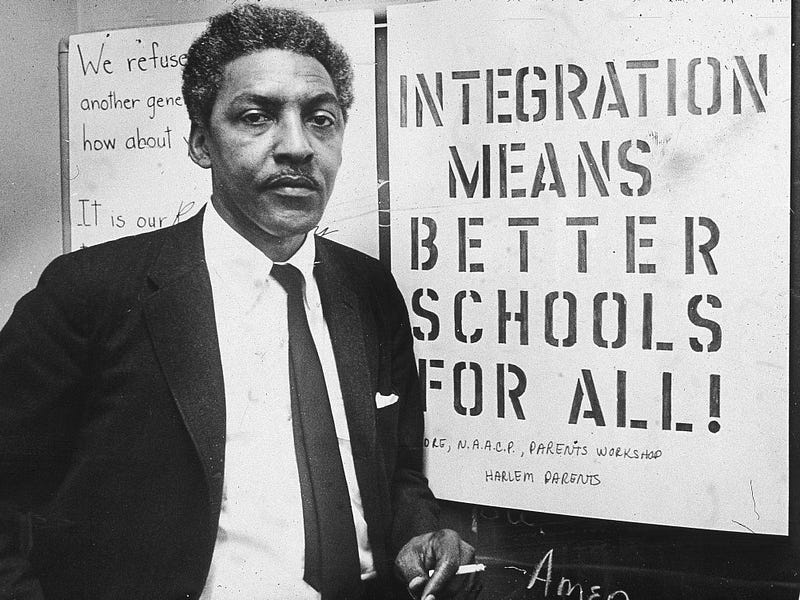
Black Queer heroes are often hidden from mainstream conversations about the civil rights movement. It’s why most Americans can tell you about Dr. Martin Luther King Jr. but not about Bayard Rustin, an openly gay Black man who organized the March on Washington for Jobs and Freedom. A. Philip Randolph, a civil rights organizer responsible for founding the nation’s first major Black labor union, gave Rustin the nickname “Mr. March on Washington” for organizing efforts that brought more than a quarter million people to gather near the Lincoln Monument. King wrote a letter to a colleague in 1960 saying, “We are thoroughly committed to the method of nonviolence in our struggle, and we are convinced that Bayard’s expertness and commitment in this area will be of inestimable value.”
Police officers arrested 41-year-old Rustin in 1953 for having a homosexual relationship with a man under California Penal Code section 647 .5, a “morals” law designed to persecute members of the LGBTQ+ community for same-sex relationships. While Rustin passed away in 1987, the California Legislative Black and LGBTQ Caucuses advocated for a pardon of Bayard Rustin, inspired by his role as a humanitarian and civil rights icon. Governor Gavin Newsom granted the pardon in 2020, seven years after President Barack Obama posthumously awarded Mr. Rustin the Presidential Medal of Freedom. While Rustin courted controversy throughout his life for being an openly-gay Black man, many remember him as a hero whose efforts challenged the injustices besieging the country, like racial segregation, discrimination, and homophobia. “Martin Luther King, with whom I worked very closely, became very distressed when a number of the ministers working for him wanted him to dismiss me from his staff because of my homosexuality,” Rustin said.
Despite their friendship, Dr. Martin Luther King Jr. infrequently spoke about the advancing gay rights movement and died a year before the Stonewall Uprising of 1969, which began after New York City police raided Stonewall Inn, harassing, assaulting, and arresting patrons of the gay bar in Greenwich Village, some for wearing clothing that violated “the state’s gender-appropriate clothing statute,” discriminatory legislation that forced citizens to wear clothes consist with their assigned sex. In addition, officers crudely took some patrons to the bathroom to “check their sex,” a degrading experience, to say the least. Those rightfully infuriated by continued harassment from police officers started a riot that lasted for five days.
“When an individual is protesting society’s refusal to acknowledge his dignity as a human being, his very act of protest confers dignity on him” — Bayard Rustin
Many describe the Stonewall Uprising as the catalyst for America’s gay rights movement. However, it’s essential to mention that members of the LGBTQ+ community have consistently fought to advance the civil rights agenda. While some organizations existed before the Stonewall Uprising, the event inspired the creation of new, influential organizations “ including the Gay Liberation Front, Human Rights Campaign, GLAAD, and PFLAG.” If King had witnessed the Stonewall Uprising, he would likely have commented on the human rights violations Stonewall patrons experienced in New York. After all, he often spoke out against police brutality and believed that an “Injustice anywhere is a threat to justice everywhere.” Furthermore, his wife, Coretta Scott King, clarified his views, saying, “I’ve always felt that homophobic attitudes and policies were unjust and unworthy of a free society and must be opposed by all Americans who believe in democracy. The civil rights movement thrives on unity and inclusion, not division and exclusion. My husband’s struggle parallels that of the gay rights movement.” Nevertheless, the average American will be much more likely to quote King than Rustin, a disparity that exists, in part because Rustin was an openly gay man.
Homophobia and transphobia within the Black community
Perhaps the homophobia and transphobia within the Black community make stories like Bayard Rustin’s scarce in our discussions about civil rights. If Rustin were heterosexual, Black History Month specials would likely feature his quotes alongside Dr. Martin Luther King Jr so that children and teachers would be more familiar with his contributions to the civil rights movement. However, the concept of intersectionality, coined by the lawyer and leading critical race scholar, Kimberlé Williams Crenshaw 1989, is a relatively new concept in the English lexicon. As a result, many people are new to understanding the idea that our identities interact, that a Black man experiences life differently than a Black woman, and that heterosexual Black men and women experience life differently from Black gay men, Black lesbian women, and non-gender conforming, non-binary, or queer Black people. One study suggested that members of the Black LGBTQ+ community experience “heightened levels of discrimination” within “the workplace, health care systems, and police interactions,” which negatively impact their mental and physical health and stymie opportunities.
Gender, like race, impacts our lived experiences, and thus, understanding Black queer people requires us to carefully consider the different challenges they face. Sadly, since some Black people adhere to so-called “traditional” or “conservative values,” they actively engage in homophobic, transphobic, misogynoiristic beliefs that further marginalize Black people and silence heroes like Bayard Rustin. Heterosexual Black people, despite being victims of racism and Black women being subjected to misogynoir, must ensure they do not use their relative privilege to silence Black queer voices. Instead, the Black community should proudly support Black queer, lesbian, and gay heroes like Bayard Rustin, who spearheaded the March on Washington for Jobs and Freedom. We should unabashedly give them their flowers.
“If we desire a society without discrimination, then we must not discriminate against anyone in the process of building this society. If we desire a society that is democratic, then democracy must become a means as well as an end.” — Bayard Rustin
“Homophobia is like racism and anti-Semitism and other forms of bigotry in that it seeks to dehumanize a large group of people, to deny their humanity, their dignity, and personhood.” — Coretta Scott King
🌹Learn more about the author here. 🖊Sign up to read all my stories and thousands more.


