
Why The Amazon and Whole Foods Acquisition Never Made Sense
It came to me while grocery shopping
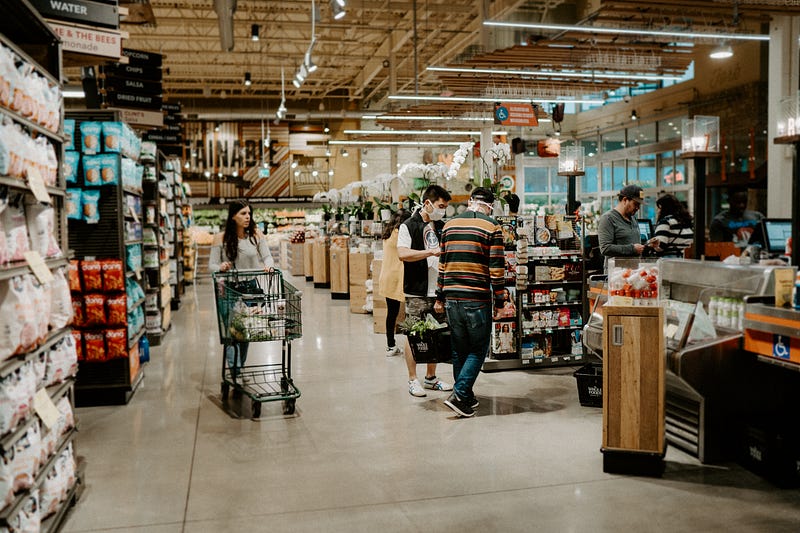
During the pandemic, the most visited place for most of us has inevitably become grocery stores. The most convenient stores close to me are Walmart and Whole Foods. They actually face right opposite of each other. In the earlier days of the lockdown, I was surprised to see the long queues at grocery stores.
I was not used it. I don’t think anyone was. Some were even taking photos of the queue to share with family and friends, I did too.
So naturally, I opted for the shorter queue at Whole Foods.
I never really shopped at Whole Foods before. Don’t get me wrong, I think it’s absolutely fantastic. Very attractive décor, delightful bakery section, and don’t get me started on the lovely ready meals.
I splurged that day. For a small household of 3 — my husband and I, and our adorable cat — I spent a whopping $300 on groceries that only lasted me a week.
When I walked in, I almost forgot that Amazon had acquired Whole Foods in 2017 for $13.7 billion dollars.
When the acquisition took place in 2017, Amazon vowed to make Whole Foods “affordable for everyone”. However, it seems to be a very slow-paced change, considering that Whole Foods still charges more than a 20% premium than most grocery stores.
I even got an argument with my husband when I mentioned it to him that it made no sense. He simply told me, “Who cares? Jeff Bezos can buy anything he wants”.
But my curiosity got to me. Why didn’t Bezos purchase any other grocery store then? Why did it have to be Whole Foods?
What strategic move was Bezos trying to accomplish by acquiring Whole Foods?
Amazon’s Penetration Attempt
Amazon’s intention towards acquiring Whole Foods is certainly driven by penetrating the grocery industry.
Amazon Fresh
In 2021, Amazon is projected to sell over $23 billion in groceries. In March 2017, Amazon announced ‘AmazonFresh Pickup’, a drive-in-type grocery store for Amazon Prime subscribers, launching in beta on March 29, 2017. Through its AmazonFresh Pickup, Amazon Prime customers can order groceries, drive up to an AmazonFresh location, and have the food delivered to their trunk.
AmazonFresh also delivers groceries to customers’ doors and also provides a pickup service from select retail locations. Currently, AmazonFresh offers 500,000 items and specializes in perishables that need extra packaging in order to be delivered and consumed safely. The delivery packaging is reusable and can be left out for an Amazon driver to pick up at the time of the customers next delivery, making it environmentally friendly.
AmazonFresh offers same day or next day delivery depending on the time the order was placed, and the available delivery times for the area.
Most recently, the US postal service partnered with AmazonFresh to increase the delivery area by allowing orders to be dropped off at a specified USPS location within a service area and delivered quietly to the customer’s doorstep before sunrise.
Amazon Go
Amazon Go, launched in September 2018, is a new kind of store with no checkout required and therefore an advancement wherein customers can avoid the checkout queues altogether.
With their Just Walk Out Shopping experience, customers need to use the Amazon Go app to enter the store, take the products they want, and simply, leave the store.
The Just Walk Out Technology automatically detects when products are taken from or returned to the shelves and keeps track of them in a virtual cart through the overhead cameras, weight sensors and deep learning technology detect merchandise. When the customer is done shopping, they can just leave the store. After some time, the customer receives a receipt and is charged to their Amazon account.
Until recently, Amazon’s success relied heavily on leveraging its ability to overcome the physical constraints that limit the reach and the breadth of assortment brick and mortar retailers can offer. However, in order to grow, Amazon needs shoppers to shop more frequently and for a wider range of goods including perishable foods, partially by establishing a physical presence, according to David Bishop, partner in Brick Meets Click.
Challenges in online grocery retailing
A survey conducted by Morning Consult in May 2018 reveals that many consumers prefer to see and touch the products in person. With today’s current situation, online deliveries are back-logged and sometimes visiting the stores in person is the only option to purchase groceries.
Indeed, nearly two-thirds of US internet users surveyed said it was a primary reason why they haven’t attempted to purchase groceries through online channels.
This is perhaps one of the main drivers behind Amazon’s motivation to acquire Whole Foods’ brick and mortar stores.
Opposing Business Level Strategy
By comparing Amazon and Whole Foods’ strategy, it becomes quite evident that the two companies do not share similar strategies.
As seen in the following Table 1, Amazon and Whole Foods both differ in terms of the economic logic, sources of competitive advantages, and competitive scope.
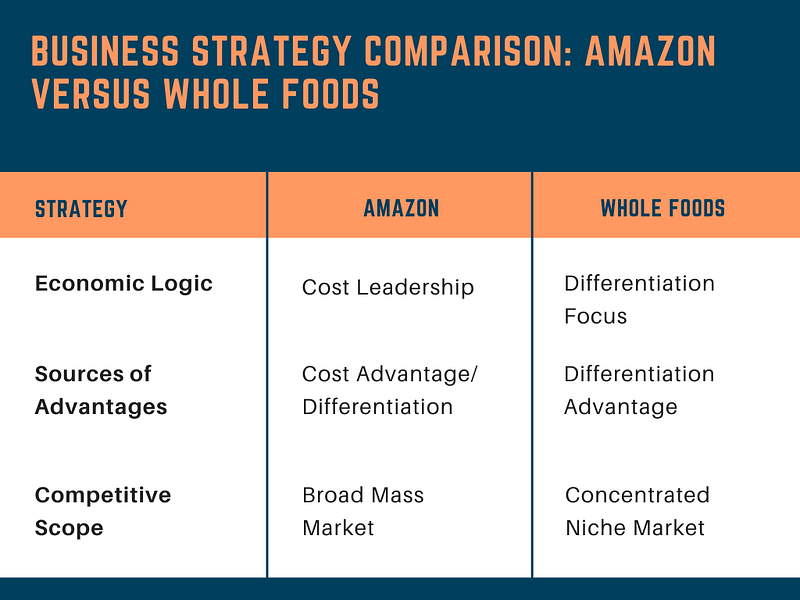
All in all, Amazon always aims to provide the most competitive prices to customers, while Whole Foods competes by providing unique products and charging a premium on its items.
Amazon appeals to the mass market, while Whole Foods appeals to the upper-middle class of the society.
Clash of Cultures
The organizational cultures of Amazon and Whole Foods have been discussed in greater detail in the internal environment section of the project.
It can be said that the two firms have drastically opposing organizational culture. An article from the Harvard Business Review (HBR) suggests how this could be a recipe for disaster. Amazon, as a data-driven company is identified to have a tight culture that values consistency and routine.
Using the 7 dimensions of organizational culture, see below the summarized comparison between Amazon and Whole Foods in Table 2:
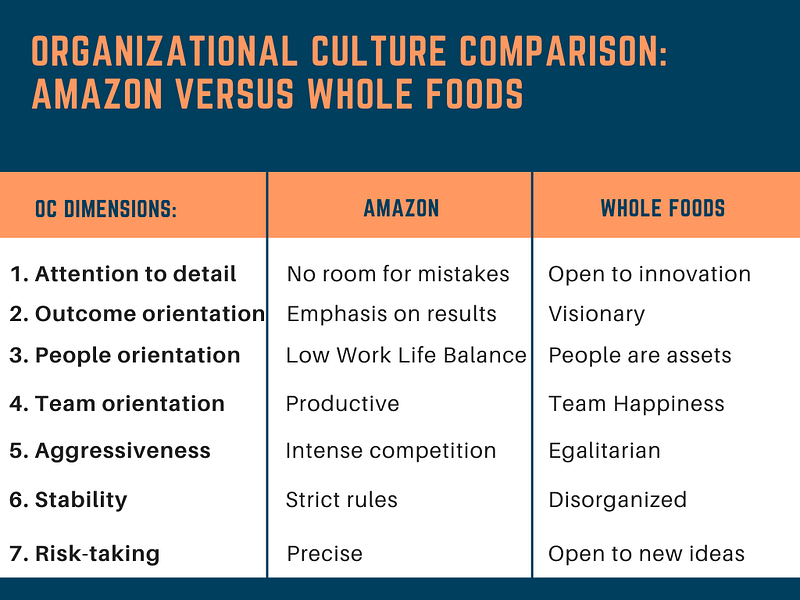
On the other hand, Whole Foods, as a loose and visionary culture, took pride in its personal touch, with empowered stores and individuals to make decisions that emphasize on the quality of Whole Foods’ products.
The term “Whole Paycheck” is said to be derived from the company’s decentralization that contributed to vast inefficiencies, driving up the prices of Whole Foods products.
The culture clash is said to be a predictable one with no good or bad guy in the story, but rather, a different approach to performance measures and accountability.
In addition, according to the HBR article, Amazon values efficiency and standardization greatly, while Whole Foods tend to seek creative solutions such as empowerment and relationship with local farmers to drive value.
Since tight cultures such as Amazon’s have little to no tolerance for mistakes, apply strict and precise procedures and processes, a CEO such as Jeff Bezos fits perfectly in displaying expectations of unwavering discipline from employees as part of his leadership style.
On the contrary, Whole Foods’ CEO, John Mackey, has an opposing style in the looser culture, celebrating visionary, collaborative efforts, and advocates for change and people empowerment.
Takeaway
With all things considered, Bezos is the richest man alive who has the capability to purchase any company he desires.
The two companies having opposing value proposition and organizational cultures just sparked my interest as to how they proceeded with the acquisition in the first place.
Perhaps Amazon has really been trying to penetrate the grocery industry, and there was no other option besides Whole Foods to acquire. Even almost three years after the acquisition took place, Whole Foods still remain to keep prices relatively high.


