
Why Tesla Is Going to Be My Next 15-Year Investment
And how Elon Musk keeps all competition 10 years behind.
The stock market is completely crazy, right now!
It’s hard to find good deals in this pandemic environment. The S&P 500 is reaching all times highs while the real economy languishes.
Robinwood and M1 Finance are thriving with new investors. Some of them came from the casino lounge directly to stock market apps.
The Federal Reserve continues to bleed the market with QEs, leveraging equities and weakening the dollar.
And there are resurging new Covid-19 cases all over the world, making us think that this virus is going to stay for a while.
So, as an investor, I’ve been watching all the movement without doing anything. My portfolio is where it was 6 months ago.
But something new is rising from all the confusion and noise. And I don´t want to miss it, or I´ll regret 15 years from now.
Technology Disruption
When Jeff Booth was a kid, his parents asked him, hypothetically, if he prefers to earn a million dollars on the spot or a penny that doubles every day for thirty-one days. Of course, he made the same mistake everybody else does. He couldn’t imagine that a small thing like a penny doubling over time could become so large.
In fact, in just thirty-one days that single penny doubling would become $10,737,418.24. After that lesson, he was sure he would never make that mistake again.
Most people are aware of Moore’s law. Gordon Moore, the co-founder of Intel, described what we now call Moore’s law in a 1965 article in Electronics magazine. He absorbed that the number of transistors on a printed circuit board doubled every year and would for at least the next ten years. He later extended that prediction and revised it, saying that doubling would continue every two years. As Moore’s law has progressed over the past fifty years, the actual doubling has occurred approximately every eighteen months. Beyond just the doubling of computing power, we should expect a 21 percent annual decline in performance.
This combination sets up remarkable gains. For example, according to Computerworld magazine, the cost of one megabyte of hard drive memory has fallen from approximately $1 million in 1967 to 2 cents today. As Jeff Booth said:
All the advances we see around us today are due to the past doubles. And in eighteen months, compute power will double again, and with that, double all of what we have had in the last fifty years. Eighteen months to two years after that, it will double again.
All of the digitization is also creating some impressive data capture, much more that we are even aware of, and the data collection from connected computers, people, cameras, and sensors have only just started.
There are developments on the horizon that will make what we have now look primitive. If it feels like it’s hard keeping up with the rate of progress today, just wait for what’s to come in the next 18 months.
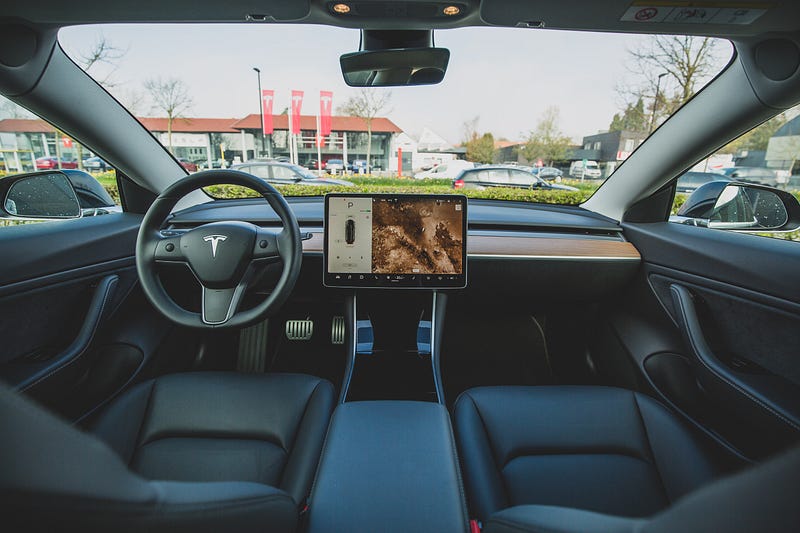
Self-driving Car
After the first attempts 15 years ago, time is nearing when autonomous self-driving cars will enter into our industries.
In early 2019, most cars on the road are still at level 1 (Most systems are still controlled by the driver). Just Testa’s have reached level 2 (The driver can disengage from both steering and acceleration/deceleration at the same time).
Tesla and Audi (A8) are likely to reach soon level 3 autonomy (The driver is still required to take control if alerted, but the attention required from the driver in previous levels is no longer required).
With all the research and investment budgets accelerating, level 4 autonomy (This is the first level that is fully autonomous) should be on the road by 2025.
The access and use of future cars are going to change dramatically. The owners of automobiles just use their vehicles 5% of the time. So, buy a car and allow it to be used by others to help me pay for the asset I own, is going to be a reality. With these choices, utilization rates on cars should be expected to increase in the next years. And means less demand for automobile manufacturers.
Automotive companies will need to change their business model. Most likely they will sell cars as a service option, similar to SaaS models in technology delivery today.
The 2020 Tesla Killers
Should Tesla be worried about the so-called Tesla killers? Somewhere in the future, they will come to this market to compete against the company.
Yet, non of them even come close to threaten Tesla business. The company has been benefiting from the first movers' advantage and each one of them has been really struggling to catch up on them on either price, performance, technology, or all three.
Tesla is shifting to a much more affordable EV, although high-performance electric vehicles for the mass market. Like the Model 3 Sedan, the Model Y crossover, and the new cibertruck.
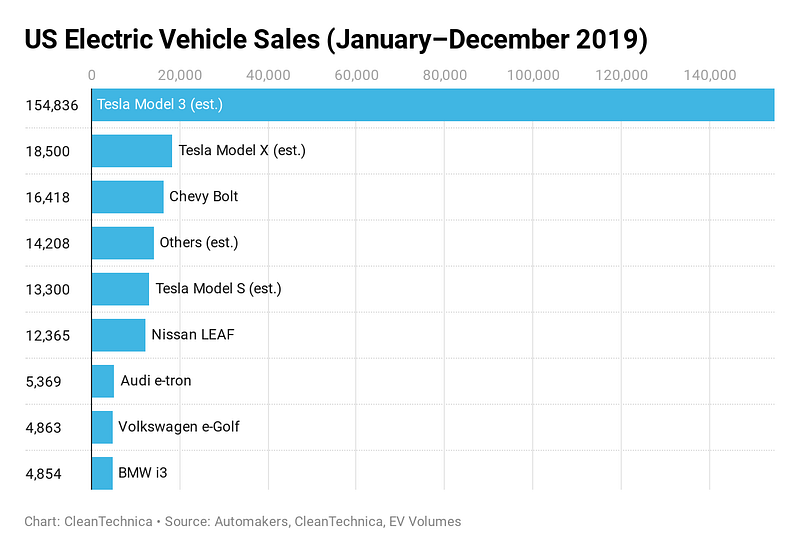
The Model 3 completely overtake the Model S and X, with 208,265 units against a compound 47,296 units of S and X.
About the competition, let´s start with the two more expensive Tesla killers, known as the Audi E-Tron and the Jaguar I-Pace, both already on the market.
Audi E-Tron is their’s first electric crossover SUV. It’s a very attractive vehicle. But this beautiful SUV starts at a price of $74,800 and still has a range of about 204 miles. If you compare it to Model 3, it starts at 40k with a 250-mile range, or Model Y that starts at 48k with a 280-mile range. It’s very far from being a Tesla killer.
Jaguar I-Pace won the 2019 world car of the year, design of the year, green car, and European car of the year. It starts at $69,850 with a 234-mile range. So, I don’t think you can compare it with Tesla’s numbers either.
Let’s try to find cheaper EV’s in the market. Maybe we can find the real Tesla killers.
The two EV’s that we hear about the most are the Chevrolet Bolt and the Nissan Leaf. Chevy Bolt costs $36,550 with a 226-mile range. And Nissan Leaf costs $29,990 with a 150-mile range.
Chevy Bolt is probably the closest option to Model 3, by the price (40k against 37k) and the range (250 against 259). Although, if you look at sales in the first 2 quarters of 2019, Tesla Model 3 sold 111,650 vehicles, against 13,111 Chevy Bolt. Is it comparable?
How Tesla Will Scale Battery Production
Tesla acquired a company called Maxwell Technologies for about $218 million about a year ago. Maxwell was found in the 1960s. They create ultracapacitors. A rapidly emerging and increasingly applied technology, ultracapacitors are capable of storing and discharging energy very quickly and effectively. Ultracapacitors complement a primary energy source that can repeatedly provide quick bursts of power, such as an internal combustion engine, fuel cell, or battery.
Are Tesla cars gonna have these ultracapacitors on their vehicles? No.
When Maxwell was developing the ultracapacitors, they figure out a new way to produce lithium-ion batteries. The same ones that Tesla has, but now they have a better, cheaper, and more reliable way to produce them by this new technology called dry battery electrode.
Tesla’s fascinated with this new cell production method because it can solve a lot of constraints the company has right now. It’s not a new cell, but a new way to build battery cells. And it’s not about having a battery that solves your extra miles range. It’s about mass production efficiency. Faster and cheaper.
Tesla is testing it and apparently is convinced enough that this break-through battery production is actually legit. And if you’re capable to build billions of batteries from a cost of $218 million by Maxwell acquisition, you may see our ROI paid back as quickly as a couple of months or years.
Tesla’s CEO Elon Musk announced via Twitter that Battery Day and the annual Shareholders Meeting are expected to be held on September 15th. He also said that this meeting will include a tour into the cell production factory.
Also, Tesla may soon have a battery that can last a million miles. Low-cost batteries created to last for a million miles of use and enable electric Tesla to sell profitably for the same price or less than a gasoline vehicle are part of Musk’s agenda.
Tesla’s new batteries will rely on new technologies such as low-cobalt and cobalt-free battery chemistries. And the use of chemical additives, materials, and coatings will reduce internal stress and enable batteries to store more energy for longer periods.
The Real Competitive Battle-Price
Tesla has something very similar to another major company in the world. Apple. Both have brand power. Like Apple, Tesla has this massive club of fans that invade the social media platforms and empower the company with positive energy. Apple has that same thing. It’s difficult to explain, but it’s harder to reach. The design is the most important characteristic both companies have. But also technology advances.
That’s why I’ve been buying Apple in a long-term perspective. And that’s why I’m going to start buying Tesla for the next 15 years.
But we cannot financially be successful just with brand power. So, what’s also important to have in mind? Price.
Unlike Apple, that keeps selling their devices at a more expensive price than the competition, Tesla wants to crush the competition by price, technology, and design. And also, Tesla has a more broad agenda as a company. They are not just competing in one category, because Tesla is not a car company. Did you hear me?
Tesla is not a car company
So, should we compare Tesla with Ford or GM? BMW or Audi?
Tesla is a tech company, an energy company, a battery company, a transportation company, and an insurance company.
That’s why no one can really evaluate the company. I started analyzing Tesla in a deeper way some months ago. Reading and watching all the documentaries about this extraordinary company. I also read Elon Musk's biography. And I found out that Elon is everywhere. He’s preparing our future. He’s thinking in a closed cycle of renewable energy sources and services that can circulate in a close chain all over the world.
And that is why Tesla is not a car company. That is why you can’t compare to any automobile company at all.
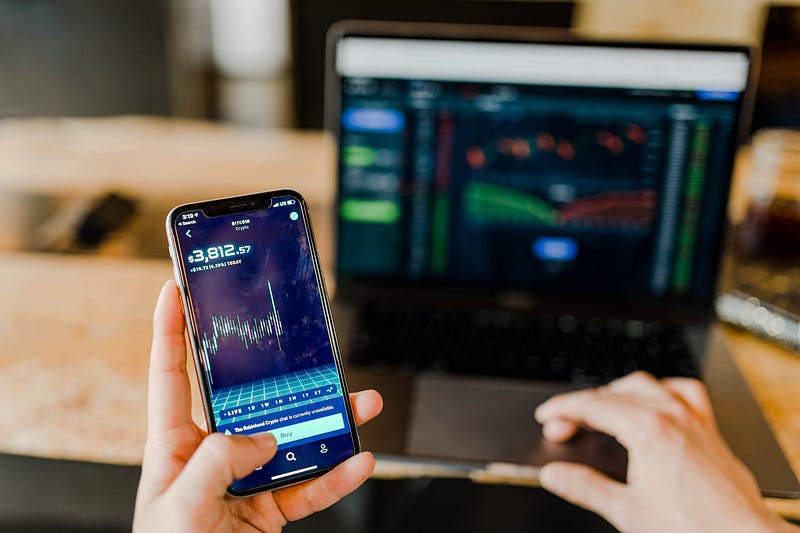
Tesla’s Worth $1 trillion By 2030
There are a bunch of people that still believe in the stagnation fallacy. They believe that things stay as they are forever.
This is unbelievable in 2020.
With all the technological disruption appearing right in front of people’s eyes, is it not enough for people to believe in this massive change?
Driving a Tesla is really a unique experience. There are several reports of people that swift from a Porsche to a Tesla. They say it’s a totally different experience. And I believe it is. Because Testa is not a car. It’s technology on wheels.
But is Tesla gonna reach $1 trillion by 2030? This company’s value will always depend on how many cars they sell. How much profit they make per car. How much they’ll profit on the battery business. It doesn’t matter what was the last tweet from the CEO of the company. Here is where numbers talk.
Tesla can transform batteries, in the next few years, into a $5 billion dollar business. Cars in another $5 billion dollar business. The company is compounding revenue so rapidly that even one of the best billionaires, Ron Baron, says in this very enlightening interview some objective data. He assumes a 15% operating margins until 2030 with $150 billion in earnings that will transform Tesla into a $1 trillion-dollar company. Baron made the framework from 2030 to today and that was a very bright way to think about forwarding earnings.
Is Tesla gonna be able to reach the podium of the top 3 companies in the world? Do Elon Musk and his team have what it takes to achieve that goal?
Musk, like Bezos or Jobs, is a visionary. Electrifying transports, electrifying our power systems with Tesla’s battery technology is a massive opportunity. A huge challenge also. So many problems to solve in the way. But didn’t these guys faced all the problems as opportunities?
The bigger the problem the bigger the opportunity
How many dead ends did these visionaries faced until they prove to the world they were right?
Musk is coming to this turning point right now. Tesla is turning into a profitable company. The keepers of the S&P 500 list, S&P Dow Jones Indices, have a rule that new companies must have been profitable in their most recent quarter and over the past year before being added. With its latest earnings, Tesla just crossed that line.
Tesla would likely be the 17th largest company in the S&P 500 with an index weight of 0.8%- between Paypal and Pfizer. It’s gonna be a big event for managers of index mutual funds and exchange-traded funds. At the current prices of Tesla, managers of passive funds will have to sell about $35 billion to make a hole big enough to fit purchases of Tesla shares.
They Didn´t Taste the Real Pain Yet
Tesla spent 10 to 15 years of their early age in total pain. They were not profitable. They were not significant in the auto industry. And nobody believed in its success.
I think that the majority of car companies are still in denial about the technological disruption because they know the pain is gonna be worse than Teslas.
Why? Because they’ll have to cannibalize their 30 years success model business, just to stay alive for the next 30. And that’s gonna be a tough decision for any auto company.
The way we’ll use energy sources is going to change dramatically. For the good, we’ll have the best companies in the world fixing the planet earth’s most important problem. Stop burning fossil fuels.
Energy deregulation and transforming each and every person in the world into a micro-producer of energy. Buying software, and batteries at a low cost. This is going to be a huge swift in everybody’s lives.
And the 15-year investment that Tesla did in the past, is finally turning into a good thing. With so many people criticizing the methods, the technology, the person of Elon Musk. So many hours of Youtube videos with people arguing and doubting about Tesla’s success. So many people explaining how Tesla is going to bankruptcy.
All those 15 years came to this day, where Tesla has proved they were wrong. Elon Musk is not just a visionary, he’s also an excellent leader and CEO.
Like Apple and Microsoft, two stocks that I will keep buying for the next 15 years, I’m going to start buying Tesla stock too.
The disruptive technology is here and it’s at a turning point. Probably the pandemic crisis boosted it. But any major event would do that. I strongly believe that technology is going to transform our next 15 years as the industrial revolution did in the past 100.
And I’m not gonna miss the opportunity to thrive by investing in these companies. By investing in these transformational paradigms.
I will continually invest in the future!
How about you?
This article is for informational purposes only, it should not be considered Financial or Legal Advice. Consult a financial professional before making any major financial decisions.
Gain Access to Expert View — Subscribe to DDI Intel