avatarIlona D.

Free AI web copilot to create summaries, insights and extended knowledge, download it at here

4197

Abstract

are helping to drive stock prices higher. So even though there might be a lot of uncertainty in the world, the underlying fundamentals of the economy are still strong.</p><h1 id="eb05">Divergence between economy and stock markets</h1><p id="7475">The divergence between the economy and the stock market has been growing for years. The stock market doesn’t always reflect what’s happening in the real world — in fact, it often ignores it.</p><blockquote id="35e7"><p>Emotions can drive market behavior in a few short-lived situations. But fundamentals still rule.

— McKinsey Quarterly: Marc Goedhart, Timothy Koller, and David Wessels</p></blockquote><div id="2968" class="link-block"> <a href="https://www.mckinsey.com/business-functions/strategy-and-corporate-finance/our-insights/do-fundamentalsor-emotionsdrive-the-stock-market"> <div> <div> <h2>Do fundamentals--or emotions--drive the stock market?</h2> <div><h3>There's never been a better time to be a behaviorist. During four decades, the academic theory that financial markets…</h3></div> <div><p>www.mckinsey.com</p></div> </div> <div> <div style="background-image: url(https://miro.readmedium.com/v2/resize:fit:320/0*mzMQd-PdgOzuLImm)"></div> </div> </div> </a> </div><p id="9e00">There are several reasons for this, but one of the most important is that:</p><p id="b409" type="7">Investors are looking to the future.</p><p id="3146">They are betting on companies that will do well even in difficult times, and they’re not being swayed by short-term news stories.</p><p id="0db3">Investors are also becoming more global in their outlook. They’re not just focused on what’s happening in their own country — they’re looking at companies all around the world. This is helping to insulate them from some of the political turmoil that’s going on.</p><p id="3aff"><b>If you want to learn an alternative way to invest any extra sum that comes your way, go and get your access here:</b></p><div id="9847" class="link-block"> <a href="https://seriousinvestorsonly.com/"> <div> <div> <h2>How to Invest Profitably 500 a Month - Serious Investors Only</h2> <div><h3>10 Proven Ways to Invest Profitably 500 a Month Start investing independently without the help of banks, funds, and…</h3></div> <div><p>seriousinvestorsonly.com</p></div> </div> <div> <div style="background-image: url(https://miro.readmedium.com/v2/resize:fit:320/0*yM71CLgdmeTc-wt0)"></div> </div> </div> </a> </div><h1 id="a08e">What should investors do?</h1><p id="3530">Some say that the current market conditions are ripe for a crash. Economic growth is slowing, trade tensions are rising, and political uncertainty is at an all-time high.</p><p id="21be">So why are stocks still going up?</p><p id="a501">The answer lies in the fact that stock prices are not determined by the underlying fundamentals of the economy or political environment. Instead, they are driven by investor sentiment. And right now, sentiment is still positive.</p><p id="c0e2">Of course, this could change at any time. If investor sentiment turns negative, we could see a sharp sell-off in stocks. But for now, the bulls are still in control of this market.</p><p id="4f67"><b>So what does this mean for investors?</b></p><p id="5e9e">If you’re worried about a market crash, you may want to consider hedging your portfolio with some downside protection. But if you’re still bullish on stocks, then this is a good time to be buying. Just remember that the market can turn on a dime, so don’t get too complacent.</p><p id="4a2f" type="7">In times of political and economic uncertainty, stock prices are driven by earnings, not headlines.</p><p id="85db">While it’s impossible to predict the future of the economy or the stock market, history can provide some perspective. It’s worth noting that stocks have risen during periods of economic and political tur

Options

moil in the past, and they will likely continue to do so in the future.</p><p id="7ae5">Investors should keep this in mind when making decisions about their portfolios. Despite the current climate of uncertainty, there are still plenty of reasons to be bullish on stocks.</p><div id="03a4" class="link-block"> <a href="https://www.wsj.com/articles/investors-see-bullish-signals-under-the-stock-markets-surface-11646538735"> <div> <div> <h2>Investors See Bullish Signals Under the Stock Market's Surface</h2> <div><h3>It's been a rocky spell for stocks. Under the market's surface, some investors see promising signs. The S&P 500 has…</h3></div> <div><p>www.wsj.com</p></div> </div> <div> <div style="background-image: url(https://miro.readmedium.com/v2/resize:fit:320/0*nK8n6QQeNKUluo01)"></div> </div> </div> </a> </div><p id="bdc7">Economic and political conditions may be volatile, but ultimately, it is earnings that drive stock prices higher.</p><p id="1ffc">If you can find an investment opportunity that is resistant to political and economic crises, then you’re onto something special.</p><p id="cf07">In times of economic crisis and political uncertainty, the stock market often provides opportunities for investors to buy low and sell high. Despite the current climate of economic and political turmoil, there are still many reasons why stocks may go up.</p><p id="cc6b">Remember that the value of fiat is constantly being degrading in this economic crisis and that to preserve the purchasing power of your money, it is important to invest in assets. Economic conditions may be volatile, but over the long term, it may be more profitable to invest in stocks.</p><blockquote id="c9dc"><p>If the rate of inflation is 10%, you are losing 10% of your wealth through purchasing power each year. To keep up with the purchasing power, you need an investment that will grow by at least that much annually.</p></blockquote><p id="9daa" type="7">The S&P 500 has an average annualised growth rate of 10.5%.</p><div id="aec5" class="link-block"> <a href="https://medium.datadriveninvestor.com/is-investing-in-s-p-500-worth-the-risk-d498aa2c91e5"> <div> <div> <h2>Is Investing in S&P 500 Worth the Risk?</h2> <div><h3>What Investors should know about the S&P 500 before investing</h3></div> <div><p>medium.datadriveninvestor.com</p></div> </div> <div> <div style="background-image: url(https://miro.readmedium.com/v2/resize:fit:320/1*2ErXiF1yHf1FMRGf16xqKA.jpeg)"></div> </div> </div> </a> </div><p id="9d3f">If you are unable to find an individual stock to invest your money into, an index fund like the Vanguard 500 Index Fund ETF may be something investors should consider.</p><h1 id="c0b2">Summary</h1><p id="fe7c">Assets like the stock market have been away for both institutional investors and retail investors to protect themselves from the current economic crisis of inflation. This is one of the main reasons why stocks go up during an economic crisis.</p><p id="7627">Stocks also go up because people are willing to pay more for a company’s earnings today than they were in the past. Economic and political conditions may be volatile, but over the long term, it is earnings that drive stock prices higher.</p><p id="bbea">So if you’re worried about a market crash, remember to focus on the fundamentals. And if you’re looking for an investment opportunity, keep your eye out for companies that are resistant to political and economic turmoil.</p><p id="4801"><b>Thank you for reading!</b></p><p id="44ef">Become the most successful investor — learn, invest, profit 🤑</p><p id="f653"><i>This article is for informational purposes only. It should not be considered Financial or Legal Advice. Not all information will be accurate. Consult a financial professional before making any major financial decisions.</i></p></article></body>

Why Stock Market is Bullish Despite Economic And Political Uncertainties

Photo by Heather Mount on Unsplash

It’s been a turbulent year, to say the least. Economic and political crises seem to be happening more and more frequently, leaving investors around the world scratching their heads in confusion.

So why is it that stock markets are still going up?

“What we are headed toward is a more divided world economically that will mirror what is clearly a more divided world politically. — Edward Alden of the Council on Foreign Relations, on how the pandemic and the war in Ukraine are upending ideas about how stronger global economic ties would lead to greater stability.

It seems like Wall Street is ignoring all of the bad news and continuing to plow ahead. In this blog post, we’ll take a closer look at what’s driving stock prices higher in the face of so much uncertainty.

Recent economic and political crises

The United States is still dealing with the after-effects of the pandemic crisis. The economic recovery has been slow, and many Americans are still out of work. The political situation is also incredibly uncertain, with a new administration taking office just a few months ago.

It’s estimated that about 20% of all U.S dollars circulating in the American economy have been created in 2020 alone:
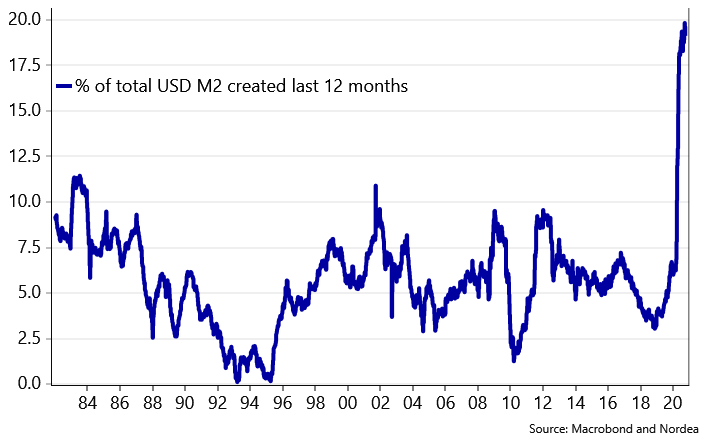
Source: Macrobond and Nordea

This is a lot of “new” money, and it’s one of the reasons why stock prices have been rising.

This has caused inflation and many people living paycheque to paycheque are struggling to keep up with the rising cost of living.

Politically, civilians are beginning to become suspicious and fed up with how the current government is supporting the economy. Over the past 2 years, we have seen a rise in both peaceful protests and violent riots. If the government does not fix the economy soon, we could see even more unrest.

It would make sense for stock prices to be down in the face of all this bad news. But that’s not what’s happening.

Why do stock markets still go higher

In the face of all this bad news, it’s no wonder that people are wondering why stock prices are still going up.

The answer lies in the fact that, despite all of the turmoil…

Stock markets are still seen as a safe investment.

Economic and political crises are becoming more and more common, but they are not necessarily indicative of the long-term health of a company.

With the rate of inflation going up, many investors are allocating even more capital to the stock markets rather than holding their wealth in cash. This is done to protect themselves from the purchasing power of their money being eroded.

According to the 2022 Long-Term Capital Market Assumptions Report by J.P. Morgan:

Equity returns are stable, even after a year of strong returns since our last publication. Adjusting for today’s sector mix implies better margins and more supported valuations than history alone suggests.

All of these factors are helping to drive stock prices higher. So even though there might be a lot of uncertainty in the world, the underlying fundamentals of the economy are still strong.

Divergence between economy and stock markets

The divergence between the economy and the stock market has been growing for years. The stock market doesn’t always reflect what’s happening in the real world — in fact, it often ignores it.

Emotions can drive market behavior in a few short-lived situations. But fundamentals still rule. — McKinsey Quarterly: Marc Goedhart, Timothy Koller, and David Wessels

There are several reasons for this, but one of the most important is that:

Investors are looking to the future.

They are betting on companies that will do well even in difficult times, and they’re not being swayed by short-term news stories.

Investors are also becoming more global in their outlook. They’re not just focused on what’s happening in their own country — they’re looking at companies all around the world. This is helping to insulate them from some of the political turmoil that’s going on.

If you want to learn an alternative way to invest any extra sum that comes your way, go and get your access here:

What should investors do?

Some say that the current market conditions are ripe for a crash. Economic growth is slowing, trade tensions are rising, and political uncertainty is at an all-time high.

So why are stocks still going up?

The answer lies in the fact that stock prices are not determined by the underlying fundamentals of the economy or political environment. Instead, they are driven by investor sentiment. And right now, sentiment is still positive.

Of course, this could change at any time. If investor sentiment turns negative, we could see a sharp sell-off in stocks. But for now, the bulls are still in control of this market.

So what does this mean for investors?

If you’re worried about a market crash, you may want to consider hedging your portfolio with some downside protection. But if you’re still bullish on stocks, then this is a good time to be buying. Just remember that the market can turn on a dime, so don’t get too complacent.

In times of political and economic uncertainty, stock prices are driven by earnings, not headlines.

While it’s impossible to predict the future of the economy or the stock market, history can provide some perspective. It’s worth noting that stocks have risen during periods of economic and political turmoil in the past, and they will likely continue to do so in the future.

Investors should keep this in mind when making decisions about their portfolios. Despite the current climate of uncertainty, there are still plenty of reasons to be bullish on stocks.

Economic and political conditions may be volatile, but ultimately, it is earnings that drive stock prices higher.

If you can find an investment opportunity that is resistant to political and economic crises, then you’re onto something special.

In times of economic crisis and political uncertainty, the stock market often provides opportunities for investors to buy low and sell high. Despite the current climate of economic and political turmoil, there are still many reasons why stocks may go up.

Remember that the value of fiat is constantly being degrading in this economic crisis and that to preserve the purchasing power of your money, it is important to invest in assets. Economic conditions may be volatile, but over the long term, it may be more profitable to invest in stocks.

If the rate of inflation is 10%, you are losing 10% of your wealth through purchasing power each year. To keep up with the purchasing power, you need an investment that will grow by at least that much annually.

The S&P 500 has an average annualised growth rate of 10.5%.

If you are unable to find an individual stock to invest your money into, an index fund like the Vanguard 500 Index Fund ETF may be something investors should consider.

Summary

Assets like the stock market have been away for both institutional investors and retail investors to protect themselves from the current economic crisis of inflation. This is one of the main reasons why stocks go up during an economic crisis.

Stocks also go up because people are willing to pay more for a company’s earnings today than they were in the past. Economic and political conditions may be volatile, but over the long term, it is earnings that drive stock prices higher.

So if you’re worried about a market crash, remember to focus on the fundamentals. And if you’re looking for an investment opportunity, keep your eye out for companies that are resistant to political and economic turmoil.

Thank you for reading!

Become the most successful investor — learn, invest, profit 🤑

This article is for informational purposes only. It should not be considered Financial or Legal Advice. Not all information will be accurate. Consult a financial professional before making any major financial decisions.

Investing
Finance
Economics
Money
Politics
Recommended from ReadMedium