
Why Some People Still Think ‘Feminist’ Is a Dirty Word
It’s not about overthrowing men — it’s about deserving the same respect.

I remember the first time I referred to myself as a feminist. I was hanging out with a small group, all of us in our late teens or early twenties, and the topic came up. I said something about believing in women’s rights, and stated that yes, I thought of myself as a feminist. Another young woman present (whom I didn’t know very well at the time) was clearly taken aback, and I didn’t know why.
Her: “Are you sure you want to call yourself that?”
Me, surprised enough to pause. I second-guessed myself for only a moment and then responded: “Well, yeah. I mean, I stand by what I believe in.”
Silence.
Me, still genuinely surprised: “I’m actually not really sure why you look so offended.”
Her, blushing: “I’m just…disappointed. I didn’t think you would feel that way.”
I was shocked. Was that supposed to make me feel ashamed? “Uh… what way exactly? I just said I want equality for women. Equal pay, equal opportunities — that’s what I believe in and what I want to fight for. Don’t you?”
Her, literally snapping at me: “Equity! Equity, not equality. Men and women aren’t the same, and never will be.”
Now I was the one taken aback. “I know... But just because we’re different doesn’t mean we shouldn’t be afforded the same opportunities. You don’t think men and women should be paid the same for the exact same job?”
She shrugged and walked away grumpily, clearly uncomfortable, and I was left with a sense of bewilderment.
That was my first encounter with someone who truly seemed to think “feminist” was a dirty word. Before that moment, I thought it was something many people agreed on — or at the very least many women. Why wouldn’t we all want equal rights?
And that was when I realized that feminism isn’t as accepted as I’d imagined, and that apparently, it wasn’t for the faint of heart.
I did, however, realize that I still had a lot of learning to do. I knew what I believed in and how I viewed our society and the world, but I didn’t know much about feminism specifically as a concept, or why some people had such an adverse reaction to the word.
And why they still do.
In order to incite real change, we need more people to understand and begin to see value in the roots of the movement, even if they don’t agree with the terminology.
Feminism is defined as:
“the belief that women should be allowed the same rights, power, and opportunities as men and be treated in the same way, or the set of activities intended to achieve this state”
At the heart of the belief, it’s not about being the same; it’s about being treated the same and having the same choices.
In a poll of more than 1,000 American women, it was found that less than a third of them identified as feminists. This varied over different demographics, but what is interesting is that when asked questions about beliefs aligning with the movement (such as advocating for women to have equal opportunities), agreement actually doubled. This could indicate that their issue was no so much with the sentiment, but with the word “feminist” itself.
Over time I’ve come to understand some of the reasons that feminism is considered “controversial” and why so many people still hate it.
That being said, I’ve found that the counterarguments I’ve read stem from misunderstanding about what feminism actually means, the belief that women already have rights and things don’t need to change, or that at the root of the matter women don’t necessarily deserve equal rights because we are so different from men.
They want things to stay the way they are, because that’s the way it’s always been.
A few statements I’ve witnessed:
- Feminists are angry, forceful women. They’re aggressive and not pleasant to be around, which makes them hard to talk to.
Well, yes, we are angry — for good reason. We’re fighting for our rights. We’re fighting to defend and stand up for ourselves in a society that often doesn’t believe or defend or stand up for us. If I’m aggressive it’s because I actually understand, and witness, and have experienced the urgency of the issue.
But that doesn’t mean that as a rule I’m always forceful and angry. I don’t need to spew venom to get my point across.
I’m entirely capable of having normal conversations with people about feminism and whatever else comes up, without wanting to burst into flames with rage.
Being a feminist doesn’t necessarily mean that I have such a chip on my shoulder that I won’t listen to anyone else.
- Feminists are all men-haters. They want to put men down.
I definitely do not hate men, and I resist the urge to roll my eyes every time I hear this.
I have an amazing boyfriend, grew up with two brothers, countless male cousins, and I’ve worked in male-dominated fields several times now. I’m fortunate enough to have a father who is one of the most caring people I know. I have a few close guys friends and many male acquaintances. I respect them and enjoy hanging out with all of them, so it’s ridiculous to me that anyone would claim that I or any other feminist automatically “hates men” as a blanket statement.
It’s not about “overthrowing” them; it’s about deserving the same respect.
We don’t hate men — we just want them to stop telling us how to act, what we deserve, and what to do with our own bodies.
We want society to stop pushing traditional gender roles on us, and stop perpetuating the belief that men are superior.
In short, we want to have the same opportunities and be able to make our own decisions, and a lot of men (though not exclusively) seem to keep standing in the way of that.
- Feminism is upsetting gender roles, and challenging religious beliefs and customs.
Let me begin by saying even though I personally don’t consider myself religious, I respect those who do. I want everyone to keep practicing whatever faith they choose to. That is their right — as long as it isn’t hurting anyone else. If remaining in more traditional roles is what you need to do for your faith, then I’m not trying to stop you.
Having said that, yes — we are, in general, challenging gender roles. If a woman wants to be a stay-at-home mom, or wants to do all the cooking because she enjoys it, then by all means, she should do that. I respect her decision. The point is that she shouldn’t have to just because society expects her to.
“That’s the way it’s always been” is no longer a viable excuse.
So yes, I do want to see gender roles start to crumble, because it’s 2020 and women deserve equal opportunity to work outside of the home if they want to. And we deserve to do that without being shamed for it.
And this doesn’t just apply to women — some men want to be stay-at-home dads, and there’s still a lot of stigma surrounding that. But why? If the woman is making the money and he is taking care of the kids, he’s still fulfilling the role of “protector”, if not provider, anyway. Society has impressed upon us that the ideas of what a man and woman should do and be are set in stone, when in fact — they are absolutely not. Many men are just as nurturing as women, and many women are just as assertive and ambitious as men. It depends on the individual.
I don’t want to be a housewife, but if others want to, I wish them well. Obviously I can’t speak for all feminists, but I for one don’t care if some women wish to uphold traditional roles — just as long as it’s their choice, and they don’t expect every other woman to make the same one.
- Men and women are too different to ever really have equality. They’re not designed the same, they don’t think the same way — it’s not logical to think they can always do the same things.
I realize that men and women are of course, not the same. But again, it’s not about being the same — it’s about being given the same opportunities. Allow me to give you an example from my experience:
For one summer in college, I was a whitewater rafting guide. I went through the 10-day training course, the grueling fitness and safety exercises, and the same testing process as everyone else. I ended up passing my final test before the other trainees, meaning I was qualified to run the river with customers. This created some tension, because I was the only woman hired and I had qualified before any of the men.
My instructor actually told me later that he wasn’t surprised I had passed early on, because over time he’d noticed a trend among female river guides. While the men tended to muscle their way through and use their own brute strength to navigate the rapids, the women tended to take the time to read the patterns of the water, and have a back-up plan. Because I wasn’t as big as the other guides, I used the resources available whenever possible (the current, and knowing which areas to avoid) instead of relying on my strength alone.
Do I think I was as physically strong as the male guides? Hell no. I was very muscular that summer, but I’m not going to pretend I had the same upper body strength as my male coworkers did. Men and women are physically built differently — that part is obvious.
But the point is that despite our differences, we were still doing the exact same job. I navigated all the rapids, talked to the customers about the history of the river, followed all safety protocols, knew all the rescue procedures, and got everyone down the river safely — just like everyone else.
Different ways of doing the job, same outcome. Same outcome, same pay.
And that’s what we’re fighting for.
Equality Vs. Equity
At the beginning of this article, when I told the story of the first time I called myself a feminist — I didn’t truly understand the other woman’s reaction.
“Equity! Equity, not equality. Men and women aren’t the same, and never will be.”
I didn’t know why she was so upset at the time, and I still don’t, to some extent. I don’t know her experience, or her life. But I do understand what she meant by making the distinction between the two words.
Fighting for equality means we are striving for equal opportunities, but fighting for equity is making sure even with the same opportunities, each of us is given the resources we need as individuals to get there.
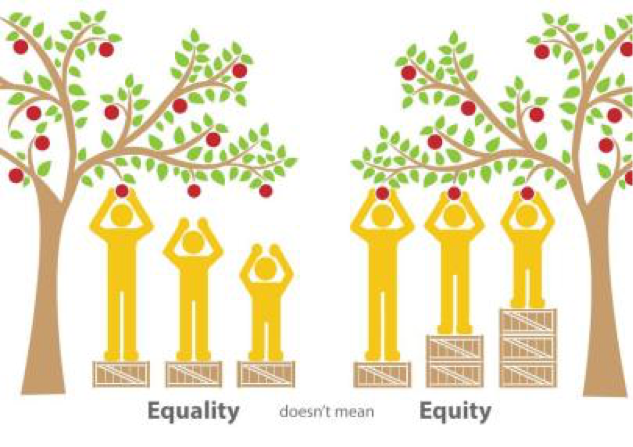
“Equity is giving everyone what they need to be successful. Equality is treating everyone the same.” -Beth Ellen Hollimon
For example, if you consider education in other countries, particularly third-world — it may be legal for both boys and girls to go to school, but perhaps only the boys attend. This could be due to the dangers of a girl walking alone to school, her being expected to help her mother with household duties, or societal pressures that don’t allow her family to spend money on a daughter’s education.
Equality is already there, because she technically is allowed to legally attend school. But equity would be making sure she can.
It would be helping to provide whatever resources necessary to help her achieve an education — whether it’s protection and/or transportation to be able to get to school, extra tutoring to help her catch up, or finances to help her purchase books and materials that may not be allotted to her by her family.
Going back to my personal experience of being a rafting guide, I in fact experienced both equality and equity (to some extent — there were still some issues with sexual harassment, but that’s another story). I was given the same opportunity and performed the same duties to earn the same pay.
One example of a difference, however, was that I wasn’t able to easily get the raft down from the top of the van by myself. The biggest guides could, but I had to ask for help. This is an example of equity — and not just because I was a woman. There were two other men who weren’t as big in stature who asked for help, too.
We knew our limitations and were accommodated, all while doing the same job.
It seems that a lot of people don’t acknowledge or understand the difference, but it’s an important distinction. Because even if and when we level the playing field, we should be striving for equity, too. We’re all aware that men and women are different, in more ways than one. I’m not disputing that. What I’m disputing is the belief that women don’t deserve the chance to try.
“Feminist” doesn’t have to be a dirty word. We may get heated at times, and rightfully so, but being a feminist does not mean I want to tear into someone with rage if they don’t instantly agree with me.
Because I want them to understand. Ultimately we care about women as people, and we want to be treated as such.
With respect.
And while I’m aware how far we’ve come in terms of women’s rights, we’re still far from equal. Legally we may have the same rights in many cases, but if you examine the way we are treated in society, there is still a long way to go.
That’s not to mention the state of women’s rights and treatment in other countries. Oftentimes we speak up and are passionate about changing things where we are, perhaps because our views tend to come from personal experience.
But we need to remember that feminism at its core is about all women, not just those in our circle, our race, or our country. Regardless of their location, all women deserve to be treated fairly and with respect, and all women deserve to make their own decisions about their lives without fear.
Until that happens, we still have a lot of work to do.
© Samantha Blake 2020


