The only one who could ever teach me
Why Some People Become Saints (and Others Don’t)
Conversation with an Ethiopian resident sage
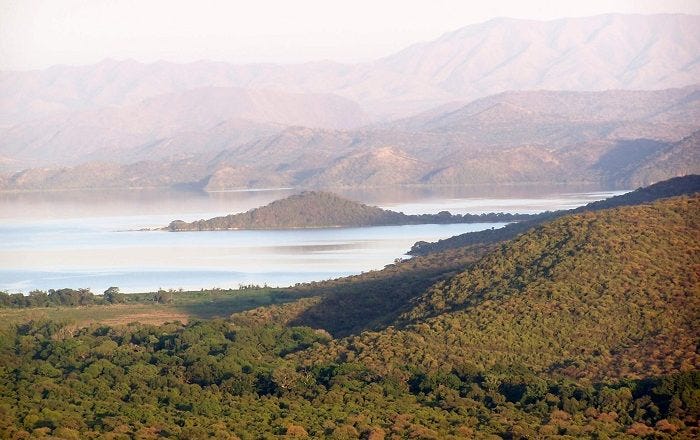
Lake Tana is the largest lake in Ethiopia. It lies like a large blue mirror between the barren hills in the rainy northeast of the country. It has many tributaries, but only one outflow: the Blue Nile. Around the lake and on its many small islands are countless monasteries.
Yeheyes is the son of a pastor from Gondar in Northern Ethiopia. His father preaches in the church Debre Berhan Selassie, which is famous beyond the country’s borders for its seventeenth-century murals. Yeheyes is a seminarian in his mid-twenties. He is very well-read, cosmopolitan, reflective, and introverted. He is tall, and slender, with coffee-brown skin. He wears his curly black hair very short. His face has angular features. His left eye tears incessantly.
Yeheyes took up quarters in a monastery on an otherwise unpopulated islet in Lake Tana. The building lies in the middle of a dense jungle with a heavenly view. He shares a room with three theology students. They all sleep on narrow benches covered with lambskin. A total of twelve brothers live in the monastery building.
Every morning just before sunrise, all the brothers meet to sing. Then they ring the bells to join in prayer. Only then do they have breakfast. A large bay window of the monastery, open on two sides, is designated as the dining room. It is sparsely furnished with a long table, two benches, and two chairs. The quiet is almost disturbing.
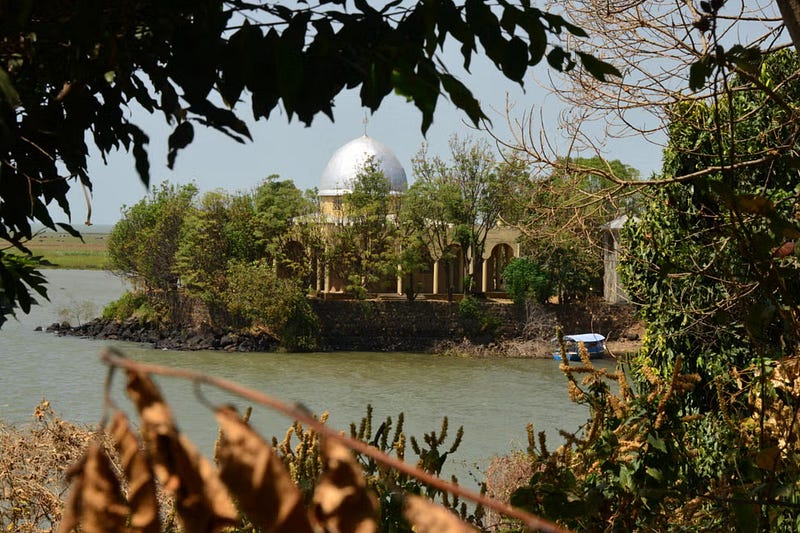
It is here and in privacy, where I meet with Yeheyes, known among the brothers as the sage, while his fellow monks-to-be are busy studying.
“Yeheyes, what brought you to this islet?”
“So I can practice spirituality.”
Spirituality
“Spirituality is one’s journey to a healthy life. […] That is through mindful awareness, connection, and practicing a good life.”
“How exactly do you define spirituality?”
“Spirituality is one’s journey to a healthy life. To me, that is through mindful awareness, connection, and practicing a good life.”
“What happens when we lead a healthy life?”
“We become godlike.“
“Godlike?” I ask in wonder.
“I believe that God is within all of us in the form of the Holy Spirit. Have you ever heard of the Trinity?“
“Father, Son and the Holy Ghost form a unity of essence with God,” I know.
“Exactly. According to my belief, the Holy Spirit, this mystical third being, is part of our subconscious mind. Jesus said, ‘The Kingdom of God is within you’. Our goal in life is to discover the Holy Spirit within us and convert it over into our consciousness.”
“Why should we do this?”
“God knows that our human ‘heart is deceitful and desperately wicked’. But He has a plan to tame the evil and evolve the goodness inside us.”
“How does it work?”
“When we acknowledge and repent of our sins, are baptized, and follow the guidance of the Holy Spirit, we willingly obey God’s authority.”
“This sounds exclusively reserved for worshipful Christians!”
Transcendence
“Self-transcendence has the end to reaching the infinite.”
“Not at all. It’s quite universal. In psychological terms, we would speak of self-transcendence. We break free from our narrow ego-centric shell and develop the capacity to expand our boundaries.”
“In how far do we expand our boundaries?” I want to know.
“I believe there are four dimensions of borders that we can stretch out:
- toward greater awareness of our values and dreams, challenging our worldviews
- toward our fellow human beings, animals, nature, and Earth
- toward our perspective of time, integrating our past and future in a way that has meaning for the present
- toward dimensions beyond the typically discernible world
Self-transcendence has the end to reaching the infinite level of human consciousness, behaving and relating. If practiced occasionally, it can put us in a state of ecstasy. But if practiced often, it can become a character trait.”
“And then what happens?”
Saints
Everyone can become a saint
“We attain prodigious spiritual energy that enables us to love all our fellow human beings and ourselves. We expand our consciousness, becoming limitlessly understanding, empathetic, humble, and gracious. At the same time, we contribute to the diversity of the Divine through our uniqueness.”
“Can you elaborate on this?”
“I believe that people who live in a constant state of self-transcendence amass a wealth of spiritual power. This power helps them influence the course of history by applying virtuousness, righteousness, and compassion. In this way, they become known as spiritual heroes and may appear as saints, sages, shamans, healers, gurus, masters, and so forth. In doing so, they reach far more people than worldly kings or presidents. Ultimately, they help us to make decisions for the benefit of all of humanity.”
“Now, I’m getting curious. Could I become a spiritual leader?”
“The idea is simple, but the execution is laborious. You want to strive for constant self-improvement and enhancing enlightenment. To this end, you must submit yourself to a diligent, lifelong training regimen. It comprises practicing humility, cultivating sublime moral standards, sharpening your emotional and spiritual intelligence, calming your mind, exercising mindful awareness, and habituating generous giving. By doing this, you develop profound, genuine, potent, and unique love.”
“So the goal is love?”
“Yes. When we truly love, we sincerely support our loved ones. As I said, we transcend ourselves. This, by the way, is a central point on which almost all religions agree. In Buddhism this state is called Nirvana, in Islam Inner Peace, and in Christianity Salvation.”
“Basically, everyone can become a saint?” I inquire.
“Yes. So long as you are truthfully willing to undergo the practice.”
“Why do so many people resist such a journey?”
“Motivation is key. As sarcastic as it sounds, it helps to have boundary experiences.”
“Boundary experiences?”
“The death of a close relative like your spouse or child, your own near-death experience, a divorce, or other meaningful critical moments in your life. Yet, nine times out of ten, we merely find ourselves in a social straitjacket, not in crisis. We feel we cannot free ourselves without drastic changes. And most of us are afraid of such transformations. The adaptations would inevitably cause challenges, confrontation, frustration, and a lot of work. This fear keeps us from growing spiritually, finding our true greatness, and becoming more self-aware…”
“…Who am I, what am I able to do, am I being loved…”
Self-awareness
“We can’t change anything by repeating yesterday’s decisions.”
“…Precisely. Our foundation is fragile. Instead of strengthening and nurturing it, we are creating a void. But remember: we can’t change anything by repeating yesterday’s decisions,” cautions Yeheyes.
“We tread a vicious cycle?”
Repression of spiritual growth
“If we don’t grow spiritually, we will grow diseases.”
“Correct. We numb ourselves in the comfort of conformity, conventionality, and unawareness; and we tranquilize ourselves by the trivial. At the same time, we identify ourselves through money, power, or status, accumulating material possessions.”
“Like everyone,” I scoff.
“As I said, spirituality is the journey to a healthy life. If we don’t grow spiritually, we will grow diseases. The mind and body are designed to grow. But if we suppress our mental growth process, the body will react with physical or psychological excrescences. Therefore, we must always reconsider our beliefs and ways of living. Then, we must venture beyond conventionality, undergo spiritual discipline and training, and ultimately experience breakthroughs leading to self-transformation.”
“I doubt that our secular leaders practice spirituality.”
“‘Many are called but few are chosen,’” Yeheyes quotes the bible one more time.
“Then, where are we headed, if most of our leaders are self-centered, immoral, and ignorant of the big picture? Will they destroy humanity? Or will they destroy our environment so that humanity loses its habitat?”
A better world
“Good and evil [are like] trial and error”
“It is up to us to determine whether we will be guided or guide ourselves. It is in our hands to say who should guide us. And we can help to develop spiritual signposts. I believe that humanity is getting better and better and is doing better now than ever before. Unfortunately, this is not equally true for everyone, and development is never a straight line. It runs in waves, but the tendency points in the direction of a better world. I believe in good and evil. They function by trial and error. Like an error, evil shows us which way to avoid. It has a deterrent effect. Unfortunately, evil does not always reveal itself immediately and instead deceives us to steer us in the wrong direction. This continues until evil is unveiled, and the error can be corrected.”
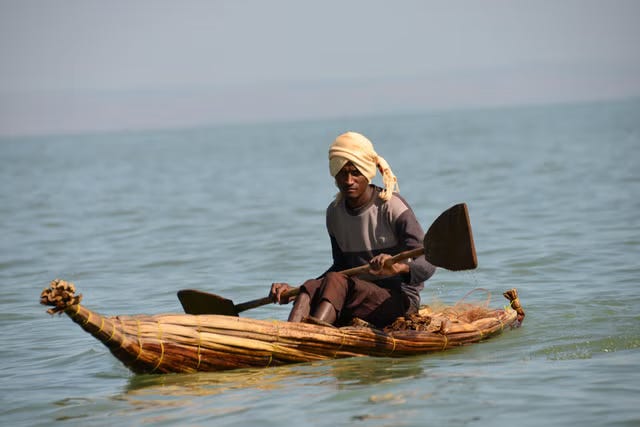
I set off in my little papyrus boat, paddling back to the shore of Lake Tana — full of calmness and confidence.