
Why setting goals are important for self development.
And how we can utilize it in our own leadership development!

Leadership possesses many meanings depending on the source who communicates it and the recipient at the other end who must generate a meaning behind the word. Stogdill pointed out in a review of management research, that there are virtually as many different definitions of leadership as people who have tried to define it (Stogdill, 1974, p. 7). The same can be believed about words like democracy, love, and peace. Although everyone recognizes what it initially indicates, it can possess various meanings for each individual! (Northouse, 2016, p. 27) It should not come as any surprise that it is the same when talking about leadership development, it is something that will be different from person to person.
Nevertheless, some of the procedures will be the same. I will try to explain briefly why it is important to develop own leadership even after graduation. Furthermore, I will go in-depth on goal theory which I believe remains a central theory within leadership development, and explaing why this is such a big part in leadership development.
What is leadership development?
Leadership development is not so different from other areas where development is in focus. It is all about seeking the right questions over and over. For then to reflect on the answers that are given. If you want to be good at kicking a ball, you investigate different ways of kicking it. You may investigate several types of balls and compare the results. What produced the most beneficial outcome? Such fundamental questions are equally used in leadership development. What makes you an effective leader? Are some ways of leading better than others? Does social behavior have something to do with the way we lead? It is by seeking such questions again and again after you have completed some sort of activity. Where you have been in the leadership role or been led by others, that you can start with your leadership development (McCauley, Van Velsor, & Ruderman, 2015).
Unlike kicking a ball that develops a physical muscle in the leg after many enough kicks. As a leader, you want to develop your cognitive capacity to process several impressions at a time. You will be capable to sense patterns in actions and behaviors. Just like kicking a ball, your memory muscles will maintain their rhythm, you do not think about tightening your foot, angling your toe when you kick the ball.
The similar thing happens when you constantly develop as a leader, a lot goes into automation. This is so you can free yourself more from the situation. You think without thinking, just like when kicking a ball. You get both mental and physical leeway to think better about new events and thus lead even better. On one hand, we can therefore say leadership development can be defined to deal with a person’s development of capacity, to be able to be effective in the role of leadership and management over a longer period.
On the other hand, capacity will purely mark the first step in developing yourself and others around you as a leader. Because when you have acquired the capacity to lead over a more extended period, you must also practice what if. Said on another way, you need to obtain a plan for the didactic choices, that you must make as a leader and train yourself in this field (Day & Dragoni, 2014, p. 145).

What’s special with your development?
How should you relate to others around you? How should you communicate? How is your behavior perceived above others? You must consider daily choices that are about how you are observed, and how you should lead. This is not something that comes by itself and must also be practiced. Didactic choices are here than how you make the decision, while your choices that aid you to take that decision will be leadership traits or qualities/tools you as a leader have and can act on.
Early in my education at the Norwegian Military Academy, we were requested to write a gap analysis. This was meant to aid us with a reflection on other arenas, leadership features, or theories that we might lack at the start of our studies. And so, we must become more skilled at them and explore them for our development. At the end and during the studies we look back at what we wrote and discuss our development with other people in the class. Based on this, we can conclude that recognizing how your behavior affects others and how others’ behavior and reactions affect you, is one of the most important success factors for a leader (Sjøvold, 2014, p. 57).
This is just the beginning of your leadership development. You are challenged to look at yourself from other people’s angles and map the gap you find in your leadership style. It is a state between where you are right now and where you will end up. It is only the beginning of the development, as you start to explore the map that is your leadership development, you are constantly discovering new and unexplored areas. If this is perceived in connection with kicking a ball, the differences are there is only one way to kick the ball. You use your legs. When you talk about training a leader, there will always be new moments for how to lead, you work with people and the people is constantly evolving.

I could therefore not stop my leadership development, even when I had graduated from the Norwegian Military Academy. And it is the same for any other form of an academic institution. On one hand, the Norwegian Military Academy provided me with only the modest package that you need of tools to initiate your development as a leader. On the other hand, you are responsible for pursuing the development when you graduate, not only for your own sake but for all those you will lead in the future. This is where goal-setting theory can represent an essential tool to play on for both keeping yourself motivated but also keeping development up to date.
What is goal theory?
The goal theory was first explored and mapped by Locke & Latham. The theory is based on research that says that with the proper goals you can increase both motivation and productivity. The fundamental idea behind this is that the goals we set for ourselves affect our performance, therefore by setting specific goals for a task, it will be possible to increase the result at the other end. Among other things, Locke & Latham managed to demonstrate this in their research by pointing out that when you set goals that challenge you, together with regular feedback on what you do, motivation and productivity will increase.
The theory points out that this applies across professions, from very demanding and complicated tasks that need proper planning and details, to straight forward and simple tasks that can be done in an instance. Therefore, regardless of the profession or position, setting goals can contribute positively to everyday life (Locke & Latham, 2002, p. 706). On the other hand, setting a goal does not automatically mean you increase your motivation and productivity. Among other things, Locke & Latham found that “doing your best” (My best is good enough, and I am happy with that.) goal in some contexts caused the same effect as maintaining no goal at all. The reason for this can be discovered in the goal theory of Locke & Latham.
The mechanisms behind goal theory
To understand the goal theory, we must look at the goal mechanisms. The goal mechanisms describe the benefits one will get from setting goals. To begin with, they say goals help us focus our energy on what matters and divert our focus from other things that are not as important.
Secondly, goals give us energy. Examples of these are goals that you repeatedly have to reach for, challenging goals do not necessarily have clear guidelines on how to achieve them. You are then forced to think in alternative directions and be creative to succeed, and in this process, energy is often created because it is new and exciting.
Thirdly, goals affect our steadfastness, especially if the goal becomes public, it then often becomes a mighty driving force for you to succeed. The reason is by having a goal, there is a greater probability that you stay engaged in the task, in addition, most people do not want to say they fail at something and therefore work extra hard to achieve the goal.
Fourth, goals force us to exploit the knowledge we already have to solve the problem, and if we do not possess the knowledge, we will have to seek new knowledge to develop. Not everyone will experience and have the same effect of the goal mechanisms. This has to do with the type of goal we set ourselves (Locke & Latham, 2002, p. 707).

Setting the perfect goal
For a goal to be effective and you to experience and get something out of it, there are five criteria a goal must meet according to Locke’s goal theory. To begin with, the goals must be specific (Locke, Chah, Harrison, & Lustgarten, 1989), they must be clear and concise so that everyone can understand them. This is not always easy to achieve, so SMART developed by Doran (Doran, 1981) is a good description of how to make sure the goals are specific.
Smart stands for specific choose a specific area or task. Measurable, you should be capable to see a progression in your goal. Attainable, with the tools you have, can you make it? If not how can you provide the tools you need, make sure you want to work for the goal! Realistically, it should be possible and accomplish. Finally, timed, a plan for when it should be implemented. Taken together, these criteria would ensure the goal is specific enough and clear.
Secondly, a goal should be challenging, it should not be ridiculously easy, but also not difficult. A goal that you do not consider you can achieve will decrease productivity instead of increasing it (Drach-Zhavy & Erez, 2002). Third, you must commit to the goal. If you have no ownership of the goal, it will be challenging to sustain your motivation up to complete it. To create a commitment, it is therefore important that you are present when the goal is set. Example goals for a group should be made together, while you can set your own goals yourself (Locke & Latham, 2002, p. 707).
Fourthly, feedback is necessary, without getting feedback on the work towards the goal, it will feel meaningless to many. (Locke & Latham, 2002, p. 708).
Fifth, the task itself must not be overly complicated. Motivation will disappear if there is too much to grip around, and it is, therefore, better to break the task down into small steps, step by step so that it seems feasible (Locke & Latham, 2002, p. 709).

The goal criteria are then related to the results that came from “doing your best” goal, such goals are often unspecific, they possess no kind of challenge. They are difficult to create confidence in because the goal is not something you are passionate about. It has no reference value and are often perceived differently from person to person. When a goal does not fulfil the criteria, the effect will, according to Locke & Latham, be the same as if no goal had been set before.
Goals are to much work, why should I care?
So why should we set goals when it seems so troublesome. On one hand, there are many reasons for this, some of which are that goals aid you focus the spotlight on what is important. Goals make you endure longer in a type of work task and help you grow into the challenge. These are all good topics that will be helpful both during and after tough work situations or development arenas.
On the other hand, there is a flip side to goal-setting theory. Goals can hinder group or teamwork. It can encourage workers to put the spotlight on their tasks and prevent them from working together or supporting each other in the future. This happens since goal theory often takes its starting point in an individual and not a more massive group.
Your own goals will therefore be able to come before other people’s goals, simply because you want to achieve your own goal. This becomes especially clear when the achievement of a personal goal may be associated with a form of reward. One way to prevent this would be to prepare two types of target groups. A group that takes and makes goals for the individual and a group that produces goals for the rest of the team. This will work if the goals of the community do not destroy the individual goals, but rather link these two together. (Locke & Latham, 2002, p. 712)

Let us see it in practice
The Norwegian Military Academy school as an example maintains a clever approach to how the goal theory is used in practice. Let us go back and look at the gap analysis. It provides us the opportunity to explore aspects of ourselves that require development at an early stage. Based on the findings here, group, and personal goals are set for the development of us as leaders.
During exercises, these goals are reinforced in a personal action plan for one’s development for the specific exercise. In addition to this, the teams gather and prepare a joint action plan based on what the team can do to perform better, and goals are thus prepared for the group that is also in harmony with their own goals.
This means that the risk of getting blinders due to your own goals is reduced. Goals, in other words, will support you on the path to developing yourself as a leader, but are not necessarily crucial to achieving the desired leadership development.
You create goals unconscious
Setting goals can therefore be argued to be an essential part of leadership development. On one hand you have a conscious goal and on the other hand you have an unconscious goal. When you want and develop yourself as a leader, you frequently automatically set goals for the day to come.
It can be straightforward things, like that today will I smile when I encounter someone in the hallway. Or today am I going to complete the research paper on motivation for employees. These are unconscious goals that you automatically frequently generate for yourself, and that often requires little or no work to set, as they are simple and natural for you.
A conscious goal is when you have discovered a specific thing or task that requires work. You then spend time and effort finding the proper goal, to develop a specific side of your leadership style. What separates the results in these two situations is how much work, and effort is put into the development of yourself as a leader.

What is the best strategy then?
Locke & Latham’s theory mentions nothing about the fact that there will be no progress if goal theory is unused. They only say that it is a noticeable effect or an increase from what it has been before. On one hand, you can therefore develop properly as a leader without having a goal theory at the bottom. It will only go very slowly or possibly you will focus on the wrong topic for your development.
On the other hand, with the goal theory, you will be able to ensure you focus on the right topics. And that you have more genuine progress than without, see figure 1. Finally, you must also look at what is the desired effect in your leadership development, the result at the other end must be clearly defined.
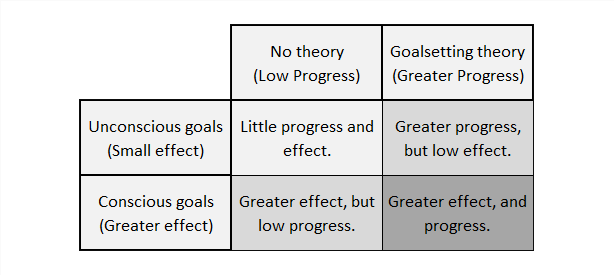
If the result is a result of an unconscious goal, it will be straightforward and achievable, but give little effect at the other end. On the other hand, if it is a proven goal, it will cause a greater effect, but perhaps not as quickly as if you had used the goal theory to set it. Goal theory is thus not crucial for you to achieve the desired leadership development but is a good tool that should be used to develop you more clearly, simply and more effectively as a leader.
How have it affected me?
Setting goals for myself so far in my career has been a tool not only to give up, but also to maintain a clearly desired result at the other end. This is so that I know that I am developing in the proper direction.
Goal-setting theory has become an effective tool not only for me but also for those I lead. It is not only me who will develop, but also those I lead. On the one hand, by utilizing the theory actively within-group processes, will I be able to ensure that the group I lead works better together and I can more easily set a direction for them.
However, I do not see goal-setting theory as a marvel that solves all problems. Much of leadership development takes place in the form of reflection and own thoughts. On the other hand, the result of such reflections and thoughts will frequently lead to an area where have to work on to improve me. This is where the goal theory can be helpful, if the problem is big I can divide it into smaller pieces, and take one step at a time to slowly but surely approach the goal.

Summarizing it all up
Goal theory is first, a tool and not a solution for establishing direction and efficiency for one’s leadership development.
Secondly, for it to be effective, you need to see it in the context of proven goals that require analysis and planning.
Third, with the help of transformational leadership, you can provide a better environment for goal-setting theory in those you lead.
Fourth, goal theory remains an effective tool for you when you need to work on a more significant topic for your development.
Do you think this was thrilling and want to read on? On that occasion I recommend you look at some of my other articles on leadership. Over here are some examples you might enjoy.
And last make sure you give this post 50 claps if you enjoyed this post and want to see more.
Reference
Day, D. V., & Dragoni, L. (2014). Leadership Development: An Outcome-Oriented Review Based on Time and Levels of Analyses. orgpsych.annualreviews.org: Annual Reviews.
Doran, G. T. (1981, November Vol. 70, Issue 11). here’s a S.M.A.R.T. Way to Write Management’s Goals and Objectives. Management Review, ss. 35–36.
Drach-Zhavy, A., & Erez, M. (2002, July Volume 88, Issue 2). Challenge versus threat effects on the goal-performance relationship. Organizational Behavior and Human Decision Processes, ss. 667–682.
Locke, E. A., & Latham, G. P. (2002, September Vol. 57, №9). Building a Practically Useful Theory of Goal Setting and Task Motivation. American Psychologist, ss. 705–717.
Locke, E. A., Chah, D.-O., Harrison, S., & Lustgarten, N. (1989, April Volume 43, Issue 2). Separating the effects of goal specificity from goal level. Organizational Behavior and Human Decision Processes, ss. 270–287.
Matthiesen, S. B. (2014). Transformasjonsledelse, ekstrarolleatferd og innovasjon. Fagartikler, ss. 35–45.
McCauley, C., Van Velsor, E., & Ruderman, M. (2015). Introduction: Our View of Leadership Development. eBook Collection : EBSCO Publishing .
Northouse, P. G. (2016). Leadership — Theory and Practice — 7. edition. Thousand oaks: SAGE Publication, Inc.
Sjøvold, E. (2014). Resultater gjennom team. Oslo: Universitetsforlaget.
Stogdill, R. M. (1974). Handbook of Leadership: A Survey of Theory and Research. New York: Free Press.


