
Why Senior Doctors and Healthcare Administrators Should Follow Popular Doctor Meme Pages
If administrators think meme pages are purely a bunch of silly posts by “shit-stirrers”, think again.
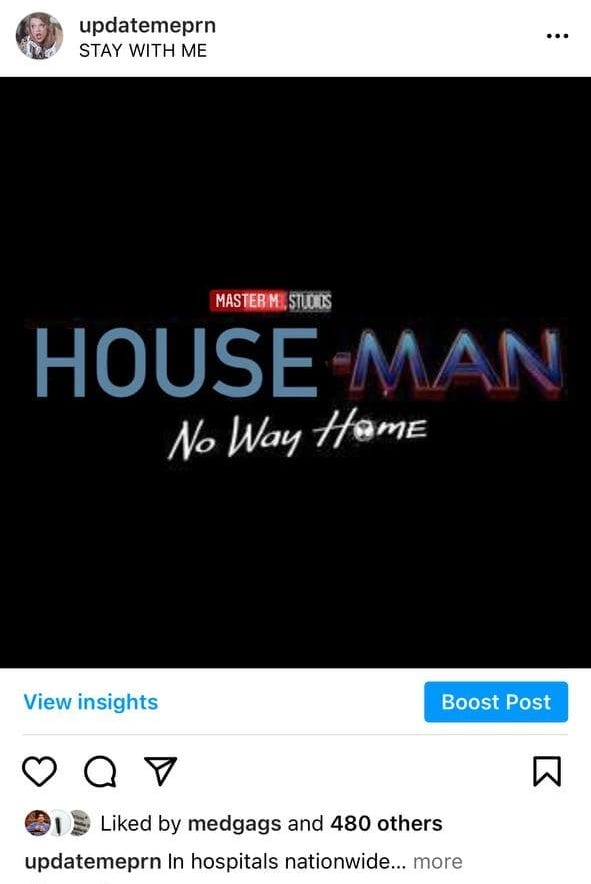
2022 began on a rather hopeful note for Singaporean doctors, as the national broadsheet finally picked up the issue of junior doctors’ welfare. The Straits Times published articles such as “It may be time to review junior doctors 30-hour shifts” and “My brain kind of stops functioning: Long working hours leaving young doctors exhausted” in February 2022. While these same issues were highlighted much earlier by smaller independent news companies such as Rice Media and The HomeGround Asia, they did not gain as much traction due to the smaller audience numbers.
Unsurprisingly, the articles by the Straits Times which highlighted the struggles of junior doctors generated a lot of discussion in both the public and medical circles. While the public’s response was largely sympathetic, the medical circles were more divided in response. In fact, several doctors who left for the private health sector wrote to the Straits Times Forum, articulating their views on the matter. Some highlighted that members of the public were overzealous in insinuating that it was due to the medical community being “resistant to change”, others continued to reinforce the narrative that “night duty (is) an invaluable part of house officers’ medical training” and even hinted that such outcries on the plight that junior doctors faced were puzzling. Dr. Yik Keng Yeong’s letter, dated 11 February 2022, in particular, seemed to bemoan this as a non-issue. He wrote to the Straits Times Forum, expressing his surprise:
In some closed medical Facebook groups, these sentiments were shared by some senior doctors and healthcare administrators, highlighting that their past experiences were worse, and in less kind words, admonishing junior doctors who were partaking in such discourses as “shit-stirrers”. More explicitly, senior doctors in administrative positions began calling out popular doctor meme pages such as @updatemeprn for being the main “shit-stirrers” who only represented a small minority of disgruntled voices. After all, what can be learned from meme pages when memes have traditionally been the Internet’s medium to provide entertainment to digital natives?
Memes: When Art Mirrors Life
For the uninitiated, the idea of memes was first introduced in 1976 by Richard Dawkin. It was intended to express the idea of an “ideological counterpart to genes: like how a gene (such as for brown eyes) spreads through sexual selection and physical fitness, a meme (such as the idea that the earth orbits the sun) spreads through social selection and ideological fitness” (McCulloh, 2019). The reference to memes on the Internet evolved to represent multimodal texts that were imitated and then adapted. Each replication followed a template and could have multiple intertextual and indexical meanings. Contrary to popular belief that creators and consumers of memes are illiterate and silly beings, Gretchen McCulloh, a Canadian linguist and author of the book, “Because Internet: Understanding how language is changing”, highlights that meme creators and consumers needed some deep cultural understanding and technical know-how. More importantly, memes function to provide humour and is a means for creators to express their opinions and views on the Internet.
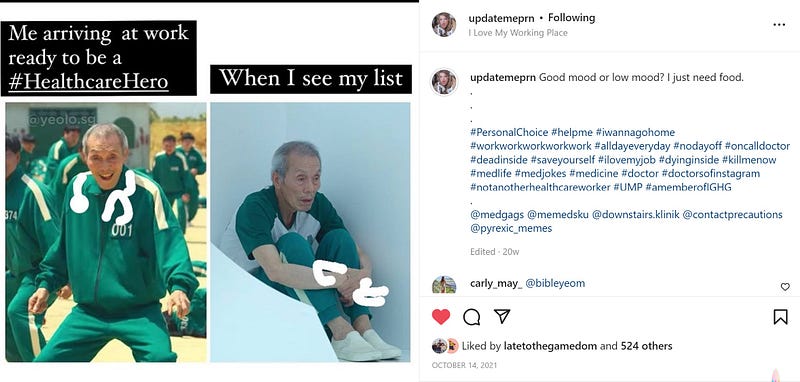
Take an example of the meme created by the On-Call Doctor above which garnered 525 likes, and 11.1k views. It takes a scene from the popular Korean show, “Squid Game”, and contextualises it to their experience as doctors in the Singaporean system. The creator borrows a popular hashtag, “#HealthcareHero”, referencing the nation’s attempt to express gratitude for the many sacrifices that healthcare workers made during the pandemic, and even adds on a doodled stethoscope. The first panel of the meme expresses their sentiments as doctors — the energy and hopefulness they feel arriving to serve, and the second panel exemplifies n the utter feeling of hopelessness and defeat when they “see their list”. This list doesn’t refer to the names of patients — it refers to the overwhelming number of patients under their care at the start of the day. This entails performing history-taking, doing all necessary checks and admits before the consultant arrives. Dr. David Yung, medical officer, explains, “It isn’t just about seeing all the patients on the list, but needing to be thorough and to know each of their stories inside out before the consultant arrives”.
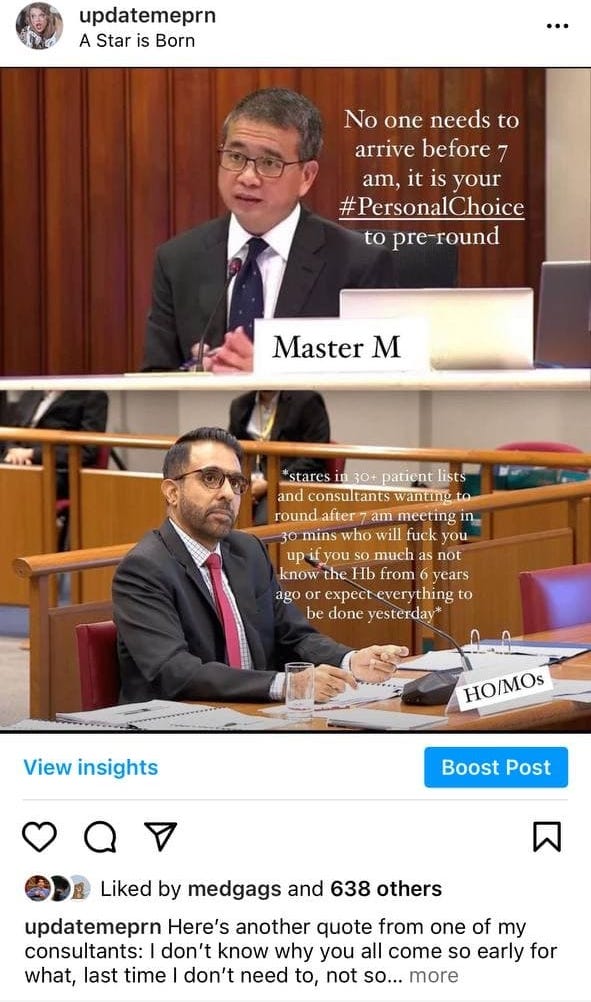
Take another example above which tapped on Singapore’s current affairs. The classic moment between People’s Action Party’s (PAP) Edwin Tong and Workers Party’s (WP) Pritam Singh sparring during the Committee of Privileges Hearing turned into great material for meme creators, and the On-Call Doctor was no exception. The meme highlights the power asymmetry that junior doctors feel, similar to that exhibited by the situation experienced by Mr. Singh against the seemingly all-powerful PAP. It also rides on the public’s sentiment that Edwin Tong’s accusatory style of questioning and explicit attempts to frame a particular narrative, was something that junior doctors similarly felt with “Master M” (i.e. Ministry of Health Holdings). It reinforces the message that the “master” is out of touch with the ground and has little understanding of what goes on in the daily experiences of junior doctors.
Such memes, while entertaining, are also highly informative. They depict the doctor’s mental state, their inner emotional experiences, and struggles. More importantly, the number of likes and engagement with the posts are highly revealing — they can be good indicators of what experiences and thoughts resonate with other doctors and healthcare workers, and can give a pretty good picture of the sentiments felt by most junior doctors.
Why are doctors running meme pages instead of going through official channels?
Administrators and senior doctors will likely have this question burning on their minds. Why run a seemingly silly page instead of actually talking to people who can make the changes? While it may seem like an act of “shit-stirring”, perhaps it may be more helpful to examine the senior doctors’ predominant beliefs about the junior doctors of today. If they truly believe that all junior doctors want to do their best job and the patients are at the center of all they do, the assumption that junior doctors are “lazy”, “entitled” and “shit-stirrers” become labels that are too simplistic and do not lead to the heart of the issue.
In 2021, The HomeGround Asia conducted a survey with junior doctors and it revealed some reasons about why official channels were not a popular platform for feedback. The article states, “All the doctors who submitted feedback indicate that the responses they received often fell into the following categories: accusations of personal inefficiency; manpower constraints; rerouting the doctors back to their own teams to settle it internally; and being told that it is “part and parcel” of the job.”
So if official channels were not working, why meme pages then? To dig deeper, we spoke to On-Call Doctor (@updatemeprn) to find out more.
Case In Point: The UMP Origin Story
It was New Year’s Eve in 2020, and that was the day that @updatemeprn was born. UMP shared that it was a day of mixed emotions: they were happy for getting the day off (the first in a long time), and also dreading work the next day because of the long list of patients and lack of manpower.
When asked about the reason for starting the meme page, On-Call Doctor (more colloquially known as UMP) shared,
“I was finishing up my [redacted] posting, and was feeling so crappy because I could not take any Annual Leave. I needed an outlet to channel that frustration and turn the depressing experiences into something more fun. It was supposed to be like my diary, and I didn’t expect it to gain so much traction.”
The choice of the name, “updatemeprn” was an ironic twist and subtle nod to the unrelenting number of phone calls medical officers had to take while serving patients. According to UMP, “Update me pro re nata” (pro re nata (Latin): as needed) or update me PRN/review PRN, “is a shorthand for doctors when handling patient referrals.” The Instagram handle, relies on fellow doctors’ ability to sense the irony — UMP really only wants to be called “only as needed”.
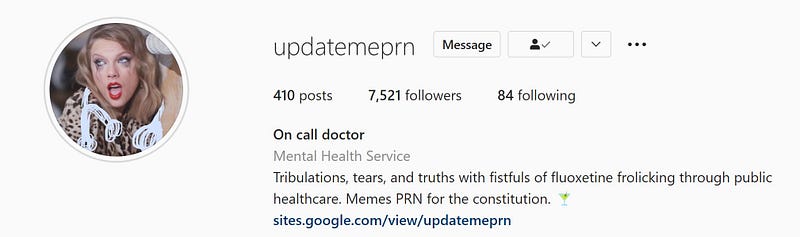
On using Taylor Swift’s signature look in her music video, Blank Space, UMP shared, “I’m a big fan of Taylor Swift and the desperate look with the running mascara and the slight craziness in the eyes was exactly how I felt.” Apparently, UMP was not the only one who felt this affinity with Taylor Swift’s classic look that was borne out of a painful phase of being criticised and canceled. They shared, “a lot of people messaged me to tell me that they also resonated with Taylor’s look — the desperation, the exhaustion, the tears — that characterised our experience as junior doctors.” More so, UMP’s mission with the Instagram account was inspired by Taylor Swift’s Blank Space. Instead of dwelling on the negatives, UMP wanted to take all the criticism and negative experiences and “turn it into something creative, fun, and quite uplifting”.
When asked how they managed to update the Instagram page so frequently, UMP shared,
“I have a bank of memes I create. I post and create during pockets of free time — while waiting for the consultant to arrive and in the twilight moments before I sleep. I use Instagram stories to create as it is really fast, and I guess I am not short of inspiration when I experience so much in the hospital.”
When the meme page turned into advocacy
Interestingly, UMP’s page gained such traction (the current number of followers stands at 7,521 followers) that it became a fertile ground to organise efforts to help the junior doctor community, and organically became a place for community building.
UMP became a pseudo-rights activist, educating fellow officers on call pays, notices on phishing emails, and even organises a helpful Excel sheet every 6 months to facilitate swapping of medical postings for all medical officers.
On top of these efforts, UMP became a place for organic community building. UMP took on the role of part-time counsellor to fellow healthcare workers who would readily share their negative experiences, and even advise aspiring medical students. This ranged from discouraging remarks made by senior doctors, to exposing some hospital practices of using sick leave as a method to penalise officers. A key part of why such community building works is due to the Internet’s unique offering: anonymity.
UMP shared, “I think that it can be hard to tell others about your experiences when they know you.”
While anonymity can be a double-edged sword, it seems that it provides more benefits in the medical context. Some may question the credibility of the experiences and information shared on anonymous accounts. However, in professional circles where the jargon and quirks of the job are so unique and require a reader to have gone through the same training and experience to understand it, credibility is hardly an issue.
Secondly, as the unspoken rule of such anonymous meme accounts is often that of a two-way respect for anonymity, it created a safe space for other doctors to share their experiences. UMP explained, “some would also ask me to organise polls or to share their own experiences in my Instagram stories, and in response, many would respond in kind, sharing their experiences and helping others to feel less alone in their experiences”.
Dr. Kuhanesh Jarnardanan, one of UMP’s followers, shares his thoughts on UMP’s Instagram page. “I’m not a fan of memes in general. But I do applaud the boldness to advocate for the difficulties junior doctors face on the ground. It highlights the collective need for more open and transparent discussion between all stakeholders.”
UMP is not the only popular meme page. In fact, the millennial healthcare workers have formed a community of healthcare-focused Instagram accounts ranging from @medgags, @thehonesthealthcareworker, @sgnightingales (for nurses), @pyrexic_memes (for other doctors) and @memedsku (for current medical students). Together, they work almost like a hive mind, gathering and informing others of unfair practices, and sharing stories to advocate for better support systems for all healthcare workers.
What Healthcare Administrators Can Gain from Memes
Apart from getting some daily dose of laughter, following such meme pages would provide key data for administrators. These memes are rich — they tell the stories of hidden frustrations, and careful analysis of the memes and the level of engagement can provide an excellent roadmap to fix some of these issues.
For example, which are the low-lying fruits that can immediately help healthcare workers to feel more taken care of? A quick run through meme pages shows one: anti-phishing emails. While it is key to train doctors to be more careful with data security especially since they deal with sensitive information, perhaps the content of these anti-phishing emails could be revised. Apparently, some of these anti-phishing emails contained promises of Starbucks Gift e-vouchers and vacation offers. It isn’t the anti-phishing emails themselves that drive doctors up the wall: the content itself hits at some of the most basic needs of doctors — food and rest, both of which the pandemic had robbed them of.
Next, it also provides great qualitative data on how strategic communication can be planned with doctors. What are the emotional pain points? What are some areas that can be reinforced to make things better, and to make junior doctors feel valued? Dr Mythili Pandi, a family physician at The Integrative Medical Centre, shared that she follows UMP’s account and other doctor meme pages. She says, “I like to have a feel of what’s happening on the ground. These meme pages help me to glean some information about how stressful it is, and the general psychology of the doctors.”
“While much of their experience isn’t that different from my experience as a medical officer, there is not the added stress of Covid-19. However, it doesn't mean that [the treatment of junior doctors] is right. Doctors need to be entitled to their rest. Only if they are properly rested can you expect to get good medical management. Obviously, stress and sleeplessness affect judgment and patient care. And that’s exactly what I stand for in my practice”, Dr Mythili Pandi said.
Last but not least, following these doctor meme pages could provide healthcare administrators with a way to police unhealthy and illegal practices in hospitals. A simple daily check would give you a heads up on which hospital management teams need to be further guided, and which are coming down particularly hard on both doctors and nurses.
So instead of seeing these meme pages as silly pages, shift your lens — they can become great assets instead.


