
Why Self-Compassion Is Worth More Than Self-Esteem
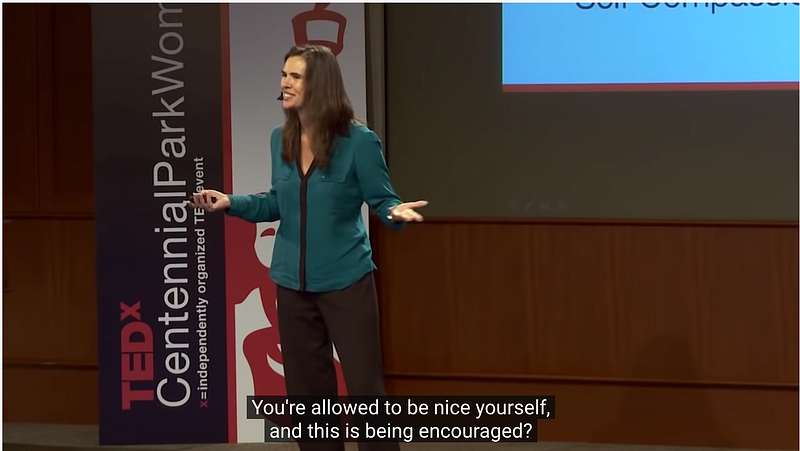
My take on Dr. Kristin Neff’s inspiring TEDx Talk
Mistakes are an inevitable part of life. But what is the secret to learning from them and moving on quickly?
If your first guess is self-esteem, try again. According to Dr. Kristin Neff, the answer is self-compassion.
Dr. Neff is a proclaimed “self-compassion evangelist.” And she’s so passionate about the subject of self-compassion because has seen its power in her own life.
Her first introduction to the concept was in 1997 while finishing up her Ph.D. at UC Berkeley. She had just gone through a messy divorce and was having an overall hard time, berating herself with shame and self-judgment. This was on top of all the stress of finishing her degree and the looming fear of uncertainty about getting a job afterwards.
So, she thought this would be a good time to try meditation. She found a local Buddhist meditation group, and the very first class, the woman leading the group spoke on the importance of compassion. It was a light bulb moment for Kristin Neff.
She was familiar with the concept of compassion, but for yourself? The thought of bringing herself into that circle of compassion and treating herself like she would a friend was life-altering. It hadn’t occurred to her until then that she could actually be nice to herself.
Of course, this raises the question of why we tend toward self-criticism rather than compassion.
Does self-criticism serve a function?
Many of us believe we need to criticize ourselves. If we aren’t harsh with ourselves, we risk becoming self-indulgent and lazy.
But is this actually true?
According to Dr. Neff, research shows otherwise. Self-criticism actually undermines our motivation. The way she explains this is that it taps into our “reptilian” fight, flight or freeze response.
We feel threatened and so we attack the problem — which is ourselves. This results in high levels of stress, and if it goes on long enough, our body will eventually shut itself down with depression, which we all know isn’t a great motivational space to be in.
Self-esteem can be a problem for similar reasons.
Consider first of all that in American culture, to have high self-esteem you have to feel special and above average. In our society, it’s really not okay to be average. Being told your performance or accomplishment is “average” feels like an insult.
This is a problem because we can’t all be above average. It just can’t happen. The math doesn’t add up. So we find ways to puff ourselves up and put others down to feel better about ourselves in comparison. Low self-esteem is problematic for obvious reasons, but high self-esteem is also problematic because of how we get it — by elevating ourselves above others.
Narcissism comes out of this, as does bullying, prejudice, ethnic and political superiority, and on and on.
Self-esteem is all about judgement, and it’s contingent on success. With self-esteem, we can only feel good when we succeed. So when we fail, we feel lousy.
And for women, this is especially hard because society teaches us to put our self-esteem in standards of beauty. Studies show that up until around third grade, both girls and boys accept their appearance. This remains fairly constant for boys through high school, but it starts to take a nosedive for girls as early as third grade!
What is self-compassion?
Self-compassion is not a way of judging ourselves positively instead of negatively. In fact, it’s not about judging at all. It’s about relating to ourselves kindly and embracing ourselves, flaws and all. According to Dr. Neff, it has 3 key components.
1. Treating ourselves with kindness versus harsh self-judgment.
2. Acknowledging our common humanity by looking for similarities with others and accepting imperfections of ourselves and our overall lives.
3. Being mindful of what is in the present moment, which means noticing and also validating our suffering in order to view ourselves with compassion.
How do we treat ourselves with compassion?
Instead of judging and criticizing ourselves, and berating ourselves when we don’t measure up—Dr. Neff recommends tapping into what we she calls the “mammalian care-giving system.” This includes warmth, gentle touch, and soft vocalizations, which release oxytocin and feel-good hormones.
Studies show that when we feel safe and comforted, we are in an optimal mindset to do our best.
So, next time you have some harsh words for yourself, see if you can reframe and instead speak to yourself like you would a friend. Wrap yourself in a warm blanket, put a hand on your own shoulder, and speak to yourself gently and lovingly.
Researched studies on self-compassion show overall that it is very strongly related to mental well-being. People who practice self-compassion have less anxiety, less stress and less of a drive toward perfectionism. They have greater happiness, life satisfaction, make healthier lifestyle choices and form better interpersonal relationships.
Self-compassion has the benefits of self-esteem without the pitfalls of narcissism. It provides a more stable sense of self-worth because it’s there when you fail, stepping in exactly where self-esteem leaves you.
You already know what you say to a friend who is struggling and how to provide the needed comfort…now just do that for yourself.
Take good care : )
Meg
Sign up for my free Practical Pathways to Inner Peace course here.You can also find out more about Dr. Neff and her passion for self-compassion. And watch her TEDx Talk below.