
Why Saying ‘I Love You’ for the First Time Feels So Vulnerable
I felt like I was deliberating at the top of a high dive with no guarantee of a soft landing.
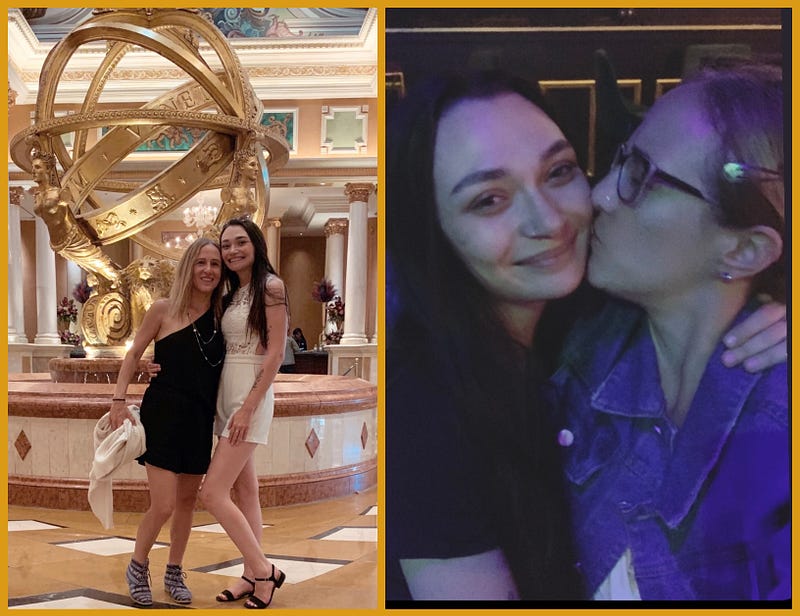
My girlfriend and I had just spent a lovely day wandering through caves and sipping coffee next to roosters. We’d shared a gluten-free pizza while looking up at the stars from massive rock formations in the ghost town of Columbia. Now back at her house, Spotify was turned to a compilation of early 2000s pop ballads. We danced in her room as her chihuahua and torty cat slept bundled into cushy balls on the bed beside us.
She and I had been dating for two months at that point, and I wanted to tell her I loved her— but the words just wouldn’t leave my mouth.
Why does the thought of it make so anxious? Why does it feel like jumping off a high dive with no guarantee of a soft landing?
Saying “I love you” for the first time can feel daunting for anyone. Part of the apprehension comes from what Lacey Johnson described as “fear [of] inciting a re-creation of the dreadful moment in Sex and the City when Carrie impulsively blurts out an awkward ‘I love you’” (after Big gifts her a crystalline duck-shaped handbag). In response he mumbles, “You’re welcome,” and swiftly flees the scene.
A similar exchange plays out in the mid aughts show The O.C. Marissa whispers the words into Ryan’s ear, only for Ryan to pause before offering back a stilted, Thank you.
According to psychotherapist Jenn Mann:
“Too many people declare their love during the honeymoon stage, which is primarily the first six to 18 months of a relationship. During this phase, many people are blinded by the excitement. This isn’t necessarily a bad thing, because you should enjoy it, but don’t be too quick to call it something it hasn’t had time to become.”
I’d never said those words out loud to anyone– at least not in a romantic way. I’d said it to close friends, sure. Family and I expressed love for each other often. My sister and I heard it consistently growing up, too.
The only time someone had said I love you to me in a romantic way, I was 18. The woman was my 24-year-old girlfriend. I didn’t say it back though; I was young and unsure she was “the one.”
Months later I formed a connection with a girl who lived in another state. After we both wrote it to each other in a letter, I flew to her city to discover it wasn’t true love in the slightest. The girl had fallen for an idea her mind had created of me, without having ever really seen or known me at all. She’d been looking at herself the whole time. To some extent, we’d both been.
My relationship later in college was marred by tension and drama brought on by our joint unresolved baggage. I had mixed feelings throughout it. Yet still when I knew the end was coming, I convinced myself I loved her. The feeling stemmed more from the intensity, fear of loss, and anxiety surrounding it all than from genuine love.
Though I ended up expressing love to her, it was in writing, and after we’d already broken up. Like Ryan on The O.C., she thanked me for the sentiment. My girlfriend in 2018 and I never said I love you either. We were briefly exclusive, but our relationship quickly fizzled once the courting phase ended.
In short, I’d never expressed love in past relationships not because I hadn’t wanted to, but because the connections had never arrived at a place where confessing it would have felt appropriate. At worst the “I love you pie” would have been thrown back in my face — or left at the doorstep to rot. For these reasons, I lacked the muscle memory of having said the words aloud. When you’ve never steered a ship, it’s daunting to press the lever that will release it from the port and send it on its way — no matter if the waters that await it thrash with uncertainty or hold every sign of remaining calm from where you stand.
The internal tug-of-war continued for a month or so more. I wanted to say it when parting ways after visiting my girlfriend’s home in Gold Country for the first time, about a month and a half into our relationship. Instead, I sent her a song that merely hinted at the sentiment.
I wanted to say it when we were laying in bed with the lights turned off after watching My Big Fat Greek Wedding. My heart had sounded like horse-drawn carriages during the scene where John Corbett first professed his love to Nia Vardalos. Their characters had reached through the screen and shone a giant bright onto it, exposing me.
But still the feeling stayed packed inside my heart. I wanted to say it when we arrived an hour late to a concert after buying dinner for a chatty homeless woman. Every time I considered confessing it though, my brain found some reason to veto the circumstances. I wanted to know if other people had dealt with similar apprehension. Did any of them take this as seriously as I did? I asked a good friend from college when she and her college boyfriend had first said it.
“Six weeks,” she answered. “We were dancing in the kitchen. It just felt right.”
I inquired with my mom, who said it “didn’t take [her] long because [she] knew fairly early on that [my] Dad was different from the other scoundrels [she’d dated].”
I queried Google, and they connected me with sex and relationship adviser Barbara Santini, who informed me:
“Recent studies indicated that most men say I love you on average after three months, while women can take two, three, six or even a year. This is not always the case as others utter these heavy words after hours, days, of knowing each other.”
“Just say it when it feels right,” my friend gently suggested. “That time will come.”
My girlfriend and I finally exchanged I love you’s at a gay bar on a trip to Vegas, three and a half months into our relationship. An orange-red phoenix spread its glorious wings across a mural on the walls that surrounded us. Vivacious queers sang ‘90s and early 2000s karaoke tracks. Our jovial bartender wore a rainbow bow-tie and complimented our matching red outfits.
Earlier that day we’d made wishes in the fountains at the Bellagio. She later told me that hers was for me to say I love you back to her. Her thought process had been similar to mine, I discovered then. She’d wanted to say it for a while but had worried about coming across as too intense by confessing too soon. She’d wanted to make sure she “wouldn’t scare me away” — because she actually saw a future together.
I’m glad we both said it, because as Belinda Luscombe put it in Time Magazine:
“Humans have a need to love, and to avoid meeting that need is to eliminate a key part of your humanity. Homo sapiens are herd animals who pair bond. So while it’s risky and dangerous to trust, it’s also one of the most exhilarating parts of belonging to the species.”
I think my initial cautiousness shows me just how seriously I take those words. I feel their weight. I understand how often they’re tossed out too soon. By love bombers, for one. By teenagers who treat love not like a marathon or slow-burning fire, but more like a full-force sprint, intense and over in less than a minute. By drunk people who yell it after an hour, knowing little about you beyond your first name and tipsy conversational style.
Even having taken a few months to say it, I think there’s a distinction between expressing love and practicing what it embodies. My girlfriend and I were practicing love for months before putting words to it. I felt it in her actions, and communicated it through mine. Even if it would a couple more months to actually say.
I say I love you every day now. It feels as natural as drawing the blinds, brewing the coffee, feeding the cats, and taking a hot shower at bedtime. It no longer feels daunting. It feels comforting and long-awaited. The words feel like home. And I plan to keep saying them and practicing what they embody for as long as I still can — regardless of what tomorrow brings.
I can say now with confidence that it was well worth the wait.