

Why Saving Money Feels Pointless
We all have fond memories of buying our first Gameboy, bicycle, or fancy pair of shoes with the money we saved in the kitty.
From a young age, my parents taught me the importance of saving, and money in general.
They taught me how to appreciate the value of items, and that to obtain them, we must save studiously.
I highly suspect this sounds familiar to the majority reading it. Some of you may still follow the advice of your parents, but others may have started to question the effectiveness of saving.
Today we interrogate this question; should we bother saving, and why does it feel so damn useless to save?
Should we save?
The short answer is yes. Of course!
The nuanced answer is, well, nuanced.
Having savings is essential for any emergency that may crop up. Our savings are our most liquid asset; money is the most liquid asset, as its function is to be traded for other goods.
Illiquid assets such as stocks, gold bars, and houses (from most to least liquid), are examples of assets that should not particularly be used for emergencies.
So, it is important to save money, to a degree, as it allows for the unfortunate eventualities of life to be covered.
Can you save too much?
Surprise, surprise, the big banks do not save the money you deposit, they invest it elsewhere.
If you are prepared to learn, you can become proficient in financial markets and investing, or delegate the task to a professional and put your savings to good use.
Whilst this is fundamentally true, it is not the main point I wish to highlight.
Inflation
Inflation eats away at your savings and corrodes your hard-earned cash.
We are all aware of the inflationary climate that has swept across the globe post covid, however, the situation is far worse upon inspection.
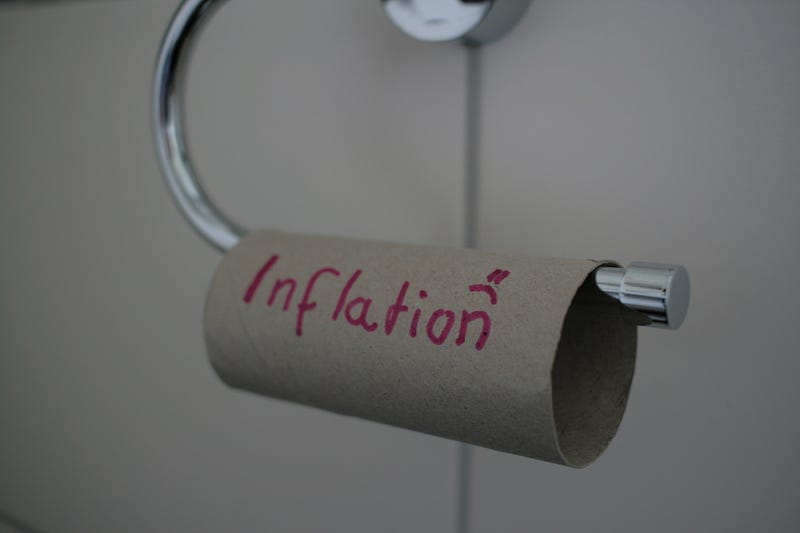
Hidden Inflation
Hidden inflation is primarily caused by the monetary policy strategy, quantitative easing (QE). In which governments print, or create digitally, money that is used to fund government policy.
In addition, inflation is generally referred to as the consumer price index (CPI) figure. However, the basket of goods encompassed within can be manipulated and has been so for decades.
The result is that inflation is far worse than the government reports; therefore, it feels worse than it appears.
The origins and function of QE policy; such a topic requires its own article.
Purchasing power
You must become more aware of your overall purchasing power, rather than the inflationary statistics (CPI) reported on every news channel and outlet.
In simple terms, your purchasing power is the amount of goods or services you can purchase with a unit of currency.
Secondly, care only about the rate at which the assets you wish to own are increasing, not the CPI. As the CPI is unlikely to be a basket perfectly crafted to your needs and desires in life.
How Does This Affect My Savings?
The problem is that the rate at which the assets we care about increase, is far greater than the CPI, and thus, far higher than the interest rate our banks provide.
So, if you are to solely save your whole life with the belief that you will be able to afford these “dream assets”, you may be disappointed to find otherwise.
It is this hidden inflation, and impact on our purchasing power, that makes saving feel hopeless.
The solution?
Utilize a proportion of your savings to yield a higher return than the rate at which specific “dream assets” increase.
How?
That is the million-dollar question, let me know when you find out!
I hope this article was useful. If you wish for me to explain any of the concepts in depth, please comment below!


