
Why Russians Have Three Different Ways of Saying Someone Died and Why Only One of Them Accurately Describes Navalny’s Death
Умереть, скончаться, погибнуть: what’s the difference?
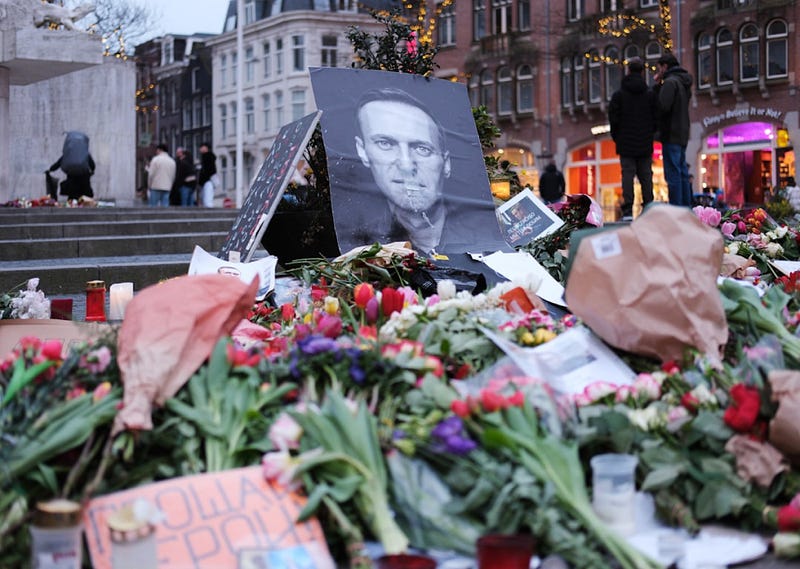
There are three different ways to die in Russian. No, I’m not talking about political assassination (in that case, the list would be much longer…).
I’m talking about the possible translations of the verb “to die,” and why that matters in regard to Navalny’s death.
During a series of interviews conducted by Navalny’s team during his funeral in Moscow, many people were asked why they chose to come and pay their respects to Alexei, thus defying the Kremlin’s intimidating warnings against “unauthorized protests” on the day of the funeral.
One of those interviews stood out for me.¹ It features an unaccompanied elderly woman holding a bouquet in her arms. Upon being asked “Why did you come here today?” she responds in the following way:
“Потому что Алексей хотел дать мне свободу, но он погиб. Я думаю, что Юлия подхватит его знамя и понесет дальше, и я на это очень надеюсь. Алексея хочу поблагодарить за его жизнь, такую, которую он нам отдал.”
Translation (by the author):
“Because Alexei wanted to give me freedom, but he died. I think that Yulia [Navalny’s wife] will pick up where he left off and keep going, I really hope so. I want to thank Alexei for his life, which he gave us.”
One of the things that stood out for me in the lady’s answer was her word choice. Specifically, the way that she phrased the sentence “He died”: “Он погиб” (“On pogib”). Let’s see why.
The general verb used to translate the English “to die” in Russian is умереть (“umeret”). Like many other European languages, it takes its root from the Latin “mors,” meaning “death,” and, just like its English equivalent, it doesn’t contain any specific connotation about the circumstances of one’s passing.
Скончаться (“skonchatsa”) is the second, less “vivid” and more implicit way to say that somebody passed away. In fact, much like the English “pass away,” it doesn’t actively describe the act of dying. The root is that of the verb кончать (“konchat”), which means “to finish” or “to end,” but the reflexive suffix -ся is added to it, indicating that the action is affecting the person themselves. And, finally, the prefix -с gives the sense of an outward movement: the expression сходить с ума (“skhodit s uma”), which is equivalent to the English “to lose one’s mind,” literally translates to “leaving/exiting one’s mind.” So, the verb скончаться conveys the idea that somebody died but expresses it in a “gentle” way, as if to say that somebody reached the natural end of their life cycle.
Скончаться was the verb used by many Russian headlines once the news of Navalny’s death first broke out, which was an apt choice because this particular verb describes the act of passing away whilst not specifying the circumstances surrounding the person’s death.
Скончаться also bears a striking resemblance to the expression уйти из жизни (“uiti iz zhisni”), which literally translates to “leaving/exiting life” and is also closer to the English “pass away” in that it implies a non-violent and most likely natural death. Unsurprisingly, “ушёл из жизни” (“he passed away”) were the words chosen by Vladimir Putin when he finally addressed Navalny’s death on March 17th, more than one month after his main opponent’s sudden demise, to describe the event of his mysterious death in a Russian Federal Penitentiary.²
By contrast, the verb погибнуть (“pogybnut”) is usually employed to indicate a violent death, such as one that took place during combat or an accident. It can also be translated as “to perish” or “to be killed.” And because of its frequent use in relation to war veterans, there is an almost intrinsic sense of honorific sacrifice attached to it.
“Погиб” (“pogyb,” meaning “he died”), as the old lady says in the interview, is used to describe heroes. Those who sacrificed their lives for a greater cause. Like Alexei did.
¹ Watch the video here.
² Watch the video here.
Want to keep reading? Check out these similar stories: