
Why “Rush Hour” Was Light-Years Ahead of Its Time
If I’ve managed to grab your attention with the title of my article, I hope this means you’re familiar with Rush Hour. But just in case you aren’t, Rush Hour is a series of 3 films centered around Jackie Chan and Chris Tucker as a pair of police detectives from Hong Kong and Los Angeles; it plays perfectly into the genre of action-comedy with a buddy-cop script.
What makes it notable? The fact that its two male lead actors are Asian and Black. In the context of Black Lives Matter and Stop Asian Hate, let me just pause you right there and repeat that this movie’s two male lead actors are Asian and Black.
Also, Rush Hour I was first released in 1998. That was 23 years ago!
I was in elementary school when I first watched it and I loved it. I loved anything martial arts related at that time and seeing Jackie Chan break into Hollywood made being Asian a little cooler. But that was a long time ago.
So when I re-watched Rush Hour last week (my “exciting” COVID plans), I found that I actually didn’t remember the storyline or the plot … but I did remember the memorable quotes:
- “Do you understand the words coming out of my mouth?”
- “Don’t you ever touch a Black man’s radio, boy!”
- “What is it good for? Absolutely nothing!”
- “Hello Benjamin!”
Do I need to continue or do you get the gist? Hopefully, it’s bringing back memories for you too!
Re-watching Rush Hour as an adult, I have to admire how it has this wonderful juxtaposition of comedic action that you would expect from Jackie Chan, paired with the fast-talking, smooth dancing Chris Tucker. While initially this duo maybe not be an intuitive combo to kick off this franchise, the contrast works really well.
And one of the things that I find extra amusing about this franchise is that the bad guy *spoiler alert* is always the old white man! In all 3 movies!
What a turn of events! After centuries of racial injustice, oppression on the basis of skin color, and unfair demonization of Blacks and Asians, we’ve been sitting on a hidden gem of a movie franchise. Cleverly under the guise of comedy, Rush Hour has in fact been decades ahead of its time and at the forefront of the topic of racism! While there are many reasons to enjoy and support the Rush Hour franchise, can we please add racial diversity to that list?!
This led me down a rabbit hole of questions.
What was the status of simmering ethnic tensions in the United States during the 1990s?
Simmering hot and boiling over!
- 1991: Washington, DC riots 1992 Los Angeles riots over the acquittal of four police officers for the use of excessive force in the arrest and beating of a Black man named Rodney King
- 1992: United States Commission on Civil Rights acknowledges widespread discrimination of Asian Americans
- 1995–1996: A series of targeted arson attacks leading to more than 30 Black churches burned over an 18 month period
- 1996: St. Petersburg, Florida riots following the police shooting and death of an unarmed Black teenager during a traffic stop
If I were to exclude the year and the location of these major events, you’d think you were reading the latest news headlines! Got feelings of déjà vu? We want to be the generation that’s “woke”. Each new generation wants to feel like they’re progressive and making changes to society but this is history repeating itself.
The fight for ethnic equality is not new. The cries against police brutality, especially in dealing with people of color are not new. The widespread discrimination and prejudice based on skin color is not new.
So with the background of the 1990s set, let’s move to my second question.
What motivated the director, Brett Ratner, to cast a Chinese man and a Black man as his two lead actors?
I got to about the 10th page of Google using various search words and still couldn’t find the answer. How has this topic never come up in any of the interviews?!
The best I could find is that the director, Brett Ratner, was a big fan of Jackie Chan’s Hong Kong martial arts movies. Maybe that’s good enough of a reason — respect and appreciation for what another culture can offer.
It seems like they always wanted Detective Carter to be Black. Eddie Murphy, Martin Lawrence, and Dave Chappelle were the top choices. But Detective Lee (which I’m sure had a different name in the original idea) was meant to be Chris Farley … imagine how different the Rush Hour movie would be!
Was it a risk to the success of the movie to not have any White lead actors?
In an attempt to find the answer to this question, I looked up the top ten highest grossing films in 1998 in the United States.
- Titanic (all White leading cast)
- Armageddon (White leading cast + Keith David)
- Saving Private Ryan (all White leading cast)
- There’s Something About Mary (all White leading cast)
- The Waterboy (all White leading cast)
- Dr. Dolittle (Eddie Murphy and Ossie Davis)
- Deep Impact (White leading cast + Morgan Freeman)
- Godzilla (White leading cast and Godzilla … would Godzilla count as Japanese?)
- Rush Hour (Jackie Chan and Chris Tucker)
- Good Will Hunting (all White leading cast)
Looking at this list, yes, of course, the cast is White-dominated but that was and still remains today the status of A-List Hollywood actors and actresses. My question here is not, “Is there an underrepresentation of visible minorities in Hollywood?” That answer is undeniably yes.
What I’m trying to delve into is, “Was the success of Rush Hour negatively impacted for casting an Asian and a Black man as its two lead actors?” And my answer is … I don’t think so.
It looks like the presence of Black actors on the Hollywood A-list was, while unequal, at least present. The presence of Asian actors? Lacking. But things are slowly changing and Jackie Chan was a huge instigator in opening the tide of Asian martial arts films into the American market (at the risk of possibly stereotyping all Asians as martial artists, but there are worse things to be profiled for).
Behind the Rush Hour scenes, there were language barriers, translators, take after take of flubbed lines, and a very stressed-out Jackie Chan who couldn’t keep up with Chris Tucker’s impromptu, off-script dialogue. It was Ratner’s decision to have Jackie Chan say all his own lines (without the use of dubs) and I really do think it made a large difference in the end result. Ultimately, I think the success of Rush Hour was its casting of Jackie Chan and Chris Tucker together.
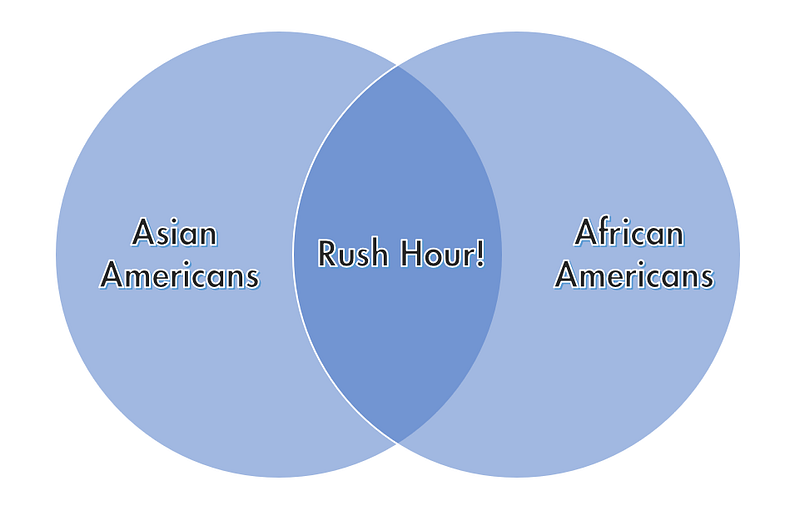
In the Venn diagram of African Americans and Asian Americans, what is there in that overlapping center?
The banner of “visible minority”. Prejudice. Simmering ethnic tensions. Shared discrimination that, while manifesting in very different shapes and forms, is painted with the same brush.
Not much good, but we’ve at least got Rush Hour.
The solution to all this hatred and anger in the world? I don’t know — mutual respect, diversity and inclusion, acceptance and tolerance? I don’t have the answer to bring about world peace. I’m just here to share my observations and attempt to justify binge-watching all 3 Rush Hour movies last week. But I can offer a few final parting words …
What is it good for? Absolutely nothing!