
Why Right Wingers Say Plymouth Colony was a Failed Communist Experiment
The Plymouth Colony’s History is an Argument for Worker Co-ops, Not Capitalism
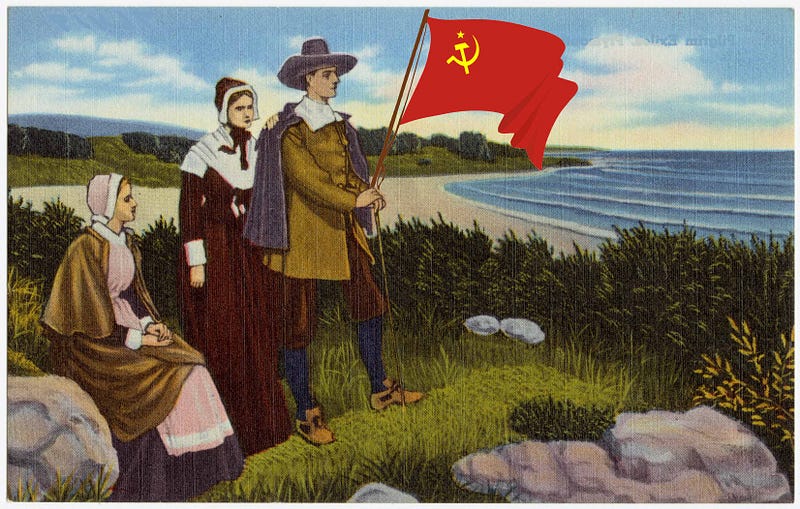
Conservatives insist the Pilgrims came to the New World in search of religious freedom, tried to work like communists and nearly starved, then switched to free enterprise and thrived. Their myth springs from distorting the facts:
- The Puritan Separatists that we call the Pilgrims had already found religious freedom in the Netherlands when they settled there in 1608.
- The Pilgrims went to North America for the same reason as everyone who had a choice in going to the Americas: to get rich.
- To cover their costs, the Pilgrims signed a contract with the Company of Merchant Adventurers of London. For seven years, all land and profits would belong to the Merchant Adventurers company. The terms had nothing to do with Christian idealism — the Merchant Adventurers insisted on those conditions in the belief they would be paid back faster. Only when the seven years were up would the assets be divided among the shareholders, which included the Pilgrims who were not indentured servants.
- When the Pilgrims arrived in Plymouth in November of 1620, they had a hard winter due to bad planning and worse luck, but the next year, they did not starve — they thrived. Their three-day festival in 1621 that we remember as the First Thanksgiving proves it. Richard Pickering, historian and deputy director of the Plimoth Patuxet Museums, said, “The celebration would never have happened if the harvest was going to be less than enough to get them by. They would have saved it and rationed it to get by.” A second proof is the Pilgrim’s payment in 1621 to the Merchant Adventurers of beaver and otter skins and timber. (The payment was captured by a French privateer, but that loss was a shipping problem and had nothing to do with the way the Pilgrims managed their business in Plymouth.
- In 1623, the Pilgrims got permission from the company to improve their working conditions. In The Pilgrims Were…Socialists?, Kate Zernike explained,
Historians say that the settlers in Plymouth, and their supporters in England, did indeed agree to hold their property in common — William Bradford, the governor, referred to it in his writings as the “common course.” But the plan was in the interest of realizing a profit sooner, and was only intended for the short term; historians say the Pilgrims were more like shareholders in an early corporation than subjects of socialism.
… Bradford did get rid of the common course — but it was in 1623, after the first Thanksgiving, and not because the system wasn’t working. The Pilgrims just didn’t like it. In the accounts of colonists, Mr. Pickering said, “there was griping and groaning.” “Bachelors didn’t want to feed the wives of married men, and women don’t want to do the laundry of the bachelors,” he said.
The real reason agriculture became more profitable over the years, Mr. Pickering said, is that the Pilgrims were getting better at farming crops like corn that had been unknown to them in England.
Joshua Keating elaborated in The People’s Republic of Plymouth:
…Communal farming arrangements were common in the pilgrims’ day. Many of the towns they came from in England were run according to the “open-field” system, in which the land holdings of a manor are divided into strips to be harvested by tenant farmers. As Nick Bunker writes in 2010’s Making Haste From Babylon: The Mayflower Pilgrims and Their World, “Open field farming was not some kind of communism. All the villagers were tenants of the landlord.”
…Bunker writes, “Far from being a commune, the Mayflower was a common stock: the very words employed in the contract. All the land in the Plymouth Colony, its houses, its tools, and its trading profits (if they appeared) were to belong to a joint-stock company owned by the shareholders as a whole.”
He continues: “Under the terms of the contract … for the first seven years no individual settler could own a plot of land. To ensure that each farmer received his fair share of good or bad land, the slices were rotated each year, but this was counterproductive. Nobody had any reason to put in extra hours and effort to improve a plot if next season another family received the benefit.”
…the Rush Limbaugh crowd should note that the settlers at Plymouth were rebelling against the rules set by a corporation, not against the strictures of some Stalinist collective farm or a hippie commune.
Keating concludes his essay wisely:
…In the end, no matter which side of the political spectrum you fall on, it’s a questionable enterprise to draw lessons about contemporary politics from early-17th-century agricultural practices.
But I will go ahead and point out the implication that conservatives miss: If having their own land to work made the Pilgrims work harder, then all large businesses should be turned into worker co-ops. When the Pilgrims saw they were only working to make a corporation rich, they demanded a better deal. They should not be remembered as heroes of capitalism. They should be remembered as the first English-speaking workers in America who won a concession from their bosses.
Afterthought
From the first comment on this:
This part, though, is the argument for private ownership:
“To ensure that each farmer received his fair share of good or bad land, the slices were rotated each year, but this was counterproductive. Nobody had any reason to put in extra hours and effort to improve a plot if next season another family received the benefit.””
That is an argument for what socialists call personal ownership (ownership of something you use), not private ownership (ownership of something that provides you with passive income). All of the smart socialist systems allow for personal ownership. I would argue that the small family farm is just a workers co-op where all the workers are related.