
Why Representation Matters More In ‘Bridgerton’ Than Most Other TV Shows
The show allows viewers to picture more minorities in positions of power and influence
I’m a pretty anti-identity politics person politically because I favor a multiracial coalition that tries to make the world a more equal place and fights for the working class of all races, but I know the current age we dwell, particularly on the left, does not agree with my brand of politics. I know how to read the room and how much the world has changed in our political thinking and discourse over the past couple of years.
I didn’t used to go into rooms thinking “wow, there are too many White people here” or “this place would benefit from more of [insert minority group here],” but now I do, because there’s been a shift in thinking on my side of the political spectrum. I’ve worked in pretty mixed workplaces racially and will notice when somehow the crowd self-segregated at social events, like when all the White people sit at the same table or when racial groups don’t mix at different tables. I’ve tried to break this lack of racial mixing by sheer knowledge that the optics of White, Black, Hispanic and Asian people all sitting apart and in their separate in-groups is just not a good look.
Again, I’m personally and politically against this kind of thinking, but the world has changed a lot and I believe we all need to adapt to the times, particularly post-Black Lives Matter liberal America.
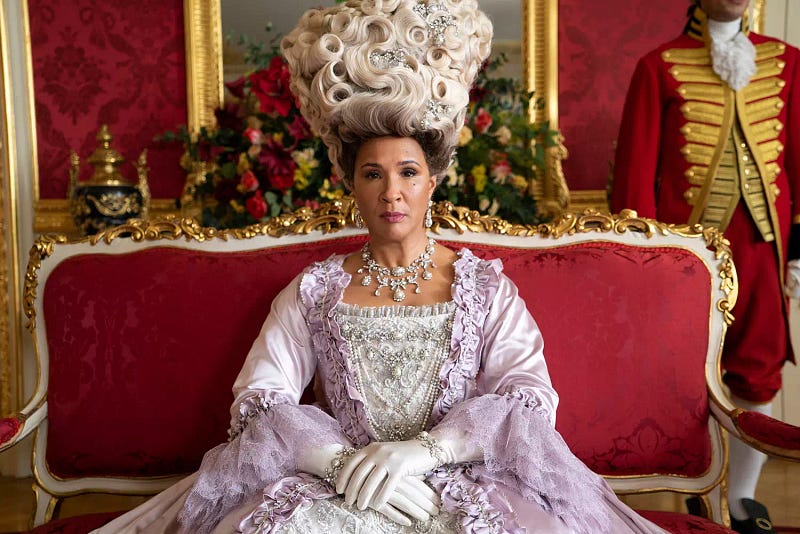
And so when Bridgerton came out, I felt like it was the perfect show for our times. It included a plethora of Black, Brown, and Asian actors within the traditionally very White space of British courtship and nobility during the Regency era of London. The Duke of the first season, Simon Basset, who is one of the most desired bachelors and one of the two protagonists of the season, is a Black man. Kate Sharma, who marries the prestigious Bridgerton family in the second season, is an Indian woman. Lady Danbury, an ambassador and great friend to the Bridgerton family and the queen, is a Black woman. Queen Charlotte herself is mixed race with African ancestry (and in real life, Queen Charlotte did have some African ancestry, but some historians say this would have been so minimal that it did not affect her appearance or ability to blend in with European society).
I’m usually not a fan of representation just for the sake of representation, as an Asian person who does want to see more Asian representation in Hollywood, per se. It sometimes feels forced or like it’s just trying to make a political point.
But the diversity of Bridgerton is actually the draw of the show.
A deficit in Bridgerton is its lack of consideration towards working-class people in Great Britain during the era, and its audience is clearly those who aspire to nobility, mobility into the upper class or mobility into the wealthier echelons of society. But the world of Bridgerton is that people of color who were traditionally denied those spaces predominantly occupied by White people could occupy it too. People who traditionally never occupied those spaces could have a world where, finally, they too are accepted into a previously exclusive aristocracy meant solely for White Europeans.
Of course, not every actor in Bridgerton is a person of color. The main cast is still predominantly Caucasian. But Bridgerton does offer the scenario and world of a more diverse aristocracy than the traditional European one, one that breaks the mold of every other show depicting royals and aristocrats in a court setting. Based on the popularity of Bridgerton, a show that had its second season as the third-most-popular English language TV show, that representation in that elite space seemed to work out.
Of course, the counterargument is that Bridgerton is just good TV and an enthralling soap opera-esque Netflix show that would have the same viewership had its cast been all Caucasian or not. People love romance no matter what.
But I don’t buy that argument. A lot of shows with a lot of minority representation show the world as it is. They are realistic and capture the struggles different minority groups face, including BEEF’s depiction of the dark side of the Asian-American experience. And there’s nothing wrong with that.
In Bridgerton, however, representation matters more, because it shows minority representation as it could be. In a mixed-race society, Bridgerton is the first show that depicts a mixed-race person as a queen or a Black man as a duke. And not only are the characters diverse, but the show is not colorblind to race — it actively talks about the additional difficulties a Black person may face at a royal court or the lack of status an Indian woman might face as the child of an outcast in British society and an Indian man.
We are past the age of dukes and queens beyond symbolic symbols. According to Salamishah Tillet at the New York Times, Brigerton breaks from predecessors like Downton Abbey, which had a more racially homogenous cast based on the historical accuracy of the time. And the show is largely escapist in its tackling of race instead of tackling the nuances of slavery and the British abolition movement of the early 19th century.
At the same time, however, we need shows that depict the nuances of real-life historical events that made racial progress, and we also need shows that allow us to envision and fantasize about the world we want and the world we dream about. The world is changing, and Bridgerton allows viewers to picture more minorities in positions of power, influence, wealth, nobility, and aristocracy. Again, we should honor people who don’t occupy those spaces as much as those that do.
But Bridgerton allows viewers to expand the realm of what we think is possible. Yes, it’s historical fiction. But its fiction is a world that seems to be close at hand, and one a lot of us on the left want.


