
Dos & Don’ts During Lunar New Year
Fun facts about the festival
When I moved to Shanghai in my early 20s, I knew little about Chinese culture and traditions. My first Chinese New Year was a cultural shock: I was an alien discovering a new planet, the Red Giant.
The city suddenly turned red and gold; there were firecrackers and monkeys everywhere as it was the Year of the Monkey, and strangers told me phrases in Chinese with big smiles and enthusiastic gestures. Some even handed me red envelopes with money inside, and there were plenty of oranges and mandarins in the office.
Since then, I have celebrated many Lunar New Year festivals in Asia, and it has become part of my culture. I’m now passing on the legacy to my daughters, born and raised in Hong Kong, who love the celebration like all the other kids.
Discovering the festival
To celebrate the Year of the Dragon, here are 10 facts I didn’t know about the Lunar New Year when I moved to China.
- It’s also known as Spring Festival because it celebrates the beginning of spring following the lunisolar calendar, which leads to the fertility of the land and the harvest of crops. In ancient China, it was the only time of the year during which the farmers were able to take a break from the fieldwork.
2. The color red has a powerful meaning: it is used to scare away the legendary Best Nian. In ancient China, Nian was an evil lion-looking beast living at the sea's bottom. It would only go ashore on the last day of the lunar calendar and eat people and livestock in the villages.
One day, an old man with silver hair came to the village and promised to chase the best away. As the night approached, Nian broke into the village but this time, he was met by red firecrackers and bright lights and flares. Dressed in red, the brave old man chased him away, and the best never returned.
The villagers applauded his courage, and since then, firecrackers, fireworks, and red decorations are displayed in the houses and streets to symbolize protection against the evil monster and good fortune.
3. The holiday is celebrated by over 20% of the world’s population, including China, many Asian countries, and overseas communities. Whereas in China, it’s called Chinese New Year, it’s more appropriate to call it Lunar New Year or Spring Festival as it’s also celebrated in other Asian countries such as Korea, Vietnam, Singapore, Malaysia, and Indonesia.
4. The holiday is surrounded not only by traditions but also by superstitions. All the house cleaning is done before the festival to get rid of the previous year’s bad fortune. On the first day of the New Year, no one cleans the house as it sweeps away the fortune for the new year.
5. It’s also bad luck to cut your hair during the 15 days of the holiday because the words hair (发) and fortune (发) sound the same (fa), and you don’t want to get rid of your good luck.
6. People don’t buy or talk about books because the words book(shu 书) and lose (shi 失) sound similar.
7. The red envelope (红包 hong bao) etiquette always confused me, as you don’t randomly give them away at will. Married people hand out red envelopes to singles, including children, but single people, even when older, don’t give them to married couples. The amount varies depending on the relationship. It’s also customary for bosses to hand out red envelopes to employees and staff.
8. It’s the longest and most important holiday in China, and everything closes for 2 full weeks.
When I was living in Shanghai, one of the things that surprised me the most was that many blue-collar workers based in factories would take the red envelope, leave for the 2-week holiday back to their remote homes in the countryside, and never return to their jobs. The long and tedious journey by train (very often, you couldn’t find a seat) made the return unlikely, and the juicy bonus justified leaving for good to be reunited with their families.
9. The Lantern Festival is my favorite part of the celebration. It marks the end of the festivities with the release of flying lanterns into the sky, symbolizing peace and forgiveness.
10. People born in the year of the Dragon (1952, 1964, 1976, 1988, 2000, 2012, 2024) are seen as charismatic, intelligent, powerful and confident.
Any dragons here? 🐲
This was us today, drawing dragons to celebrate!
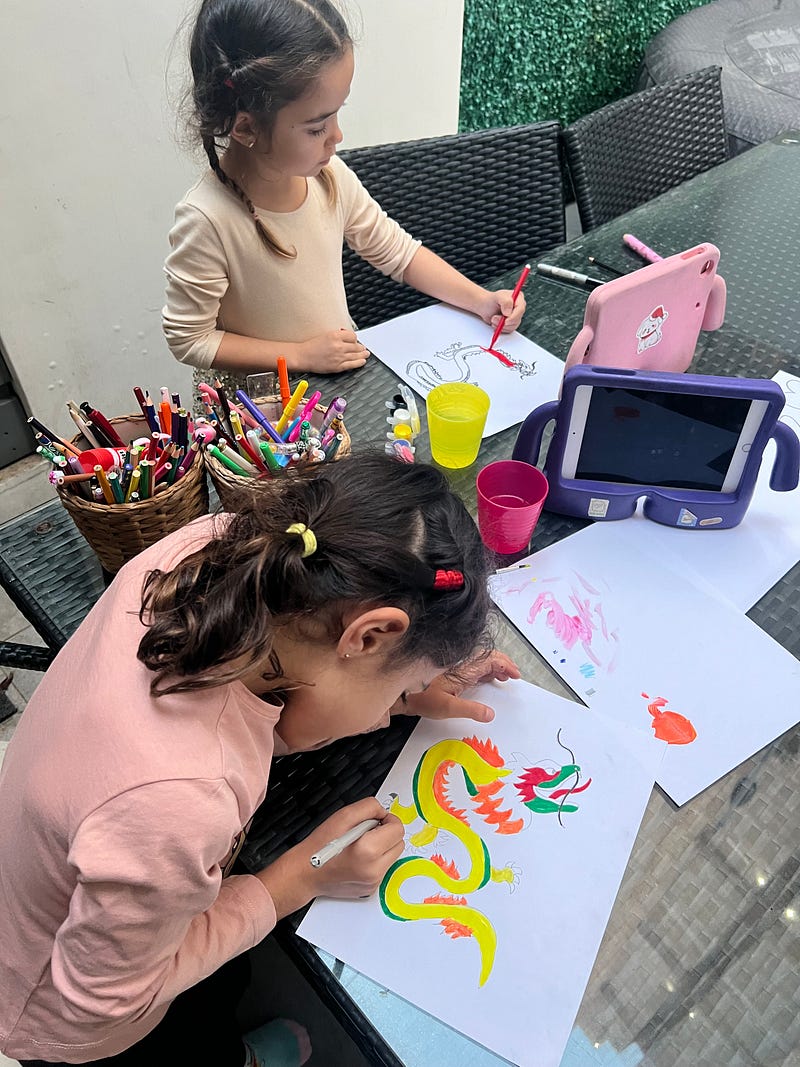
Happy Lunar New Year from Hong Kong 🇭🇰 昔年快乐 🙏🏼