
Why Read? Some Reasons to Love it Again
5 lessons from a life-long passion for reading
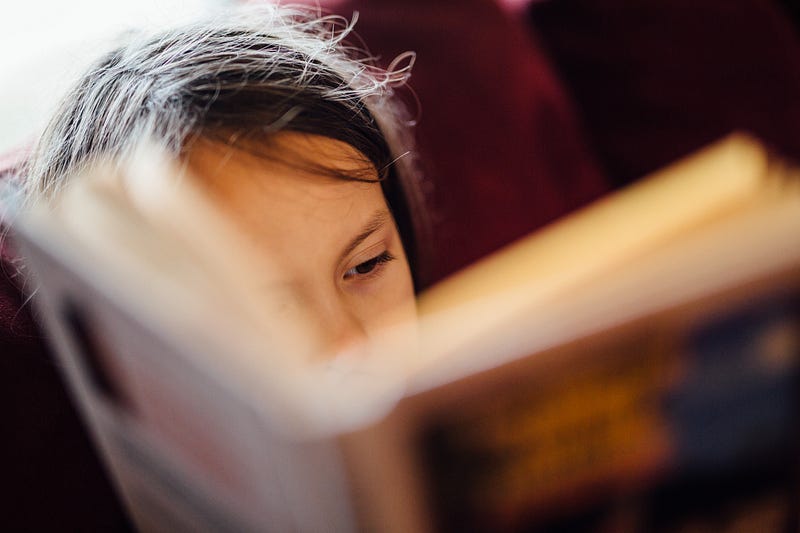
Pick up a book. Read.
Such a simple act, reading. Since childhood, we were taught to turn the page, voice the words, scan the story, predict the end. In primary school, we delighted in tales told and retold: picture books, Saturday morning Coyote and Roadrunner adventures, family stories, saints’ lives, Sunday comics, Dr. Seuss and Silverstein. Those words sprang to Technicolor life as we opened our eyes and read.
In those days, life and fiction blurred. I woke in my quilted bed, conversed long and meaningfully with my dolls and animals, frightened my little sister with the three-horned demon who lurked beneath the stairwell, scanned the a.m. comics in my dad’s discarded Tribune, ran to play Escape in the Woods with my best friend, returned for goulash and my mother’s dark German songs of love, listened to bedtime books, and read by flashlight until sleep overtook my dreaming eyes.
And then I grew. Life intruded more and more. I tried to hide in books. Books offered a world I understood and longed for, a land where characters were certain and plots began and ended in tidy loops. An open book swung open a door to a waiting universe — one that multiplied my world from one to a multiplicity of many.
I dove in.
While I read, I longed. I longed for joy, adventure, victory, and love. I dreamed of justice, journeys, and jealous abandon. I think I sensed, quite early, that life was one long spell of longing, that I would always be seeking, that humanity was on one continual hunt for something outside of itself, and always would be. I began to understand Dostoyevsky’s words: “The mystery of human existence lies not in just staying alive, but in finding something to live for.” Purpose, however, eluded me.
And so I read. It stilted my hunger. It calmed my nerves. It gnawed against my adolescent angst.
In those years, I summoned worlds. Paper lives leapt into reality. Characters breathed and sighed in flesh and sin and sainthood. I felt grime beneath my fingernails while planning sweet vengeance with the Count of Monte Christo. I ached with Heathcliff as his bitterly sweet Catherine slipped seductively away. I rolled and rumpled the grass blades as Whitman sharpened his single pencil. When Anna K let her body drop beneath the black engine, I felt the steel wheels carve trenches on my back.
There was so much to know. The Great Unknown stretched before me as I read. It was despairing to note that the more I read, the more I sensed the stretch of Unknowing unravel like a growing gulch of Ignorance.
“The fundamental problem of life,” psychologist Jordan Peterson said, “is the overwhelming complexity of being.” (“Three Forms of Meaning and the Management of Complexity” published in The Psychology of Meaning)
Good books addressed this existential issue. Great books asked questions that left life’s complexity unresolved.
A chronology of reading
When I consider my reading life, I find the underlying doubt and fear and love that engulfs and entwines us all.
As a child, I read for the joy a vivid scene could evoke, for the touch of my mother’s arm against me as she read aloud, for the castles that imagination built.
As a teen, I read to escape the gray world that confused my black and white soul, to find a love I felt I lacked, to discover galaxies that sprawled outside my reach.
As a college student, I sought out data, dove into clear pools of new-to-me information; I gathered knowledge like hoarding stray kittens.
As a young mother, I discovered developmental theories and expert reassurance. I measured maternal impulses against social and scientific norms. I attempted to reconcile my role as reader with that of parent and guide.
As a grad student, I became an academic. I learned to judge with critical eye and disdainful glance, to pepper my understanding with objective control, and to scan research like an addict.
This compilation of readerly tricks and turns is my own, yet reflects the ubiquitous universality of the reading realms we all enter when we open a book, read a page, collect our thoughts, and indulge in our very human need to read.
We all were readers, once. Perhaps we should pick up and read again.
Lessons from the love of reading
1. Reading opens other worlds
Reading is an act of faith, and a sticky web of treachery. Words create and destroy, build up and tear down. Language lifts us to the pinnacle of bright hope, and dashes us down to the bleakness of Hell. Books enlighten and damage, sometimes on the same page.
In his book, In Bed with the Word: Reading, Spirituality, and Cultural Politics, author Daniel Coleman points out the potential for books to inflict doubt, uncertainty, and pain; reading that restructures the mind, heart and soul, that challenges what we thought we knew, that reveals the elegance and ugliness of the Other, that forces us to see with eyes unknown, these are books that allow us to acknowledge: “You are changed.”
2. Reading changes us as we ourselves change
Books change us, but we also change books. With every lived experience, we alter our lives as readers. With every conversation, every action, every moment of love and betrayal, each connection and relationship, we bring a new grain to our storehouse of reading. I was one reader when I first opened Where the Sidewalk Ends at the age of eight; four children, one divorce, several academic degrees and 40 years later, I am a different reader of Silverstein’s “I Cannot Go To School Today” (said little Peggy Ann McKay). Do I mean better reader? Sometimes, though not necessarily.
Reading is colored by life’s indelible Sharpies: age, time, children, career, academia, heartbreak, loss, faith, death. What I did not know in grade 3, I now have some knowledge of. The ways of the world have changed my perception — for both good and bad.
3. Reading forces us to face ambiguity
We all inhabit a world of uncertainty. Like all of us, I struggle with it all: discomfort, confusion, life’s unrelenting ambiguities. Like Alexander Pope’s hierarchy of humanity, I am ever caught betwixt the angels and the unspeaking stones. I wish to soar in lofty realms, yet I sink toward the rocky earth. I remain indelibly mid-comprehension. Lumps of rocks do not sprout wings.
I am steeped in literary esoterica. Like all readers everywhere who attain a certain measure of mastery (in the U.S., probably anyone who reads a book beyond grade 12), I have read my way through dense, obscure, and obsolete literatures, some on purpose, some by accident. Because I can passably read German, I periodically torture myself with that as well. (Echoes of Herr Professor Heine boomingly narrating Das Niebelungenlied in Middle High German in contrapoint to my faltering German-major portrayal of Kriemhild remain embedded in my dark subconscious to this very hour: “I intend to remain a virgin: I will not let my life be ruined through love of a man!”) Like the unfortunate classmate who carried a copy of Mein Kampf to German 301 one day, we all suffer from errors of judgment — though some more forgivable than others.
A young man — tall, strident, authoritative — pushed a copy of William Burrough’s Naked Lunch into my hands one early fall afternoon on the quad.
“It’s pure genius,” he emphasized. I demurred until I opened the book and tried to read the damn thing. Incomprehensible could be construed a compliment; profane may be a better choice. Some things I still just don’t get.
I felt the same attractive repugnance for “Howl,” and Eliot’s Prufrock — as well as Lady Chatterly’s unmannerly lover. I didn’t think much of Hamlet the Ambivalent, or that vicious, gap-toothed Wife of Bath.
And what the hell was Emma Bovary thinking? I asked myself before becoming pregnant my senior year of college and marrying my own mistake.
4. Reading transforms itself and us
Reading is more action than presence, more verb than noun. Once acquired, it remains. Reading improves, decreases, waxes and wanes. It follows close behind, a lone moon trailing our life.
Like Optimus Prime, reading transforms itself. It morphs and moves. Chimeric, it shifts from blue to green, camouflaging and concealing, and bursting forth in a rainbow of intent. Reading is muted and demure, huddling in a cavern of pillows with a cup of hot, honeyed tea. It is raging and red, burning with consumptive fire. It falls asleep curled in your arms, only to awaken, yowling with hunger. Feed me, it demands.
Reading is much like the sea: a roiling, shadowed, submersive pool that yanks us under then spits us out. We ride its moods like careful boatmen wary of the storm. Giant whales surge beneath. Overhead, an ancient albatross haunts the sky with somber song.
That albatross never abandons nor deserts. It remains close by, in pleasure and pain, in busyness and boredom. Enraged, we may strike or shoot it, hang it from the sail or about our neck. Unerring phoenix: it rises from the grave, a befeathered Lazarus. Her song haunts: she has seen both the living and the dead.
5. Reading shadows our growth — and encourages it
Like a child, reading grows. It ages as I do. I grant it the gift of my finite time, feed it my attention, grant it periodic consideration, and it becomes my playmate, my companion, and finally, my peer.
“[Reading] matters,” Harold Bloom firmly stated in How to Read and Why, “if individuals are to retain any capacity to form their own judgments and opinions, that they continue to read for themselves.”
Why Read?
Bloom asks the fundamental question: why read? This query is answered by the self and soul.
I read to squander time, and to hoard it. I read because I want to know, or am driven to find out. I read to immerse myself in the world of ideas, and to unearth how they are chained together, “each to each” (Eliot). I want to familiarize myself with the Unfamiliar, an action that unhides the Other. I read to open doors, and to discover great and feeble notions. I read to unearth both conversations and love affairs. I seek answers for my questions, and questions for my half-baked answers. I read to dive into the lake of language — those waters where we swim together in time, thought, ideas, and death.
I read to touch immortality’s hem.
I read to laugh and weep, to stumble and fall. I read to find and lose myself. I read to enter a discussion that began millennia before my birth and that will continue its whispers and howls long after my demise. I read out of urgency and laziness. I read hungry and sated, half-asleep and wide awake. I read because I am.
Daniel Coleman links reading to spirituality, and that bond seems honest and firm: “Spirituality assumes that I have something to learn and that I can learn it from many things around me that draw me out of myself.” Curiosity draws us to the larger God. It provides that deep pondering that results in immutable prayer.
Conversely, curiosity can also lead us directly away from Light (see Faust, among others). It can deceive us into illusions of the knowledge’s power — and learning’s purpose. Such are the risks of reading.
Wisdom is not located on one specific page. It is not found in the Koran, Talmud, or Bible, though glimpses can be found there. Though the words and ideas 10,000 years are collected in 10,000 texts, yet wisdom is not written above, below, or between their lines. It remains elusive, a moth nibbling at the parchment’s edge.
Proverbs states: “Hold on to instruction, do not let it go; guard it well, for it is your life.” Individually, we read and learn. Uniquely, we walk through life’s foibles and failings. Ubiquitously, we falter and flail. Those intent on the smallest sliver of wisdom will rise once more, re-open the book, and read the next page.
In the end, reading is a verb
Reading is action. It is a choice we make to open both mind and heart. Reading is presence — terrible or beautiful, mindful or redundant. Opening a book teaches something new. It gives voice to an unknown world. Its beauty can hold the soul.
Reading is passion. It is immersion and sin. It is prayer and redemption. It calms ambiguity and carves deep dissonance. It is life empowering and time depriving. It is magic and metaphor, word and wing.
How to read? Pick up the novel. Lift the magazine. Heft the Sunday New York Times. Turn the page. Begin.


