
Why Racism?
An Explanation
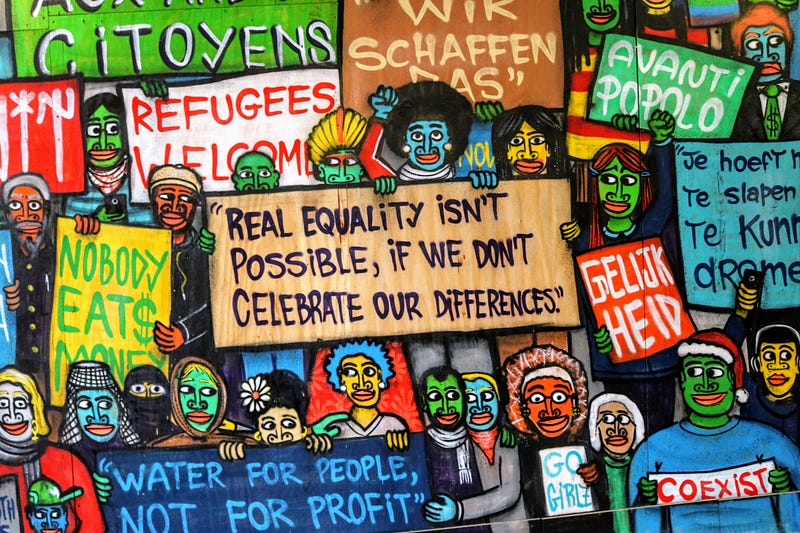
My friend Kevin Buddaeus wrote a timely piece
I don’t think anyone understands racism. I’m no psychologist, but I think I have some insight. My mother and I were both born in Florida. She lived in the deep south until she met and married my father who hailed from California.
My father moved us back to his hometown in northern California when I was only a year old, so I did not grow up in the south as my mother did. My mother understood racial prejudice from having grown up around it.
Although she grew up with segregation and racial bias as part of her culture, she did not buy into it. Instead, she sought to see the good in all people, regardless of color, and treated others with dignity and respect. If anything she treated people of color with great deference. We had Mexican friends and Asian friends. My dad became close to a Portuguese man who couldn’t read English and spoke very little of it. My mother taught me to respect others. To her, we were all human beings.
Black neighbors
As fate would have it, we moved into a run-down house in a small enclave on the outskirts of town called Inspiration Point. Just up the hill from our house lived a black family, Mr. and Mrs. Harry Harris. I wrote about Harry in A life well lived.
My dad and Harry became life-long friends. I often played with his nephew, Homer. In fact, even though he was several years older, he was my only playmate for a couple of years.
The fact that the Harrises and Homer were African Americans (we called them “colored folk” in those days) made no difference to me. Yes, I noticed that their skin was a different color, but that didn’t matter. I knew them as people. They might talk differently than I did, they might look different, but in the important things, they were people just like me and my mom and dad. We got along great.
Experiences with Racism
My first experience with racial prejudice came when I entered the Air Force in 1966. During Basic Training, we had a flight song leader we called Goldie, who was black man and had a beautiful baritone voice. One day we were marching and Goldie did or said something that got our TI’s (Training Instructor’s) attention. The TI said, “Goldie, I may be northern (he was from Michigan), but I think southern.” We all knew what that meant. I’m sure Goldie did too. Racism was a reality. We knew it and Goldie knew it.
My next encounter with racism came some months later when I was in Medical Admin Training at Shepard AFB in northern Texas. We had a group of loud and boisterous black Airmen in our barracks. They bunked together and hung-out together. They peppered their speech with “MFer” as if the word was an essential part of speech. I found it and them very offensive.
Until that time I had not been felt racial prejudice within myself, but during that time I grew to dislike those airmen with a passion. They’d often come in late, drunk and obnoxious, disturbing the entire barracks. We complained to the dorm chief and he talked to them. They quieted down for a while, but the mutual resentment persisted. Their behavior did not turn me into a racist.
Someone to Look Down on
I remember my mother explaining to me once that poor white people needed someone to look down on. “Poor white trash,” she said, looked down on “colored people.” The white person might be on the bottom of the scale economically, but at least they were better than the blacks. They despised black people. They used the “N” word to describe them and spit it out vehemently.
Fear
We tend to fear people who are different from us. I think this fear goes back to prehistoric times when we had to size up others to determine if they were friend or foe based on appearance. I know I feel uncomfortable when I see a group of young black men with their hoodies on at the mall. They may be good kids, but my antenna goes up.
When people look and act differently, we naturally feel discomfort around them. However, if we have the opportunity and take the time to get to know them, as my folks did with the Harrises, they may turn out to be great people and we may form lasting friendships. Many intercity boys’ and girls’ clubs seek to provide such opportunities. Churches and other religious institutions do that, too.
Need to Feel Superior
As humans, we have a deep-seated need to feel good about ourselves. We have a tendency to compare ourselves to others. Our ego tells us that we may not be so good, but at least we are better than another person. For many people, the inferior person is the black person or person of color.
I know a few people who hate Mexicans (Latinos). They say the Mexicans clog the schools in some parts of the country. Many don’t speak English well and need remedial help. Some schools have even embraced bilingual teaching to address the problem. Some people resent that and see it as taking money, time and resources away from their children who are native English speakers. Some say Mexicans bring crime and the drug trafficking with them. In short, they see latinos as a group being a burden to society. They miss seeing the success stories, the hard-working people who live decent lives and only want a piece of the American Dream.
These days we have a xenophobic President who contributes to the unrest. He seems to prefer more violence rather than pursuing peace.
What is the solution?
Education will help, but I think training must start at a very early age, as it did with me. Parents must teach their children to be respectful of others regardless of the color of their skin. They do this not only through their words but by modeling such behavior.
Kids having multi-racial play groups helps, also. Integrated schools help. Teachers need to watch for and confront racial bias when they see it in the schools.
I wrote more about this in another article
The Role of Faith
The best hope I see is through the church. Churches bring people of all economic levels together in their neighborhoods. They have the potential to bring people of different races, ethnic origins, sexual orientations, etc., together. Our congregation has an active program aimed at making us more diverse and inclusive. We have men and women pastors. Even though our congregation is mainly white, we have an Asian American pastor, an African American intern pastor and a Latino pastor.
We must learn to love our neighbor as we love ourselves. That is what Jesus taught. We need to apply it. We all have the potential to become children of God. We need to see people as God sees them, as spiritual beings with great potential.
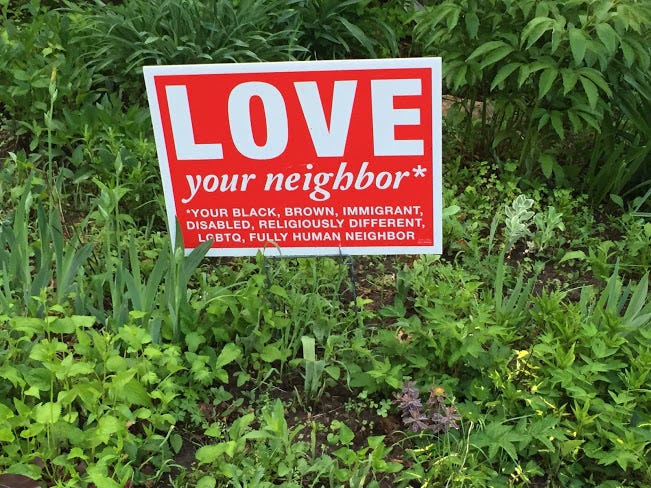
As this sign in a neighbor’s yard points out, we need to learn to love our neighbor regardless of the many traits that make him or her look different from us.
I hope you found this article helpful in understanding racism.
I’d love to hear your thoughts. Please feel free to leave a comment below.
As always, thank you for your time reading this.
Blessings on your day!
Happy Reading, Writing and Connecting!


