
POLITICS | FINLAND | WELFARE STATE
Why Prime Minister Sanna Marin Is the Poster Child for Finland’s Welfare State
She was the average Finnish Jane, and social support enabled her to become a person who is now at the helm of the whole nation
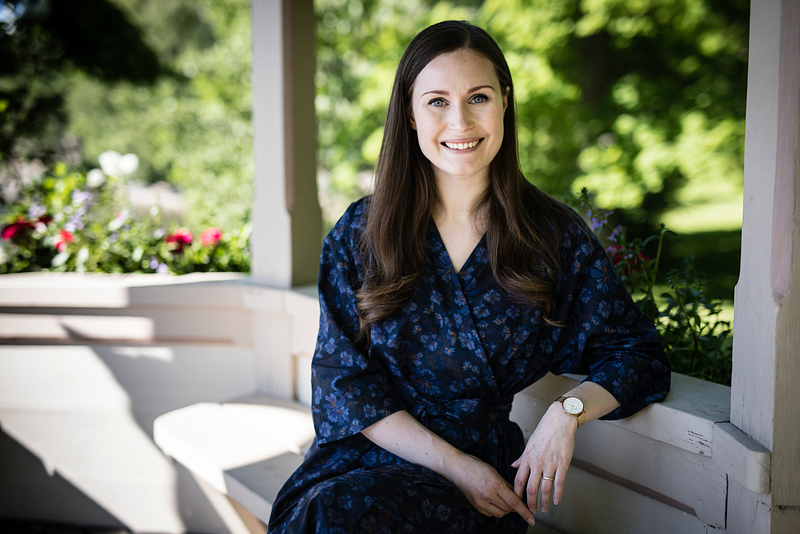
Sanna Marin still remembers the stigma she had to face as a child.
The Finnish prime minister was growing up in the 90s like other children of her time. While her peers had a mom and a dad, she had two moms.
Homosexual families were not the accepted social norms yet in the progressive Finland that we know it to have become today.
Spending time with friends did not make Marin feel like an outsider; being out in the society did. In 2015, when she became a parliamentarian at the age of 30, she told Finland’s Me Naiset (We the Women) magazine she could not freely talk about her family during her childhood because it was not recognised as a “real” one back then.
There was this “silence” about homosexuality in the society that made her feel “invisible”.
But it was also this stigma that worked as a positive force in her life.
It gave her mental strength. It profoundly shaped her values. It influenced her ambition to get into politics, and she did so when she was only 20.
After seven years, she became a council leader. She almost flew through the ranks of her Social Democratic Party (SDP), eventually becoming the prime minister in December 2019.
Before that, she was the transport minister.
Starting from humble roots
Marin’s parents divorced in the face of her father’s alcohol problem when she was a child.
The scourge of alcoholism remains prevalent in Finland, which has been ranked the happiest country in the world for three years in a row. Figures from the University of Helsinki’s Institute of Criminology and Legal Policy showed a 30 percent increase in booze-related violent deaths in 2018 compared to the year before.
After the split, Marin’s mother was in love with a woman, and the two ladies brought her up. She has met her father only once since then. She told the British Vogue magazine that “I would say I do not have a father.”
In addition to the parental stigma, money was also tight in the family. She worked in a bakery and distributed magazines to make ends meet during high school. She was also the first member of her family to finish university, getting a degree in administrative science from the University of Tampere.
In her many interviews, she has repeatedly attributed her success in life to two factors:
- Finnish education system
- Finnish welfare society
She was committed to changing her life and said she would not be where she was today without social support.
Though there has been a prominent presence of women in the Finnish political scene for some time, Marin’s assertion reveals the power of the Finnish welfare state in transforming an ordinary citizen’s life.
Welfare protects the average Finnish Joe and Jane
Finland, which was largely an agrarian economy until the 60s, saw the expansion of welfare system mainly in the 70s and 80s.
Today, the Nordic country has one of the most comprehensive welfare policies. It aims to ensure a basic level of social protection for all Finns regardless of their place of residence, profession, and economic status.
The policy includes social assistance, pension, unemployment, and family and housing benefits. Healthcare and education are also part of the system. The services are mainly funded through high taxations.
Finland follows a progressive taxing system, meaning the more Finns earn, the higher they pay in taxes.
Because of the comprehensiveness and universality of the welfare programme, Finns across the country can maintain a decent living condition. The support continues throughout their life, from cradle to grave, and they do not need to belong to some sort of privileged class to enjoy this.
The welfare system is founded on a principle of “universal rights” based on citizenship.
If Finns do not have a job, they get unemployment benefits. If they do not have enough money to pay rent, they get housing benefits.
Free education
Education is free for all in Finland. Unlike Americans, Finnish students do not have to bear the mountainous burden of student loan.
They can educate themselves as much as they want — from primary school up until higher education — and do not have to pay for it.
The Nordic country sees education as a civil right and a public service, not as a commodity. Everyone is entitled to receive state-funded education.
Free healthcare
Finns also enjoy free or an incredibly low-cost public healthcare. Like education, it is a right rather than a privilege.
If Finns fall sick and receive primary medical care, which is provided mainly by the municipal healthcare centres, it is free. (Here is a list of public healthcare services in the country that are offered free of cost.)
Finns do not have to pay exorbitant healthcare fees that will put a big dent in their bank account, which, for example, is the case in my home country, Bangladesh.
Child benefits
Finland offers generous maternity and paternity leaves to parents. In February 2020, the government announced plans to give fathers the same paid paternal leave as mothers, further advancing the welfare policy to strengthen the relationship between parents and gender equality.
Apart from that, families with children get a range of benefits, including child benefit, childcare allowance, and assistance for ill and disabled children.
Finland also has state-subsidised, high-quality daycare centres. Their key objective is to promote health and wellbeing of children instead of imparting “education” in the formal sense of the word.
Considering all this, it is no wonder that Save the Children in its 2015 Mothers’ Index Rankings ranked Finland the second-best country to be a mother, preceded by Norway.
“I am proud of Finland”
Like every Finn, these are among the benefits Marin and her family were entitled to under the welfare system.
She was the average Finnish Jane, and welfare support enabled her to not only design her life but also to become a person who is now at the helm of the nation of 5.5 million people.


She is a glaring example of how the Finnish welfare policy works as a powerful catalyst for social mobility even for a member of the masses.
Finnish journalist Jasmin Ojalainen told the UK’s Stylist magazine:
“Marin had reached this position because of the welfare state.”
Another Finnish journalist Anu Partanen, who frequently writes in the US media about her country and is the author of The Nordic Theory or Everything, told Vogue magazine:
“Marin is a poster child for the Finnish model.”
A government official of Finland’s biggest trading partner Estonia insulted Marin after she became the prime minister, describing her as a “cashier”. She shrugged off the criticism with grace, and said she was proud of Finland.
She tweeted:
“Here, a poor family’s child can get an education and go places in life. A store clerk can become a prime minister. Finland would not manage without blue-collar workers. I highly appreciate the work every employee, tradesman and entrepreneur does!”
A token of gratitude
Marin remains a very down-to-earth person despite her distinct political identity and status. She is very active on social media.
On Instagram, she has offered glimpses of her personal life, including pregnancy and breastfeeding pictures.
She emphasises being herself, saying she is a “real person” even though she is the prime minister.
The millennial politician is mostly viewed as a next generation leader by the youngsters. Maria Bäck, lecturer in political science at the University of Helsinki in Finland, said she is a young, knowledgeable, ambitious, and quite tough prime minster.
She is widely regarded as a better communicator than her predecessor Antti Rinne. 84 percent of respondents to an April poll by the leading Finnish daily Helsingin Sanomat expressed satisfaction with her performance during the coronavirus pandemic.
Moreover, a September survey by the Foundation for Municipal Development, an independent, non-profit think tank in Finland, ranked President Sauli Niinistö and Marin the best at providing information about the pandemic.
Despite all these achievements, Marin has not forgotten that her arduous life journey hinged on the Finnish welfare system over the years. That is why she strongly believes in safeguarding the Finnish welfare state.
Her way of showing gratitude to the system is to work now to uphold it. In her speech in the parliament after becoming the prime minister, she said:
“For us Finns, the welfare state is a source of pride, and it should remain so. I value our efforts to create equal opportunities and security for all and to take care of the most vulnerable people in our society. We will not leave anybody to struggle alone.
It is the common will of this Government to make reforms in order to build a country where every child can achieve anything they put their minds to and where every person can age safely in a dignified way. Many people in the world hold Finland in high regard and think of us as an example.”


