
Why Prague Disappointed Me Almost as Much as Paris.
Disclaimer: This whole article was written under the optics of a budget traveler. If you are a deep-pocketed luxury jet-setter and frequent guest of Ritz, chances are your perceptions are completely different.
In this article, I will list 3 reasons why Prague disappointed me, so you can avoid it.
Prague is one of the most visited cities in Europe. With 8.8 million tourists per year, it receives more visitors than entire countries like Tunisia or Brazil (8.3 and 6.6 million respectively).
The Czech capital is known for its good beer and cheap costs. Especially for young tourists.
While they surely produce some great Pilsen (beer type named after the Czech city of Plzeň), I dispute the idea that Prague is a bargain, based in the 3 points below.
1st — Scams. Currency exchange scams everywhere.
The hype made scammers flourish in the city. Unless you developed some serious budget-traveling skills (you can get some in my last book), you risk being ripped off on a weekend.
The old town of Prague is full of scams that are rare in eastern or central European capitals like Warsaw. Talking about comparisons, in my experience, the cost-benefit of visiting Prague is far worse than other regional touristic spots like Budapest or Krakow.
The Czech Republic has its currency (Czech Koruna), so take care when converting your Euros.
The most famous (and damaging) of all scams happen in currency exchange houses. Those establishments developed an assortment of methods to deceive tourists. For example, some of them show a very attractive rate to exchange Korunas to Euros. Simultaneously they hide the rate to exchange Euros to Korunas, which is the one that matters for tourists. By not seeing the correct rate, visitors fall into the trap and lose up to 40% of their money.
Another way to cheat travelers is to announce a commission of only X% to buy currency, but in the small letters, have a commission much higher to sell currency. Since the concept of buying or selling currency depends on interpretation (who is selling and who is buying when both are exchanging currencies?), they will again attract innocent victims who not see the trick.
After being scammed, it is common for angry travelers to return to the scamming exchange houses. But any effort to argue will be in vain, and they may even face aggressive security staff.
Shameful.
2nd — Tourist Traps
While scams are attempts to openly cheat or defraud an unaware passerby, tourist traps do not have the same malicious character. However, they are simply…
A waste of time, money, and, in some cases, irritating.
The most common tourist traps in Prague are the ones disguised as typically Czech when they are, in reality, imported stuff, totally not related to the local culture.
One example is the Trdelník, a sweet-bread sold in the streets as typically local, but with its actual origins in Hungary (where it is called Kürtőskalács). Even not Czech, it is still tasty, but if you have a limited number of calories to eat, I would recommend trying some real local desserts.
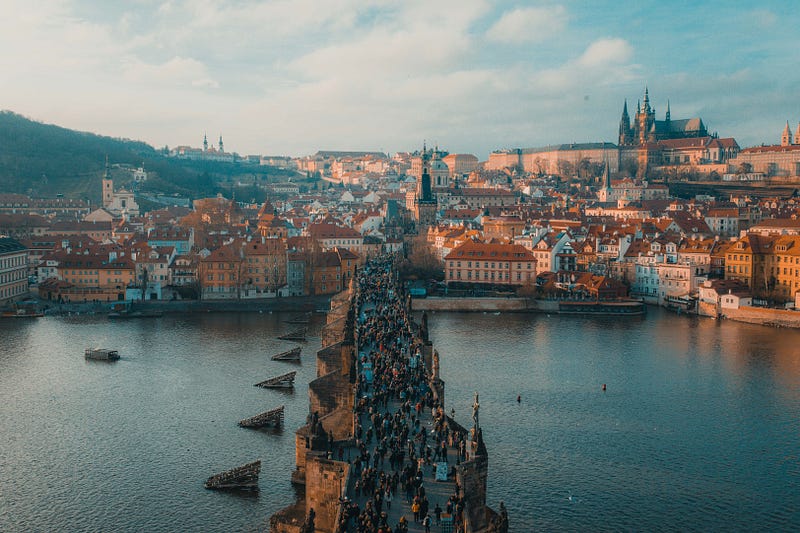
The Trdelník is probably the most innocent of the tourist traps. Not irritating at all. The same cannot be said about the street-sellers of the Charles Bridge. They are in excessive numbers, breaking the atmosphere of such a scenic place. What puzzles me is why someone would go to the Czech Republic to buy caricatures of Hollywood stars?
3rd — Not much control over lousy, flashing tourists.
With such a big influx of international tourists, it is clear how important they are for the local economy. But tourists can be lousy. If you want to keep your attractions intact and the experience of your museums, churches, and historical landmarks remarkable, you must enforce rules.
The acoustic of medieval Czech Churches can be incredibly efficient. That is more than enough to make a (giant) group of talking tourists unbearable.
Besides the noise, there are the camera flashes. It is disputed how harmful flashes are for artistic masterpieces like portraits and carpets. But even if not damaging, I find it unpleasant to have dozens of blinking lights in a dimmed ambient like a museum or church.
Yes, You can call me grumpy if you wish. Still, 80 decibels of loud conversation and flashing lights are not favorable to the ambiance of a historical castle, but rather to a club.
Maybe this is the reason to call Prague a party city. And in this aspect, I think most people will not get disappointed.
Author: Levi Borba, founder of Colligere Expat Consultancy, former RM specialist for the world´s greatest airline, writer of the books Moving Out, Living Abroad and Keeping Your Sanity and Budget Travelers, Digital Nomads & Expats: The Ultimate Guide. You can check some of his articles here.
Subscribe here, for free, to my email list and receive the digital book 20 Essential Hacks for Saving Money While Travelling. Discover the way to cheaper flight tickets and even an upgrade to Business Class! Written by an author that worked during years in some of the best airlines of the planet.


