
Why Personal Spirituality Is Healthier for You than Organized Religion
Treat your experience as valid, instead of arguing with it.
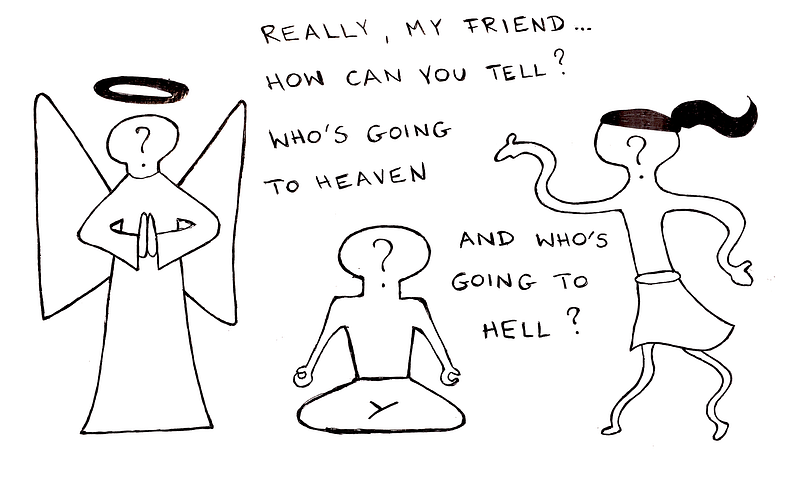
She gave me that look I knew so well. A bit moralizing, full of concern and apprehension about what I was going to say.
I held my breath for a second. I hate being pressured to explain myself.
My grandmother just asked me why I don’t go to church anymore. How do I explain to someone so immersed in the catholic religion that I have different ways of nurturing my spirituality?
Plus, she’s my grandmother. I’d never want to upset her. And I sensed that, underneath her question, there already was a big worry.
She worried that I stopped believing in God. Or worse, that I converted. In any case — that I abandoned the only way of living that was right to her.
As I started clumsily laying out that I don’t agree with many catholic practices, and that I have my own ways of connecting with “something bigger than us,” she interrupted me:
One thing I know for sure. Without God, you’re not going anywhere in life.
I agree with her baseline. To me also, spirituality seems like an intrinsic part of our experience. But while it’s a universal human trait at the core — the expression of it seems to be very different for different people.
Why impose a uniform way of practice bundled with a set of dogmas on everyone, regardless of their individual needs and conditions?
Much of Organized Religion Is Built on Fear and Control
As a child and young teenager, I was a pious Catholic. When I was preparing for the First Communion at the age of 8, I was made aware of just how sinful my life had been so far.
The teacher in charge of those preparations informed me and other kids that God would forgive most of our sins, if only we felt genuine regret for having committed them. However, she also mentioned something called eternal sins. Those, once committed, couldn’t be forgiven. They’d send you straight to hell.
Imagine — encouraging 8-year olds to feel guilt and regret for what they’ve done as part of your job. Why would an adult want to do something like that?
My guess: because of fear.
Catholic religion as I know it operates from the place of controlling people. The whole narrative is based on “if you don’t do as the Church says, you’ll be condemned.”
If that’s the story you’ve been hearing from the first day of your life — no wonder you’re afraid to break the rules.
As a result, people end up believing that going to Mass every Sunday, fasting on particular days, or whatever other practice they follow is the only rightful way to live. They’re don’t think to question the doctrine. Then, they teach that doctrine to their kids with the best intentions.
They want to give them the necessary knowledge base to live rightfully.
Except this is not a knowledge base. Often, it’s more akin to a system of control which values certain arbitrary notions about reality more than it values the personal experience of practitioners.
The reason why I’m sceptical about following a dogma-based religion without questioning the practices is that I experienced the catholic faith to be destructive for my mental health. I’m now recovering from it, because I realized what it has done to me.
When I was younger — the catholic faith oppressed me. And I have a feeling that it continues to oppress many people today by telling them that there’s only one right way to live. Moreover, it often doesn’t take into account what effect this practice may have on an individual.
The duty of going to confession is non-negotiable. It doesn’t matter if you experience a panic attack each time you do that.
Feeling guilt and shame for your sins is necessary if you want to have them forgiven. It doesn’t matter if practising guilt on purpose brings your already low self-esteem to the ground floor level.
These are examples from the particular religion that I used to practice — but I’m pretty sure that much of organized religion operates on a similar basis. It values the system and the rules more than it does the spiritual growth of its practitioner.
If that’s the case — embracing a personal approach to spirituality may be the only way to grow in this area of your life. After all, you don’t want to harm yourself while looking for God.
Personal Spirituality Honours Individual Needs and Circumstances
The catholic practices I used to follow were often counterproductive to my spiritual growth. I didn’t recognize that when I was a kid — but they were reinforcing guilt and unworthiness as default feelings to live by.
It seemed like a spiritual life equalled a miserable life. If I was to be a religious person, I needed to focus on my faults, shortcomings and sins.
Such form of practice disempowered me, instead of making me stronger. But I saw it as the only way to go about spiritual growth. As a result, I stuck to it even when it harmed and belittled me.
I wasn’t until I reached my mid-20' s that I realized it was possible to explore spirituality on my own terms, without sacrificing my mental health.
I discovered meditation and was drawn to the idea that I could plant my spiritual practice in what was already happening in my everyday life. I started treating the most mundane experiences as raw material to grow from.
All of a sudden, it hit me that spiritual life isn’t — and can’t be — about blindly following what someone else claims to be true. It only made sense to approach my life experience as the most authentic of teachers. Living in the present moment in the most conscious way possible became the essence of my spiritual practice.
As Michael Brown, the author of The Presence Process, put it:
“We are (…) encouraged to make the most of every opportunity to connect intimately with Presence through application of this present moment awareness process. Once we accomplish this connection, everything is accomplished.”
Personal spirituality is really about the way in which you relate to your moment-to-moment experience. It grows from the quality of attention you give to everything that life presents you with.
It is the attitude and intention you bring into your interactions with the world right now — not in some imaginary, wishful future.
In this sense, personal spirituality addresses the individual in a way akin to therapy. You’re encouraged to treat your experience, exactly the way it unfolds, as valid, not random. You investigate as best as you can what said experience feels like on the physical, mental and emotional level.
Then, you look for the most wholesome responses available to you.
When you take a personalized approach to spirituality, the line between the “spiritual” and “ordinary” life blurs. There’s no need to discern between sacred and profane. Why would you?
It feels natural to get rid of this division — and looking back at our history, this is how we used to live for the most part of our existence. Most hunter-gatherer societies didn’t make a clear division between the natural and supernatural world. Their perception of reality was non-dualistic. Consequently, they treated spirituality as one of the ways to ensure survival — e.g. perform rituals for a successful hunt.
Personal spirituality today enables you to hold such an integrated view of the world, too.
To connect with the complex picture of the globalized society and find your place in it, you first need to get to know yourself sufficiently well. This is what the personalized approach encourages — placing focus on the inward experience, rather than chasing externally-based beliefs.
When you observe your inner experience consistently enough and come to peace with it — this eventually allows you to break free from your personal and social conditioning.
You get to see the world for what it really is — which is the prerequisite to thriving in it.
“Much of spiritual life is self-acceptance, maybe all of it.” — Jack Kornfield
Personal Spirituality Doesn’t Mean You Can’t Stick with a Religious Group
As you explore spirituality, you may come to the conclusion that all religions really talk about the same thing. The name of the god or an exact version of a saint’s anecdote don’t matter.
What matters is the feeling of connection with all life.
Once you experience this feeling, you start seeing the names of gods and their stories as nothing more than metaphors. They can certainly help your mind enter the state of connection that you’re looking for. But whether they’re “true” or not is of secondary importance.
Primarily, you’re looking for the experience, not the story. The experience of connection with all life.
From this point on, it becomes easier to interact with people of all faiths — or no faith at all. You may simply exchange insights from your different spiritual paths with them. Or, you may choose to become a member of a specific religious group, while still maintaining your personal approach to spirituality.
The difference is that now, you make a choice. You’re not sticking with the Christians, Buddhists or Muslims out of fear that if you didn’t, you’d be condemned. If you choose to be a part of a certain community, it’s because you realize that their practices, philosophy and narrative actually serve your spiritual growth.
You may also start your own community that’s in alignment with your spirit’s needs. That’s what a friend of mine did after years of spiritual seeking within the framework of the Catholic Church. Eventually, he realized that even though he identified as a Christian, the catholic doctrine was against his deepest convictions.
He couldn’t come to terms with the fact that within that doctrine, he always seemed to need a priest as an intermediary between him and God. He felt this — among other practices — limited his spiritual growth and wasn’t in accord with his intuition that God is much more accessible than that.
As a result, he started a congregation with a group of close friends. They still identify as Christians but reject the agency of a priest. They base their faith on the community, playing music and discussing the Bible together — rather than having someone tell them what it means.
Being a part of — or at least maintaining bonds with — a spiritual community is helpful for most of us. Other people can provide inspiration, support and guidance when you struggle to give these things to yourself.
The beauty of our times is that you can seek that support in established spiritual groups without immediately identifying with them. You can look for insight in the Buddhist teachings as a Christian — and society won’t condemn you for it.
It may still be tricky to explain it to your older relatives or more conservative friends. But the global culture gives permission for this kind of search.
Recently, I participated in a colour throwing festival in a Hare Krishna eco-farm in Scotland. Although I’m not inclined to join as an official member of The International Society for Krishna Consciousness, I took a lot from that event, spiritually speaking.
I did experience the feeling of connection with everything and everyone around. I chanted, danced and ate with them. I felt like a part of the community throughout that day.
But no one was trying to convince me to believe in Lord Krishna as the only rightful god. I was offered a flavour of how this particular community celebrates and connects with the divine, without ever forcing me to do or believe anything specific. It was the experience — not the doctrine — that mattered.
To me, that’s an authentic expression of spirituality.
Why Personal Spirituality Is Better for Your Mental Health than Organized Religion
Let’s wrap it all up.
For a long time, organized religions with their specific narratives and dogmas were the only available way to explore spirituality. Chances are, you were by default assigned to a specific religious group, based on where you were born.
Maybe you initially followed that default religion out of fear to question it.
Today, personal spirituality is a real alternative to organized, dogma-based religion. For most conscious, open-minded people I know, it seems to be a healthier way.
As you mature and become aware of the diversity of viewpoints in this world, it’s hard to entertain the belief that there’s just one “right” spiritual tradition out there. When you realize that, it becomes obvious that the spiritual practice you follow (if you do) is subject to choice.
Making that choice based on which form of spirituality serves you best is important for your mental health.
Psychologists agree that the sense of agency over our lives is important for psychological wellbeing and emotional stability. When you get to choose — especially about the stuff that matters — you feel empowered.
According to The Center for Self-Determination Theory:
“Conditions supporting the individual’s experience of autonomy, competence, and relatedness are argued to foster the most volitional and high quality forms of motivation and engagement for activities, including enhanced performance, persistence, and creativity.”
By taking charge of your spiritual life, you come closer to being the truest and most vibrant version of yourself. You also increase the chances to actually follow the spiritual path, rather than being put down by its challenges.
The act of choice matters. And it’s always available, in each moment of your life.
The question is always the same: what will you choose?


