
Would Michael Jordan Be Just as Physically Dominant in Today’s NBA?
How much has the performance of elite athletes improved in the past 30 years?

There is a popular narrative among some modern sports followers (mostly LeBron James fans) that athletes are far more athletic now than they were 20 or 30 years ago.
In particular, this conversation often evolves around Michael Jordan in an attempt to explain and underplay the significance of his dominance.
People will tell you that Michael Jordan was only so good because he played in a less competitive league, and Jordan had it easy.
“Michael Jordan played against Plumbers and Accountants…”
“Michael only won so many titles because he played in a weaker era…”
People will say ridiculous things like that and argue that there are now several players in the NBA just as athletic as Jordan. They’ll tell you sportspeople today are bigger, faster, and stronger.
Is there any truth to this theory?
Have improvements in science, training methodology, nutrition, and technology made much of a difference in the performance of today’s elite athletes?
Would Michael Jordan be equally dominant in today’s league?
The narrative that today’s athletes are superior
You see it all over the comments for basketball posts on Facebook, YouTube and Reddit threads.
There are also articles written about it. I typed “Are NBA players more athletic now?” into Google, resulting in articles on the first page such as:
Sorry, old-school guys: Modern-day NBA players are better than ever
Today’s players more athletic than 20 years ago, but are they better?
NBA Players Today Would Dominate Michael Jordan’s Era: Unchecked
People who believe this often cite reasons such as:
- we now have a better knowledge of sports science
- improved nutrition and training methodology
- players receive better medical advice and treatment
- players have access to better equipment and more opportunities
- basketball has grown as a global sport, so there’s increased competition
If the quality of athletes has improved, by how much?
“I think today’s players (are better) to a great degree, because of the innovative training techniques that are available that didn’t exist or weren’t believed in 30 years ago.
…Looking at film may make it easy to say that today’s players are much more gifted than players of the past,” — Mitch Kupchak; former player, Lakers GM and current President of Basketball Operations/GM Charlotte Hornets
Looking at the numbers
Have athletes improved in general?
First, I looked at the progression of world records in individual sports where peak performance is objectively measured—for example, being faster or stronger.
By looking at how much the very best athletes in the world have improved, we can assume the best basketball players might have enhanced athleticism to similar levels.
The NBA has been professional for over 50 years. They have plenty of money and access to the best knowledge and advice.
How much have we progressed athletically over the last 25-50 years? (stats all sourced via Wikipedia)
Track
The 100-metre sprint is probably the pinnacle of athletic performance. Sprinters broke the 10-second mark for the first time in 1968.
Only eight people have ever recorded a time faster than 9.80, broken in 1999. The governing body now attributes steroids as a factor in three of those.
Only Usain Bolt has gone under 9.7 — only three per cent faster than 50 years ago.
We haven’t broken the women’s record in over 30 years. To save time, the rest of the records I discuss are men’s only.
The record for the 400m sprint was 43.29 in 1988 and improved to 43.03 in 2016, an improvement of less than one percent.
If we want slightly more endurance but essentially still a sprint, the 1500m record was last broken in 1998.

Field
What about the field events that require a lot of athleticism? Like jumping and throwing?
The current High jump record of 2.45 metres has stood since 1993—no improvement in nearly 30 years.
Athletes last broke the Long jump record in 1991, and that record stood since 1968, and we've only improved it by 5 cm.
We have only jumped further than 8.9 m once in over 50 years!
Triple jump? The record was last broken in 1995.
Are we stronger?
Although a field event, throwing sports has a significant component of strength, athleticism and skill, these athletes are typically very muscular, tall, and strong like basketball players.
- The discus record has stood since 1986
- The hammer throw record has stood since 1986
- The shotput record has stood since 1990
- The javelin record has stood since 1996
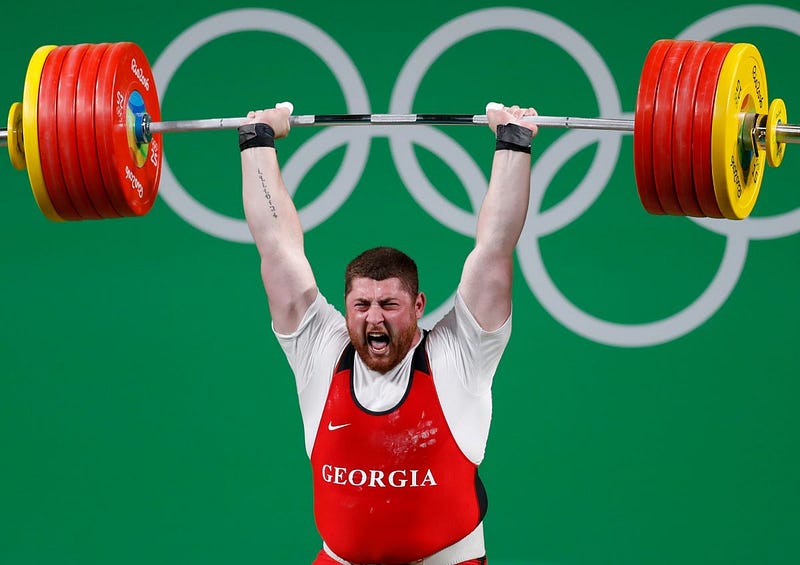
Over the years, Weightlifting has had a couple of major restructures, with older records made void under new rules.
I will give the records' transitions for each of those restructures, including minor weight class changes. These actually coincide with when Michael was in the league and when LeBron was playing.
We’ll start with the big guys.
- 1988 (110+ kg) 475 kg
- 1997 (108+ kg) 462.5 kg
- 2019 (109+ kg) 484 kg
The small guys
- 1989 (52 kg) 272.5 kg
- 2016 (56 kg) 307 kg
- 2019 (55kg) 294 kg
As you can see, there’s again minimal improvement — just under 2% for the big guys and just under 8% for the small guys; but they also had 6% more bodyweight.
Swimming?
In the showcase event, the 100 metres men’s freestyle, the record of 46.91, has stood since 2009. Swimmers first broke the 49-second mark in 1985.
We’ve improved by 4 percent in 30 years. Swimsuit technology also played a part in that.
Across the board, there’s very little improvement in the performance of elite athletes in individual sports since the 1980s and 90s.
But aren’t more athletes using performance-enhancing drugs?
There is also a narrative in some circles (primarily bodybuilders trying to justify their use) that performance-enhancing drug use is rife with professional athletes and that we’re just much smarter at hiding it.
If more athletes take PEDs and nutrition and training practices improve, why are we not breaking records anymore?
This narrative makes little sense.
What makes more sense is that more people took PEDs in the 80s and 90s and did not get caught.
The lack of progress in records, with many not being broken since the 1990s, suggests that sport is probably cleaner now.
Anyway, this tangent is beside the point, although an interesting question to pose.
What about basketball?
There’s little improvement in individual sports since Michael Jordan won his six NBA titles in the 1990s.
Maybe basketball is different? Perhaps the cash lure of pro sports takes all the best athletes?
But in a team sport, how do we determine whether players are more athletic now than they used to be ten, twenty or thirty years ago?
How high a person can jump is a pretty objective measure of measuring basketball players’ athleticism.
Luckily, the NBA records players’ maximum vertical jumps at NBA Draft Combine.
The draft combine is when the best young prospects coming into the league are measured and tested on athletic aspects and skills to help teams decide what players they want to draft.
Unfortunately, the NBA has only kept those records since 2000. Of the six players recorded with a 44-inch or better vertical jump, only two got regular game time, and neither were stars.
Difference online media sources report unofficial records from other combines, but the NBA doesn't keep a centralised record. However, you can find numerous articles talking about it.
I have compiled the numbers from over ten of these sources. Different websites have listed players with slightly different numbers, so I have used the most commonly reported number. So these are not all verified numbers.
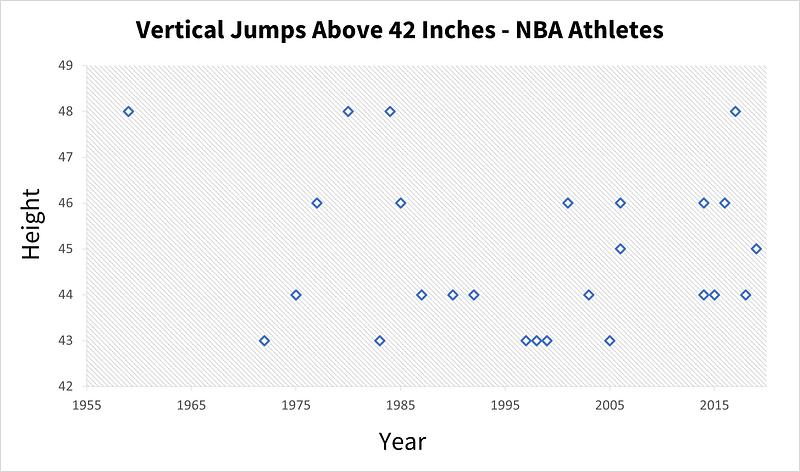
I have created a scatter graph and a table to illustrate the findings.
As we can see in the scatter graph below, there is no discernible trend in the data.
Wilt Chamberlain is the outlier way back in the 1950s with a reported record 48 inches vertical, which he shares with three other players. Two of those entered the league in the 1980s; one of those people was Michael Jordan.
Only one other player has recorded a 48-inch vertical since the Bulls drafted Michael into the NBA in 1984.
The number of players with a vertical jump 43 inches or higher since 2015 is probably over-represented, as some of those players have had minimal impact on the game. Everybody before 2000 was a well-established player with enduring careers.
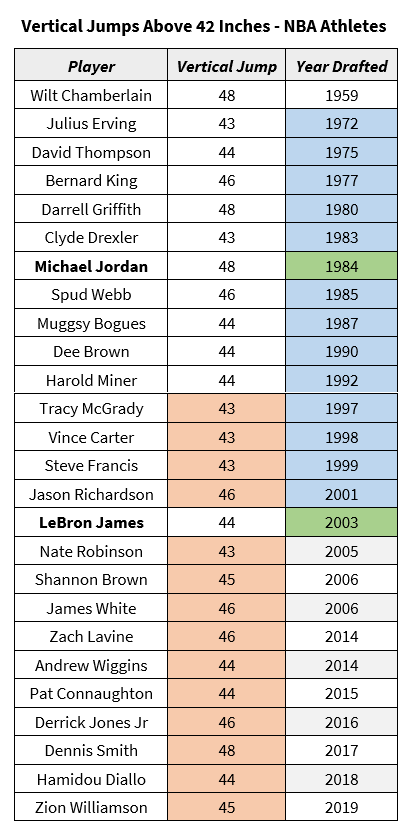
Below is a table of every player in chronological order of draft year, with a reported vertical jump over 42 inches.
It is worth noting that Bill Russell may have also made this list but doesn’t have a recorded vertical jump. He was a world-class high jumper and sprinter. Ranked number 2 in America, Russell could have attended the 1956 Olympics as a high jumper but chose basketball.
Are current NBA players bigger and more athletic?
We are going back to the Michael versus LeBron debate. Has LeBron played in a more athletic league?
The blue cells indicate guys Michael played against, and the red are the players LeBron has faced.
- Michael faced 13 players with 42+ inch vertical jumps over 15 seasons.
- LeBron played 14 of these players over 18 seasons.
There is a slightly higher ratio for Jordan, so arguably, he played against the more athletic players.
So how is it that NBA athletes now are apparently so superior, but arguably the better athletes were in the 1990s?
There is also a narrative now that players are bigger and stronger than 20–30 years ago.
Let’s see if they are any bigger.
I compare players across three seasons about a decade apart:1989–90, 2008–09 and 2020–21. I found this source already comparing the top 10 players for 89–90 and 08–09. For 2021, I use the top 10 scorers via current NBA stats.
I compare two positions. First, a shooting guard, usually one of the smaller guys but often very athletic and skilful.
I’m also comparing a centre — the big guy but usually not the most athletic. I averaged the height and weight of 10 top players in the league in their position.
Shooting guard
- 2020–21 — 6 foot 4, 208 pounds.
- 2008–09 — 6 foot 6, 209 pounds
- 1989–90 — 6 foot 5, 203 pounds
Centre
- 2020–21 — 6 foot 10, 257 pounds
- 2008–09 — 6 foot 11, 268 pounds
- 1989–90 — 7 foot 0, 252 pounds
As you can see, there is minimal variation in the average size of players between the game in 1989 and now just over thirty years later.
In both cases, players are 5 pounds heavier but an inch or two shorter.
We might assume they hold slightly more muscle due to more of an emphasis on weight training. But it’s negligible, really, and without using a larger sample size of players, it’s only an assumption.
The competitiveness of the NBA
The league has been entirely professional since it began in 1946, so the “Jordan played against accountants and plumbers” thing is ridiculous.
They see a picture of some skinny white player from the 1980s, and that’s their reasoning.
Well, there is a similar number of white players in the league today. In the 80s and 90s, there were very few European players in the NBA compared to today.
The salary cap brought in the early 80s was much lower, which meant teams had less money to lure multiple star players, making the NBA more competitive.
In the 90s, when Michael won six titles compared to the 2010s when LeBron won four, 11 different teams made the finals.
Eight teams made the finals in the 2010s — if we start with the 2011 champion instead of the 2010 champion. We’ll give LeBron his 4th title from the 2019–20 season.
That statistic suggests that Michael’s era of basketball had more evenly spread talent across the teams.
Parting Thoughts
Why is this idea so prominent that players are so much more athletic now?
Many fans and analysts consider LeBron a better player than Michael because he’s been consistently dominant for over 15 seasons.
The thing is, Michael won six from six in the finals, and LeBron won four from ten.
Ten final appearances in the modern era are remarkable. LeBron has set all kinds of statistical records and continues to be a massive force in the league, well past what would be considered most peoples’ primes. He seems ageless.
But his finals record will always be a blemish on his career.
Social media has facilitated the spread of the idea that Jordan had it easier. It seems like the more finals that LeBron loses, the more prominent this narrative becomes. It’s like fans are trying to diminish the legacy of what Michael did to justify their belief LeBron is the best ever.
It’s hard to compare to a guy who won six from six finals series as the most dominant player in each.
Michael was also an elite defender as well as an elite scorer. He was ten times scoring champ and nine times all-defensive first team. That means the best defender in his position — whilst being the best offensive weapon in the game.
In comparison, Lebron has been five times all-defensive first team but only once was the scoring champ. But, a more dominant rebounder due to his size and a better passer.
Probably the best two basketball players of all time.
But we need to stop comparing the two and acting like Michael had it easier against lesser opponents.
I think the stats have proved he didn’t have it easier at all.
The average player's athleticism might be slightly better in today’s game, but we’re talking a few percentage points.
The statistics indicate that elite athletes thirty years ago are still elite athletes today.
Thank you for reading.
If you enjoyed the content, you might be interested in this article about using progressive overload to build muscle.
Read More Medium Articles
Non-Medium members can only read 3 articles a month.
Become a Medium Member for unlimited access to my content and articles from thousands of other writers, for just $5 a month.
Subscribe to be notified when I publish new content.


