
Why Online Classes don't Work and How to Improve them
It’s very evident this world wasn’t ready to teach online.

At the time of writing this article, Colleges and universities around the world have to cancel face-to-face classes to avoid the spread of the coronavirus. we have implemented the online classes as a “good alternative to keep the schedules plans”, however, it’s very evident that this world wasn't ready to teach online.
Let's start from the beginning: Teaching by video call is not online education. Many teachers are doing everything possible to teach something to their students, but not everyone was prepared for this change. What is being done with online classes is urgently trying to fill a gap to try to keep up the education.
And I know that there are currently many websites that teach online courses and people learn with them. The reason why online courses and companies like Udacity and Udemy work is because from the beginning they are focused on teaching something via the internet, they have activities, teachers dedicated to this type of education, resources, and skills.
Why online classes don't work
To solve a problem, we must first know why it doesn’t work. I did a survey of students from the United States and the Dominican Republic, in which they explained what were the advantages and disadvantages of this type of education, and if they would prefer to stay online.
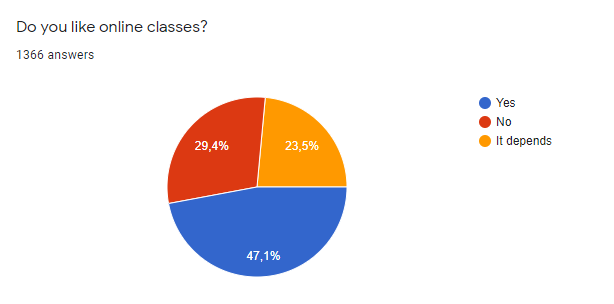
As you can see in the image, more than half of the respondents don’t like online classes. In the answer “what do you like most about online classes” the most common were:
- No traffic: As you don’t go out, you avoid all the bad things about going outside, one of them, traffic.
- Flexible schedule: In some cases, you have the opportunity to study whenever you want. This applies more to private online courses than school classes.
- On-demand knowledge: You can learn what you want to learn, so you have the chance to avoid studying unnecessary things that you don't like. This point applies more when you take an online course than online classes.
- Self-paced: Since you have your own resources, you have the possibility to search for other sources, and you have access to other information. When you are in a face-to-face class, at least at that moment, you should only pay attention to what the teacher says.
- I can save and eat healthily: Since you don’t have to leave the house, you don’t have to spend money on food, gas, and everything that goes with getting ready to go somewhere. Also, since you are at home, it is an opportunity to prepare healthy foods.
- Less waste of time: You don't lose time getting ready, going to the place, waiting for every student and the teacher, and going back to your house.
- Comfort from home: Being at home is an opportunity to build your own workspace. This has many benefits, especially because you can make a space as comfortable as possible for you.
As you can see, online classes have a lot of advantages, but most of them have to do with comfort and flexibility, and not with the quality of learning. Now we go with the disadvantages of online classes, the most common were:
- Hard to focus: Some people may need someone there watching and guiding to have a commitment. Requires discipline, when you go to an institution is easier to focus on studying because everybody is there for the same unlike being home.
- Environment distractions: When you are at home, you can do a lot of things while you are in a class, so its easier to get distracted than when you are in a classroom.
- Less effective communication: When it is a virtual class, interaction with the teacher from a screen is difficult, sometimes it is even difficult to understand what he is saying.
- It depends on your resources: Devices, internet connection, workstation. You need to have everything on point in order to take your class.
- Doubts are not easily resolved: Sometimes you require any additional information when you need to complete a task and there isn’t any teacher online or available.
- Internet issues: Not everyone has a good internet or a computer to participate correctly in an online class.
- Reading a presentation is not class: Some teachers only reads a presentation for hours while a student is looking at the screen. this does not work and you lose interest in a class. Normally nothing is learned from this type of teaching.
In this case, the disadvantages of an online class focus more on the learning they are obtaining, than on comfort, like on the advantages. For this reason it is confirmed that the purpose of online classes is not working as it should.
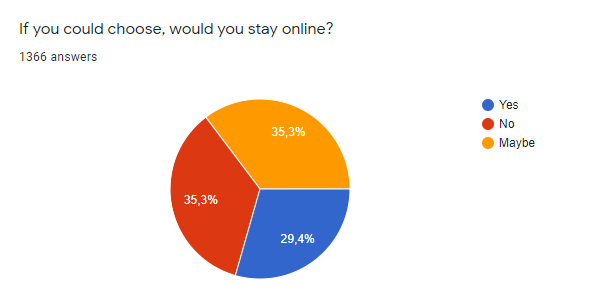
Finally, respondents were asked if they would stay with online classes, and only 29.4% said that they accept this modality. This means that although technology has advanced considerably, there is still room for improvement in this regard.
How to improve online classes
As a student of both platforms (online courses as face-to-face classes), I have compiled a series of tips that have helped me learn online, and how they can be implemented in today’s education:
Consider teaching asynchronously
Instead of giving live web talks, it’s better to provide videos to the students, so they can watch at any time of the day or night. With this, less time is wasted waiting for the students to start the class, you can avoid the connection failures that don’t allow them to listen or talk, and students have all the time of the day to get and watch the video.
There are many advantages to asynchronous learning. It gives students more flexibility during a time of crisis and gives them the opportunity to review lectures multiple times. For faculty, developing conference videos can be a real-time saving, especially for those who teach multiple sections of the same course.
You can use video calls to answer questions and make these types of meetings more precise and dynamic. With this you will not have to waste time waiting for any student, because whoever has doubts about the assignment will be available at the time the doubts are going to be resolved.
Avoid long presentations
If attending a presentation for more than 40 minutes is difficult enough in a face-to-face class, what makes you think that students are going to learn if you start reading a presentation online for 3 hours? When a teacher teaches a class to meet requirements, students will go to class to meet attendance.
You can make short, accurate, and dynamic presentations, involving activities for students, like doing assignments or answering questions if necessary, that will keep the audience’s attention while speaking. An example I can give you is when I make an explanatory video on my channel:
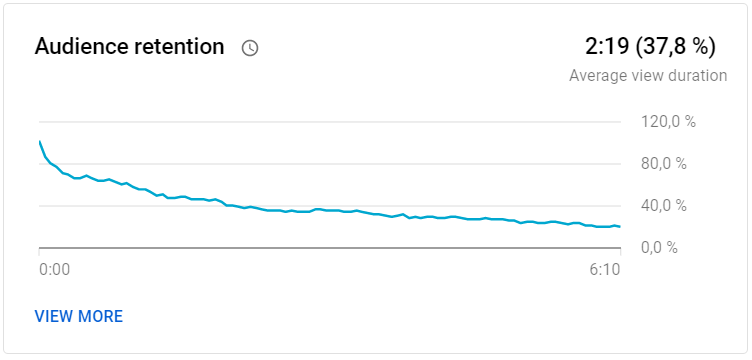
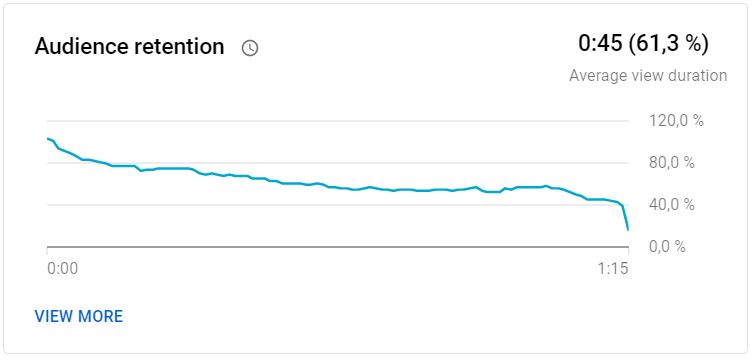
Something that I have noticed in my videos explaining on YouTube, is that the audience is losing interest as the video progresses. A 6-minute video can lose interest after 2 minutes. Unlike shorter or more entertaining videos, it keeps the audience from start to finish:
Provide other resources
There is an big amount of educational resources already available for you to use with your students. You don’t have to invent anything from scratch or do master to teach completely online. On the web, you will find videos of conferences, activities, discussion messages, and simulations. This should be your first step before creating a lot of content yourself.
I know teachers that their activities include taking a course on one of the existing online platforms and mailing the certificate. I see this totally valid although many believe that it means that the teacher “would not do his job”, after all, we want the student to learn. If you want to add participation to these courses, you can create extra activities to make sure they are learning correctly.
Take advantage of technology to simplify you
There are many colleges and universities that have platforms for homework assessments, but if not, you can currently use free applications that already exist on the market. Take into account that they must be the easiest for both you and the students.
An example is using google drive to upload assignments there, try not to use complex applications because if you are not a technology teacher, you will still have to teach technicalities if your 15–30 students cannot access it. If google drive works, it is easy and fast, stay with it.
I recommend that you create a forum where students can participate and answer questions from other students, so the interaction between them will be more dynamic and you can avoid answering the same question over and over again.
Accept feedbacks
Lastly, feedbacks don’t necessarily have to be bad. You can use feedbacks to know what you can improve, and what is good to keep working. You can create a section where the students share their opinion of the class you are giving and take it to help both you and the students in the future.
We do not know how far the pandemic will take us, and it is good that we adapt to changes and continue to improve. What other tips would you like to add to this list?


