
Why Nvidia Surpassed Google Parent Alphabet in Market Capitalization?
Big tech is now pivoting away from the pandemic-induced spike in e-commerce and immersive technologies in favor of the opportunities in artificial intelligence (AI)

The race for Artificial Intelligence (AI) dominance is on, and the champions we assumed would lead the way — internet and software giants — are now fighting a different battle. Specifically, the big tech is now pivoting from the pandemic-induced spike in e-commerce and immersive technologies in favor of the opportunities in artificial intelligence. At the same time, hardware companies at the forefront of AI technology development, such as Nvidia, are not only seeing a steady rise but are even surpassing the market capitalization of their internet and software counterparts. This past week, Nvidia reached a symbolic milestone on Wall Street when its market capitalization ($1.83T) sightly edged over that of Alphabet ($1.82T) and Amazon ($1.80T), and now is the third largest tech company, only behind Apple and Microsoft. This is a remarkable feat for Nvidia, which was established as a gaming hardware manufacturer dominating the graphics processing unit (GPU) market, but has since expanded into various other markets.
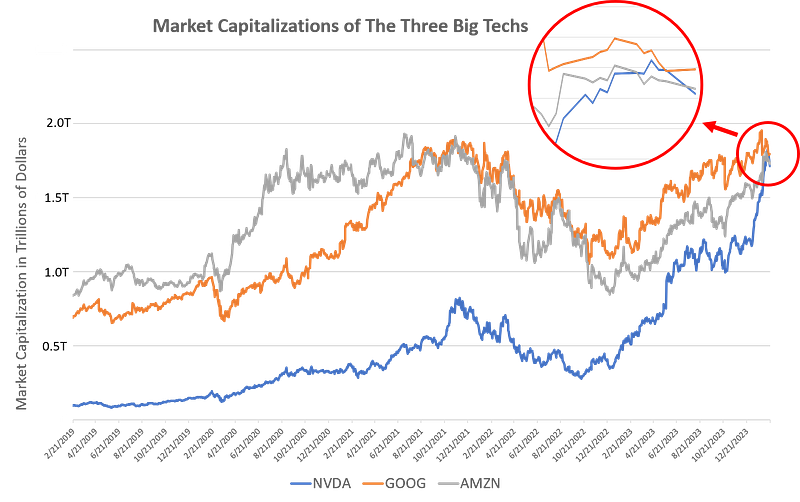
Here is a quick look into why the AI hardware development has maintained a steady growth in view of the current restructuring of the other big tech players.
AI’s Dollar Dash: Algorithm vs. Hardware
Although AI can take many different forms, at its foundation, it refers to the development of machines that can:
· Simulate intelligence: AI is a branch of computer science focused on simulating intelligent behaviors in computers.
· Imitate human behavior: AI enables machines to create systems that mimic human decision-making.
· Complete tasks that previously required human intelligence: AI allows computers to perform tasks that typically demand human intelligence, such as speech recognition, visual perception, translation, and decision-making.
Although the introduction of ChatGPT and other generative AI may have sparked a surge in popular interest in AI, excitement for advancements in the subject has been building for years in academia and research. The quantity of publications on AI has increased during the last ten years, more than tripling between 2010 and 2021. There is no doubt that more and more AI applications and products will be coming onto the market in the near future and most businesses will be looking to employ AI products to streamline their business and find new market opportunities.
The emergence of Google in the early part of the century and the following social media sector has also accelerated research in development of AI algorithm for various applications. While there are numerous and expanding number of AI topics such as natural language processing, computer vision, reinforcement learning, and others that are being researched and explored for general applications in a, sometimes, sporadic, or periodic progress. The effort in developing the associated hardware has been quite consistent, at least, at these early stages.
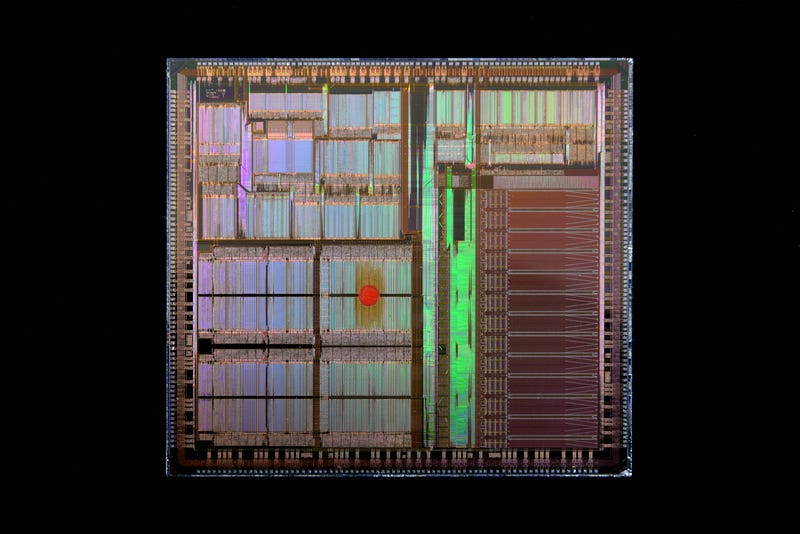
Artificial Intelligence (AI) chips typically comprise of graphics processing units (GPUs), field-programmable gate arrays (FPGAs), and AI-specific integrated circuits (ASICs). While some basic AI activities can also be completed by general-purpose chips like central processing units (CPUs), but CPUs are becoming less and less relevant as AI develops.
Similar to general-purpose CPUs, artificial intelligence (AI) chips are becoming faster and more energy-efficient by design optimizations to make them operate faster and more efficiently in a variety of complicated AI applications. This allows AI chips to perform more computations per unit of energy used. However, AI chips also include additional AI-optimized design elements, unlike CPUs. The identical, predictable, independent calculations needed by AI algorithms are significantly accelerated by these optimizations. The use of programming languages designed specifically to efficiently translate AI computer code for execution on an AI chip, as well as the ability to execute large number of calculations in parallel rather than sequentially, as in CPUs, are some examples. Other techniques include calculating numbers with low precision in a way that successfully implements AI algorithms while reducing the number of resources needed for the same calculation (i.e. in neural networks).
Certain tasks are better suited for specific types of AI chips. The most common usage of GPUs is in the “training” phase, which involves the initial development and improvement of AI algorithms. FPGAs are mostly utilized for “inference,” or applying taught artificial intelligence algorithms to real-world data inputs. ASICs can be created for inference or training.
In all, AI hardware development is still mostly independent of the particular type of AI research topic, whether it is a large language model, computer vision, reinforcement learning, or any other AI topic. Therefore, this remains one of the main reasons for the continuous growth of the AI hardware companies (Semiconductors) when the algorithm developers are focused on the basic research in AI. Perhaps even more importantly, the AI hardware (semiconductor) manufacturers did not indulge in the hiring binges carried on by the internet companies in anticipation of the rapid spike in e-commerce business as a result of the pandemic. Then, it should not come as a surprise that almost 80% of the market for high-end AI chips is now controlled by Nvidia, a position that has increased the company’s stock price 47% this year after it more than tripled in 2023.