
ENVIRONMENT
Why Nuclear Waste is Far Safer Than You Think
Non-nuclear fossil fuel waste is MANY times worse for the environment
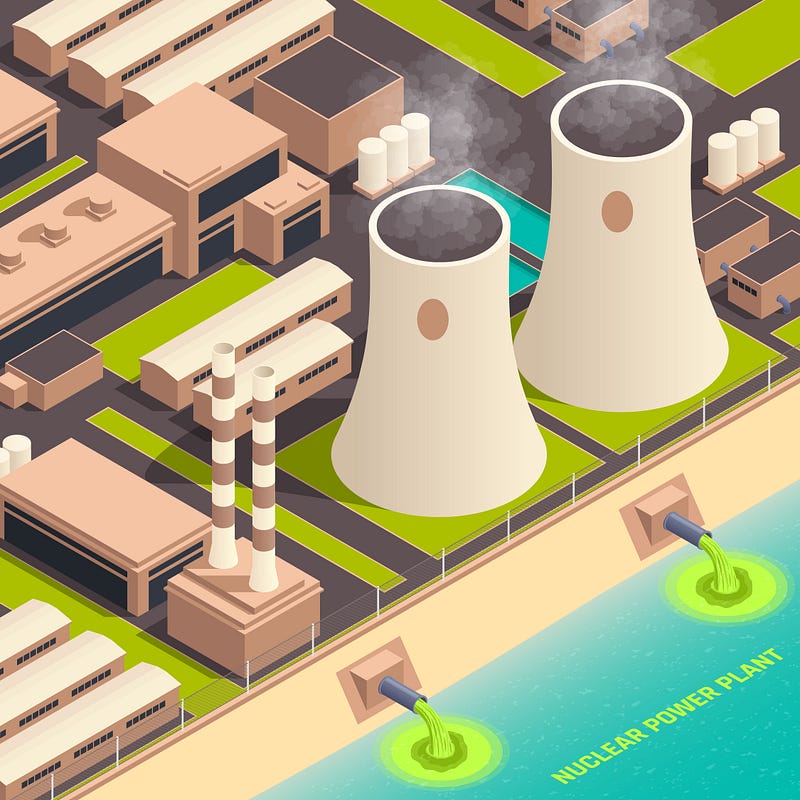
Most of us don’t like the idea of nuclear waste. We associate it with nuclear accidents like Chernobyl and with nuclear warfare. Around 60–75% of people think nuclear waste is an obstacle to the expansion of nuclear power.
But it’s nowhere near the problem we think it is.
What is nuclear waste?
It is any waste that emits alpha, beta, or gamma radiation. It can be anything from spent nuclear fuel rods down to gloves worn by nuclear engineers. It comes from:
- Making nuclear medicine.
- Producing nuclear power.
- Reprocessing nuclear weapons.
- Rare-earth mining.
So far, about 450,000,000 kilograms of nuclear waste have been generated. About a third of that has been recycled.
Due to the public perception of nuclear waste, it is usually stored:
- Where it is generated, in pools of water;
- or in dry casks, above ground.
Non-nuclear waste is far worse
In the United States, this is how much pollution is released into the sky:
- Coal plants: 130,000,000,000 kilograms PER YEAR.
- Nuclear waste: 450,000,000 kilograms from ALL nuclear waste in their LIFETIME.
That’s 300 TIMES as much pollution from coal per year than in total from nuclear.
A single coal plant will put more ash into the air PER HOUR than a single nuclear plant will in its LIFETIME.
One in five deaths can be attributed to the burning of fossil fuels. For example, the air quality in Beijing is worse than Ground Zero was after 911. And coal plants are the single biggest source of mercury pollution on the planet.
And then there are the various fossil fuel disasters that have happened over the years. For example:
- Deepwater Horizon oil spill, Gulf of Mexico, April 2010.
- Gas leak, Marshfield, Massachusetts, May 2021.
- Pemex ocean fire, Gulf of Mexico, July 2021.
- Great Smog of London, December 1952.
- Kingston Fossil Plant coal fly ash slurry spill, Tennessee, December 2008.
How is nuclear waste dealt with?
Nuclear waste is not completely harmless. But let’s get things in perspective.
There are three types of nuclear waste:
- Low-Level Waste (LLW): anything from paper to gloves that are lightly irradiated.
- Intermediate-Level Waste (ILW): requires some shielding, but decays well enough over time.
- High-Level Waste (HLW): this needs to be cooled down in cooling ponds for a couple of years and then stored away.
But only about 1–3% of nuclear waste is HLW. All the HLW ever created in the world could be buried in an area the size of a football field.
It is stored above ground in “dry casks”. Giant concrete cylinders filled with nuclear material combined with glass and ceramic. This keeps the nuclear material cool and below critical.
But over 95% of nuclear waste is either LLW or ILW. It has a short enough half-life to be able to decay to a harmless state within the lifetime of the power plant. By then, standing next to stored nuclear waste is less harmful than flying in a plane across America.
Compare this to the metal pollution from coal plants. That will never lose its toxicity. Nuclear waste, when properly stored and managed, is far easier to deal with than fossil fuel waste.
What if an accident happens when transporting nuclear waste?
The casks used to transport nuclear waste are almost totally indestructible. You can even crash a train into one of them and nothing will happen to it.
There have been no recorded accidents where one of them cracks open and stuff leaks out. And there isn’t any stuff to leak out anyway. It’s not green glowing goo. It’s concrete, steel, glass, and ceramic.
Properly stored and managed, nuclear waste might even be the safest form of waste there is.
Deep Isolation: the ultimate solution?
The absolute best way to store High-Level nuclear waste long term is deep underground. You take the already-safe dry casks and put them in a hole dug so deep that it’s below anything like a geologically active water table or a biosphere. It’s as far away from people as you can put something without sending it into space.
And the best way to do this could be by using borehole technology that the oil and gas industry already has. This involves drilling 18-inch diameter holes a thousand feet or more below ground.
And the great thing is, they could do all this on-site at a nuclear power plant. And that means there will be no need for a single large nuclear waste site.
This article was based on the following video:
Come join Medium and support me and thousands of other writers by signing up for a membership. It’s only $5 per month. You could also make money by writing too. The top writers can make $500+ per month. Sign up with this link, you’ll support me directly and it won’t cost you anything extra. Thank you in advance.


