
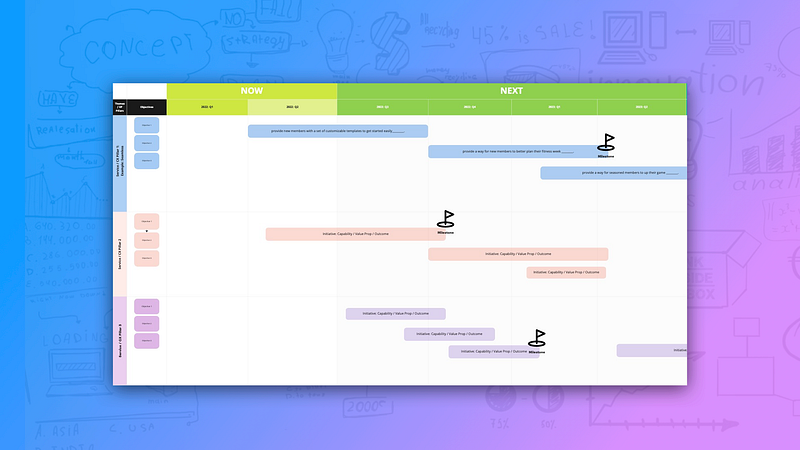
Why “Now” “Next” “Later” is one of the best frameworks for roadmapping
If you would like a Now -> Next -> Later strategic planning tool, you can check out one of mine on Miro (link below). The board includes a strategic pillars exercise to organize work as well as an OKRs workshop.
*** Update — my official strategic roadmapping template is now on the Miroverse. You can get your copy here: https://miro.com/miroverse/personify-strategic-planning-playbook-template/
There are quite a few ways to roadmap — but there is one I have used over and over, regardless of the type of initiative I’ve done.
And that is the “now” -> “next” -> “later” style of roadmapping and planning.
One of the hardest things about roadmapping in general is, well, things change. Constantly. The best laid plans are the plans that are waiting to be disrupted by some unforeseen force. Roadmapping can be a headache because if you’re not careful, your roadmap will be constantly outdated or impossible to manage.
Many teams that are asked to roadmap often struggle to be both strategic and executional. Worse than this, roadmaps can easily devolve into simply a release calendar of features or tactics (which is NOT a roadmap btw).
A good roadmap at it’s most abstract is mainly about 3 things (and your roadmap should somehow reflect ALL 3):
- A vision (what do we want to be & where do we want to end up).
- A compass (which general direction should we head in to get there).
- A plan (a set of steps, directives and instructions we will take to actually get there).
This is why I like “Now”, “Next”, “Later” because at its core it is designed to handle all 3 of these into a single framework.
“Now”, “Next”, “Later” also solves several common problems I see a lot:
- It lets you move away from calendars or specific dates and focuses more on periods of time and intention.
- It breaks work into chunks and helps you understand what you need to do and in what order over time.
- It helps you easily re-organize or re-assess at strategic points (say between “now” and “next”) to tweak the roadmap without tossing everything out or starting over.
- It can apply to many different types of situations (annual strategic planning, a re-design / digital transformation project or a from-scratch product).
- And most importantly it provides a framework ANYONE, especially non-product people, can understand and even help execute against.
There are a few roadmaps I will show you that use the “Now”, “Next”, “Later” concept to illustrate this point. Feel free to steal any of these btw.
The Strategic Roadmap
Strategic roadmaps really are about goals and objectives and a plan to achieve those. They link business objectives and outcomes (via KPIs) with customer needs (aka: jobs) and benefits / value (aka: capabilities).
Generally the idea is by providing customers some unit of value or capability (x), you hope to achieve some type of company goal or objective (y).
Below is a very high level example of an annual strategic roadmap for an experience pod.
(I tend to organize teams by what I call “experience pods” — not by platforms or business units — happy to talk about this if anyone is interested in seeing how this works)
You’ll notice below that there is NO mention of any features or functionality.
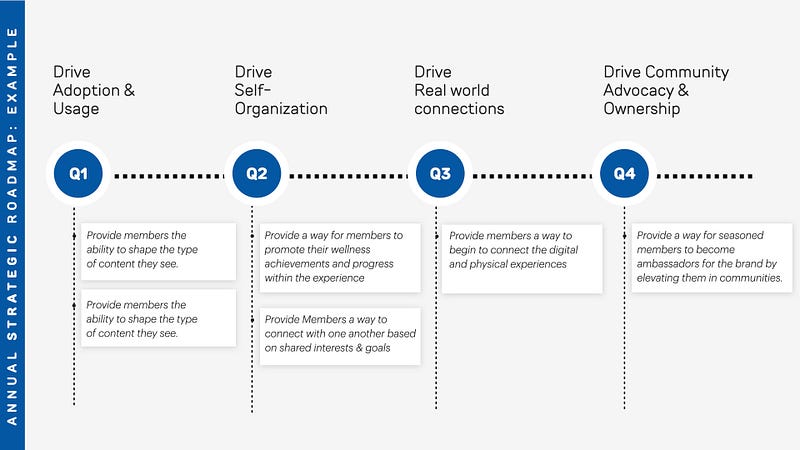
This type of roadmap can then be broken into a more discrete execution plan with units of now / next, which align to sprints like below:
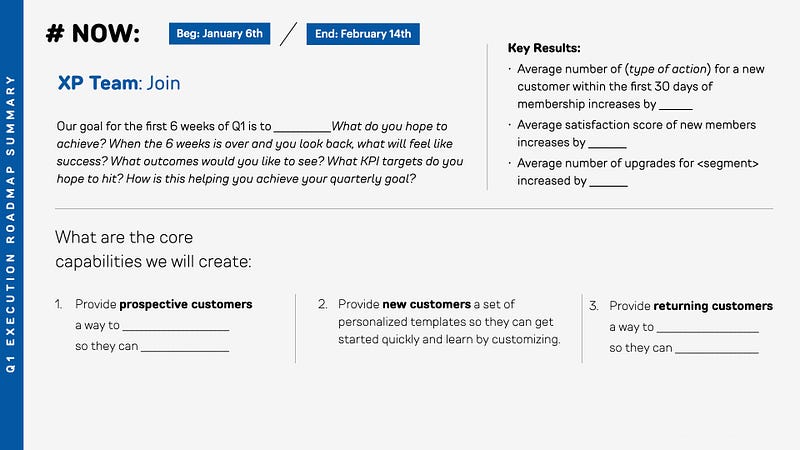
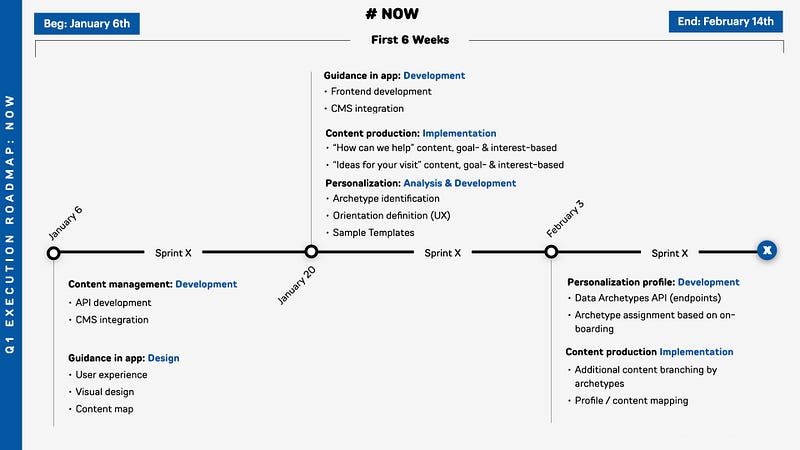
You can quickly see how the work, by being organized around “Now” and “Next”, can be both executional and strategic at the same time. In fact it’s now pretty easy to track how your execution plan is helping you realize the larger goals.
And it lends itself to a timeframe — in this case “now” is 3 sprints and “next” is another 3 sprints.
Which is a quarter. Boom.
The Transformation Roadmap
Sometimes people want to know, ok, so what are the various chunks of work that need to happen at key phases or stages of a transformation or re-design project so I can tell how this transformation will be playing out?
Re-design (digital transformation) projects for me tend to go through 3 key phases:
- Re-design: This is the “now”. This is where you take a current service and set a new foundation (often this happens because the current service is no longer meeting the needs of customers or a business — OR further — some new opportunity has been identified that necessitates a transformation in order to capitalize on it).
- Enhance: Once the foundation has been set (you’ve put in the plumbing and enabled the baseline set of value props for the new service) you then set about differentiating it or adding those things that will make it more unique or valuable.
- Innovate: It’s often hard to innovate until you know how the new service plays out. Especially when you are seeking to re-imagine an existing service (out with the old, in with the new). But innovation or “being an innovator” in the field or industry is what can lead to unlocking some type of real long term growth — and even shifting the focus of a business.
Below is an example of this:
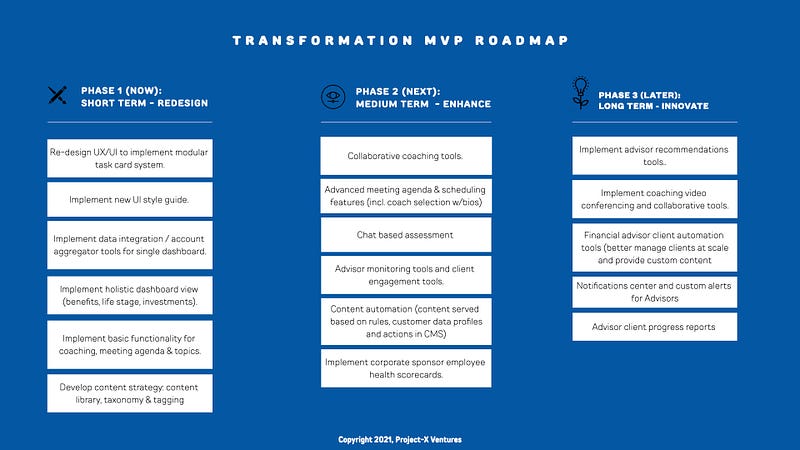
You will notice that this is very different than the strategic roadmap. But it still lays out the general capabilities of the service by some phase linked to “now”, “next”, “later”.
Again, different purpose, but similar concept. For a non product person it’s easy to understand what will be done in what order and more importantly WHY.
- It’s a vision — we want to be this.
- It’s a compass — we should go in this direction.
- It’s a plan — we should (generally) do these things in this order to get to our vision (or realize our transformation).
It allows you to easily move and replace things as you learn without having to redo an entire schedule.
Validation and Testing
“Now”, “next”, “later” can even apply to a project where you are doing several different phases of validation and testing — a proof of concept type project.
The timeframes for each phase can even be different, but again, this will give you a sense of how you will be breaking up various test & validation cycles, WHAT type of testing you will be doing and why (and what you hope to get at the end — which in this case is a proof of concept AND a set of MVP features to begin to build out the actual product).
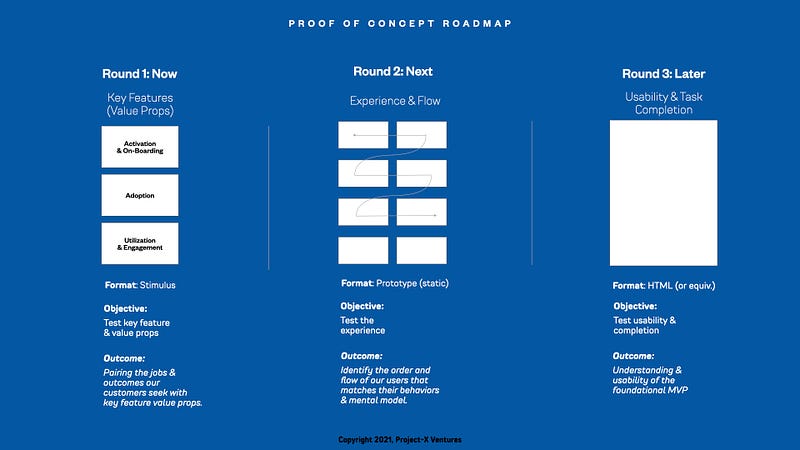
So there you have it.
“Now”, “Next”, “Later” is a great flexible framework that can be applied to many different types of situations or initiatives.
Note: Sometimes you will see marketing folks or business people use this concept of “crawl”, “walk”, “run”. It’s a very similar idea, so if you encounter that lingo you’ll know it’s pretty much the same.
Hope you found this useful as a starting place to be able to use this concept to help you create and communicate your plans to others.


