
Sustainability
Why Not Walk?
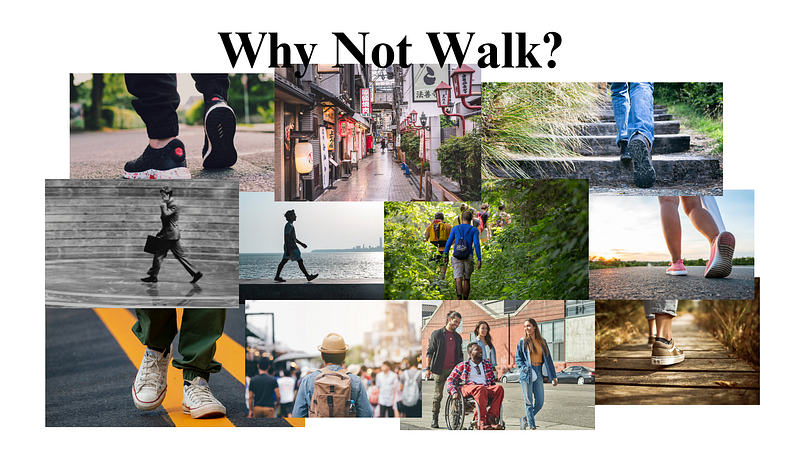
Walking is the only affordable and sustainable transportation choice. We have a right to people-centric city planning.
Car traffic is on most people’s minds and is a primary concern of city planners and traffic engineers, but history shows us repeatedly that more and bigger roads won’t solve the car traffic problem. It can only be solved by having fewer cars on the road.
Walking is a sustainable transportation choice that reduces a person’s carbon footprint, car noise, and light pollution at night. It improves a person’s mental and physical health and increases social interactions within their neighbourhood. Walking is a pleasant experience (usually) that increases the revenue of businesses along the route and preserves historically significant buildings.
Walking is affordable as well as sustainable. No resources are used for walking.
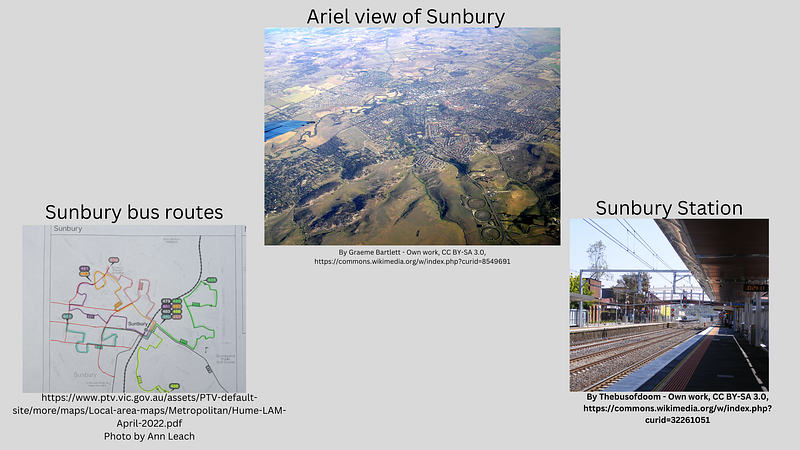
When walking is teamed up with well-organised public transportation and car-sharing services, every place is accessible. Did you know most homes in Sunbury are within a 10-minute walk of a bus stop or the train station?
But I’m not anti-car. I love to go camping and there is no public transportation to the campground in the Otways! However, the Bendigo line does go to Swan Hill where the train station is directly across the street from the campground. Did you know a beach wagon will hold a 4-person tent, the kitchen box, and 2 camp stretchers?
My journey toward #whynotwalk began in my 20s when I took an Environmental Science class that opened my eyes to the impact human choices were having on Earth. Something HAD to change.
Since then, my own choices have ranged between really, really good and really, really bad. No one is perfect. But I can’t unknow what I know and so that voice is always asking “Ann, can you do better?”
For me doing better means looking for less impactful ways of getting to desired outcomes and that’s what brought me to #whynotwalk.
In 2017, I looked at where I live and my lifestyle, and started asking myself “Why not walk?”. Oh, I had all the reasons — it’s inconvenient, I don’t have time, I can’t be bothered, and others. But over time, some of those reasons held less value for me and I started walking — to the library, to the store for a couple of items, and to the train station.
Choosing to walk or walking + public transportation isn’t for everyone. It is a location-dependent choice to make, but going forward, everyone can ask #whynotwalk before getting in the car. And that is what the #whynotwalk campaign is all about. Being mindful of the choice being made.
Is walking a choice for you where you live? If not and you live in the city, have you written a letter to the city planner letting them know change needs to happen?
Please respond below. Cheers
If you would like more information about Why not walk? — join our group on Facebook by clicking the link: Why not walk?
This is a transcript of the presentation I gave recently at the Great Green Get Together hosted by Hume Council bringing together Enviro Champs from this year and last year plus the Sustainability team from Hume Council as well as a couple of Councillors.
It was a lovely evening of meeting and talking with others in the community who are vested heavily in doing what is right for the environment that we all share.
Next article: Online Dating Isn’t Ideal
Previous article: Monthly Budget Update — June 2023