
Fahrenheit 122
Why Net Zero by 2050 Is a Deadly Myth
“I am terrified by what I see coming” — NASA climate scientist

When a climate scientist from NASA says he’s terrified by what he sees, you sit up and listen.
In the past few months, climate scientist Peter Kalmus wrote “Net Zero by 2050” is not a policy but “a deadly procrastination.”
Net zero by 2050 was a strategy agreed by governments worldwide to decarbonize their economies. (Let’s not even mention Saudi Arabia (2060) and India’s (2070) Net Zero carbon emission targets.)
But is it only a sprinkle of sugar to make the bitter medicine palatable?
There are two flaws with ‘Net Zero by 2050’
“As a climate scientist, I am terrified by what I see coming. I want world leaders to stop hiding behind magical thinking and feel the same terror. Then they would finally end fossil fuels.” — Peter Kalmus
Flaw #1: The 2050 target
When we talk about 2050, it’s far enough away to not worry.
Think about how many things can happen in 28 years. Think back to life in 1993. Ironically, the United Nations held the first ’Earth Summit’ in Rio de Janeiro, Brazil, in 1992.
What we do know is there are no long-term incentives in politics. The longest political term is five years; while most world leaders will not be alive in 28 years’ time.
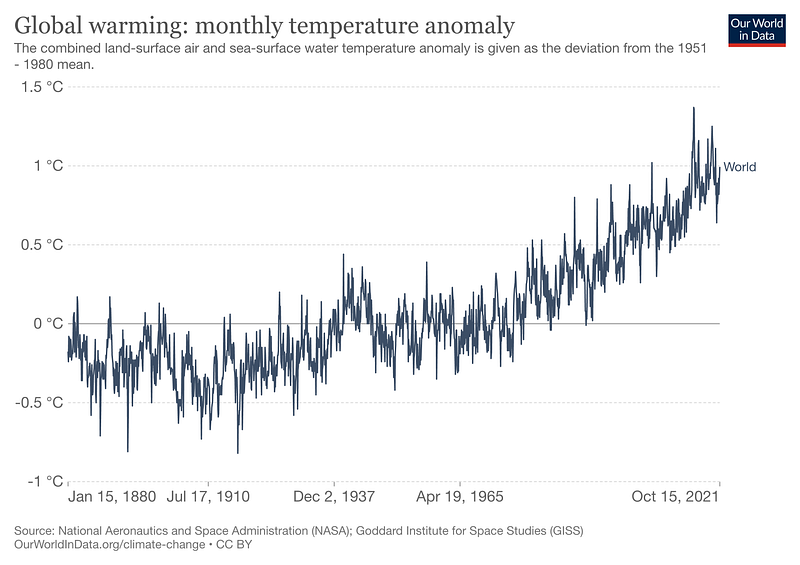
We are currently experiencing 1.1 degrees now. We have a target of 1.5 degrees for 2030 — in 97 months time.
Unfortunately, recent climate catastrophes show climate models seem to have underestimated the intensity of the impact of global warming by a few 0.1 degrees.
The violence of climate change is faster and more savage than they predicted, even at 1.1 degrees — let alone at the “safer” 1.5 degrees.
Flaw #2 Forget about the Net in Net Zero.
“”Net zero” is a phrase that represents magical thinking rooted in our society’s technology fetish.” — Peter Kalmus
Net zero is a sum based on taking out carbon emissions to what we put into the atmosphere. It should equal zero.
But policy makers are betting the house on hypothetical carbon capture technologies. They do not yet exist and if they do; they are not proven at the scale we need.
Reforestation will help, but this will have a tiny impact compared to stopping fossil fuel use.
Here are some actionable tips put forward by the NASA climate scientist:
1. Don’t bet the Earth on technology that does not yet exist
When policymakers talk about Net Zero by 2050, they are balancing the books of carbon emissions. They work to an equation: take out carbon from the atmosphere equal to what we put into the atmosphere.
And yet, none of these hypothetical technologies have proven to work on the massive scale needed.
Stopping fossil fuels would stop more carbon going into the atmosphere.
2. Big oil needs to feel the pain first.
Instead of tip-toeing around big oil, governments need to end fossil fuel subsidies. New oil and gas infrastructure halted.
According to Mark Jacobson of Stanford University’s Solutions Project, alternatives to fossil fuels already exist. Almost every country has the natural resources required to convert to renewable energy.
Otherwise, it will be us who feel the pain first.
Environmental and social justice
There will be riots if fossil fuels suddenly stop without consultation.
It can not be a decree from up high.
As the Gilets Jaunes in France showed in 2018, when faced with clumsy fuel taxes by a new President, social justice must be at the heart of environmental policy.
The silver lining, if you could call it that: Peter Kalmus says the drastic policy, infrastructure and lifestyle changes will seem less radical with each new climate disaster.
Are we to accept lurching from one man made disaster to the next? That’s no way to live. Any more procrastination is going to be deadly.
To stop a collapse, we need to stop using fossil fuels and faster.
Further reading:
5 Sad Reflections After Listening to 196 Countries Last Speeches at COP26