
Why More Families Are Deciding Not to Have a Funeral for Loved Ones
You might think it’s about the money, but something cultural is also happening here, and the trend is not good or healthy.
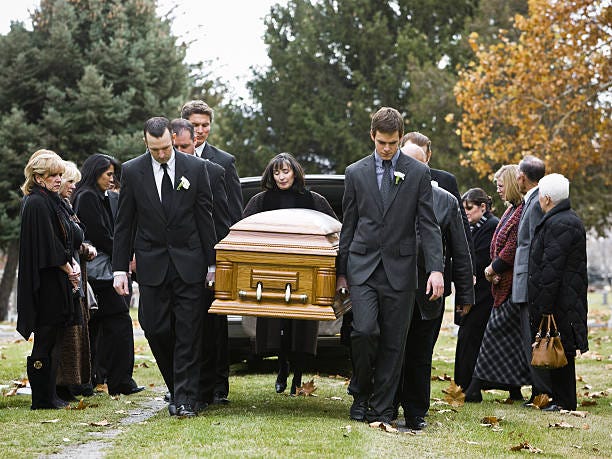

My mother’s second husband died after her, but his family decided there would be no funeral, which was a shame. It took a few years for my siblings and me to like him, but we wished we could have said goodbye differently. The decision not to have a funeral service is sometimes financial, but that was not the case here.
Denying the survivors an opportunity to grieve and mourn together is short-sighted and selfish. Unless you are Charles Manson or a serial killer, some loved ones and family exist and need to spend time together, sharing grief. And together does not mean on Zoom or live-streaming. Funerals also remind us of our mortality and how to live every day to the fullest. Most of our lives are spent in death denial, and not attending a funeral strengthens that fallacy.
My first experience with the “no funeral” decision (NF) was when my mother’s father died many years ago. For some inexplicable reason, my mother and her sister decided not to have a burial or funeral. He died in Florida. My mother lived in New York, and my aunt in Baltimore. The third sibling, my uncle, lived in Los Angeles but had been estranged from his father for decades.
I don’t know why he hated my grandfather so much, but his instructions to my mother and aunt can be summed up with these words as his father was dying in Florida. “I am going to Europe. Don’t call or contact me when he dies.” Devoid of any warm and fuzzies, this instruction sent me chills when I first heard it.
Admittedly, the pandemic years played a pivotal role in this NF trend. Lockdowns and Covid fears shut down many funerals, weddings, and other gatherings vital to human interaction. Orthodox Jews were shunned, shamed, and even arrested in New York City as they defied lockdown orders and assembled by the hundreds to say farewell to loved ones and Rabbis. More families have turned to cremation rather than burials. But that it is a separate issue from an “in-person” event. And whether it is called a funeral ceremony or a “celebration of life” is unimportant. Rather, the chance to grieve together is what is relevant.
The Ramifications of a Non-In-Person Funeral
A virtual halt to funerals was only one of the many devastating effects of the pandemic lockdowns. Even now, some families livestream funeral services. This benefits those who live long distances from where the services are held, cannot afford or are physically unable to travel. But there are many advantages for those able to make the trip and the time.
- Closure: Without paying your respects to a deceased friend or loved one, there is a hole or space inside you. Although we all grieve differently, the lack of that final farewell makes the death seem unreal. There is an emotional business that is never finished or closed. It is like an open wound. Attending a funeral service lets your mind and subconscious know that your grief is not only allowed but is valid.
- Support for the survivors: Just showing up helps them know that their loved one meant something to others. An email, text, or Facebook post cannot replace this solace. Even if you struggle with what to say, your words do matter. “I am sorry for your loss” or “Accept our condolences” seem cliched, but they still help others' grief. I would, however, avoid phrases like, “At least they are in a better place now” (you don’t know that) or “They are no longer in pain or suffering.” While the latter may be true, those words never diminished my grief when I heard them.
- Words of encouragement: Survivors are often at a loss for words. Eulogies allow others to express what the family can’t and offer kind support and encouragement.
- Bonding: The in-person funeral helps the family and friends to meet and bond. Lost friendships and relationships can be rekindled. However, the opposite is also true. An in-person funeral may be awkward and counter-productive if a family has spent years immersed in internal feuding.
- Physical presence: There is no substitute for a good hug or looking into the eyes of loved ones who have entered the grieving process. The human physical touch helps to start healing and is impossible to replicate online.
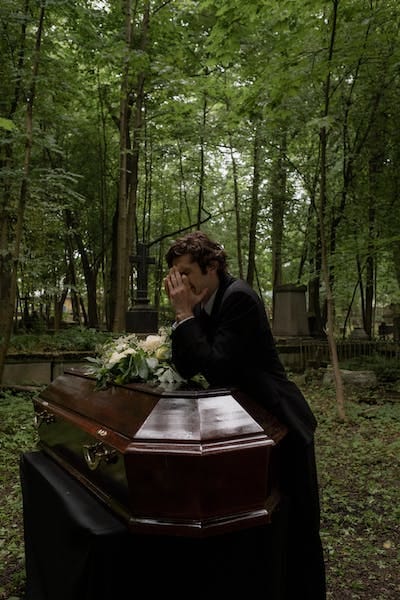

Secularization
In the 1950s-1960s, around 57–63% of the US population reported attending church regularly. Since then, those numbers have steadily declined. In 2022, one source reported that only 22% of US citizens were regular church or synagogue attendees. In addition to guiding children and young families about leading moral lives, religion provides structure to important life events, such as births, marriages, and death.
There is fair criticism about the failings of organized religions. Yet, without a roadmap to life event celebrations, we are left directionless and in a void. With a steady decline in support of organized religion, it is unsurprising that many people would choose not to opt for some memorial ceremony to permit final goodbyes. This is sad and another sign of the downward spiral of American culture.
And the USA is not alone. The United Kingdom and most of Europe preceded us in glorifying the secular. There is little doubt that traditional religions have not kept up with cultural trends. Orthodox Judaism, for example, is still patriarchial and anti-feminine, as are many Islamic sects. Catholic priests are forbidden to marry and have an awful record of childhood sexual abuse.
Thus, it stands to reason that traditional religions, with all their warts and limitations, are being replaced with the “religion” of Progressivism. Belief in and worship of God, Mohammed, or Jesus, has been steadily replaced by worshiping man’s ability to alter climate change and other causes of the progressive agenda.
Conclusions
- There is a growing trend towards cremation over burial.
- The pandemic may have accelerated the decline of in-person services or ceremonies.
- The decision to defer a funeral service is not always financial.
- There are strong reasons to have an in-person funeral service of some kind.
- The steady drop in those identifying as religious or having church affiliation has likely contributed to the trend toward not having a funeral.
- As traditional religions fall out of favor, secular faith and beliefs dominate. This trend weakens our bonds of human connections, at least as it relates to the funeral service or ceremony, and is a disturbing cultural trend.
Thank you for taking the time to read this. I would appreciate your thoughts and comments.
I am a retired MD passionate about culture, health, medicine, science, sports, and food.
Get an email whenever I publish by clicking this link:https://davidmokotoff.medium.com/subscribe
I will never spam you or give out your address.