Why Modern Society Still Has So Many Hangups About Nudity
And do societies with different concepts of “nudity” have different ways to sexualize the naked body?
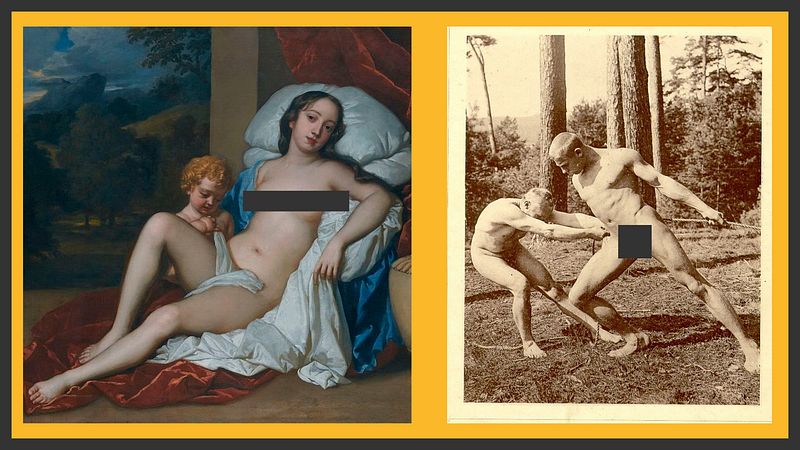
Love it or hate it, nothing inspires more heated debate than the idea of walking around in public in full view of others while wearing nothing. And nowhere is the debate more profound than when religion is involved.
The original “bare” Christians
Let’s bring in a curious footnote from the ages of history — meet the Adamites, early Christians who routinely practiced naturism.
No one nowadays would dare walk into a church naked. But 2000 years ago, some people did.
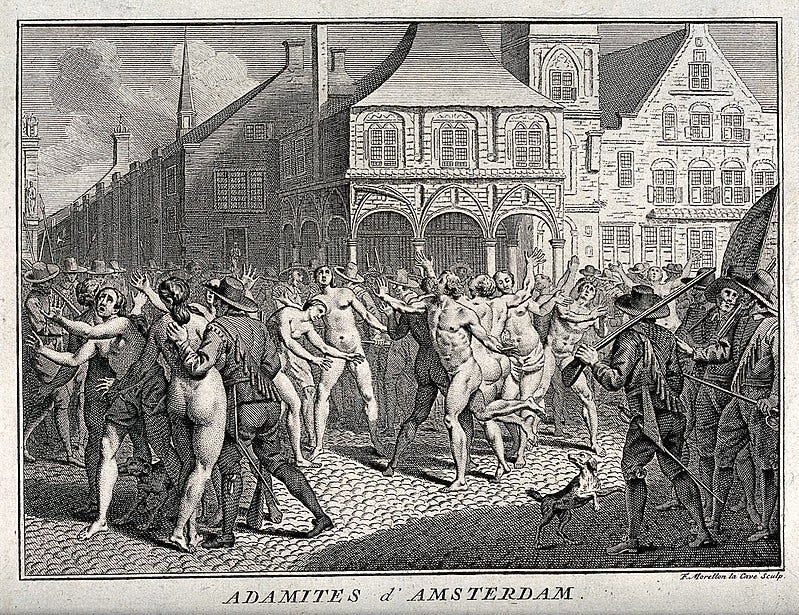
The Adamites or Adamians were an early Christian sect that flourished in North Africa beginning in the 2nd century. They practiced “holy nudism”, claiming that their members were re-established in Adam and Eve’s state of original innocence.
They argued that since God made Adam and Eve as pure naked creatures in Paradise who until their corruption had known neither shame nor evil nor embarrassment, humans were intended by God to be naked after all. As such, the Adamites wore no clothing during religious services.
The sect would later fade away but be revived in varying degrees by groups in places as diverse as Bohemia (now in the Czech Republic) and the Netherlands (by the so-called Neo-Adamites) between the late Middle Ages and the 18th century. The movement had been likened to the Hippie subculture from the 20th century and its members were rumored to practice “promiscuous intercourse”.
But part of the main attraction was that the stripping away of one’s clothes represented the removal of vanity — after all, that fancy suit you put on is the illusion, the real you is the naked you staring back out from your bedroom mirror.
The Adamite movement would be stamped out by the 18th century and by the 19th century a conservative “Victorian” brand of morality with strict taboos (at least in public) against sex and nudity would take hold across Europe (with the possible exception of German-speaking regions and Scandinavia — see below), remnants of which remain with us to this day.
Indigenous cultures
Many indigenous cultures practice full nudity and tribe members go about their entire lives without wearing any clothing.
In the highlands of Papua New Guinea and Irian Jaya (the other half of the island of New Guinea that belongs to Indonesia), nudity is the norm. Men from many tribes wear a single item of “clothing” — the koteka, horim or penis gourd — a penis sheath made from a dried gourd that covers the penis but leaves everything else, including the testicles and pubic area, completely uncovered. Women wear simple grass skirts and go about topless. Both men and women wear other forms of decoration like ear and nose piercings, headdresses, necklaces and body paint.
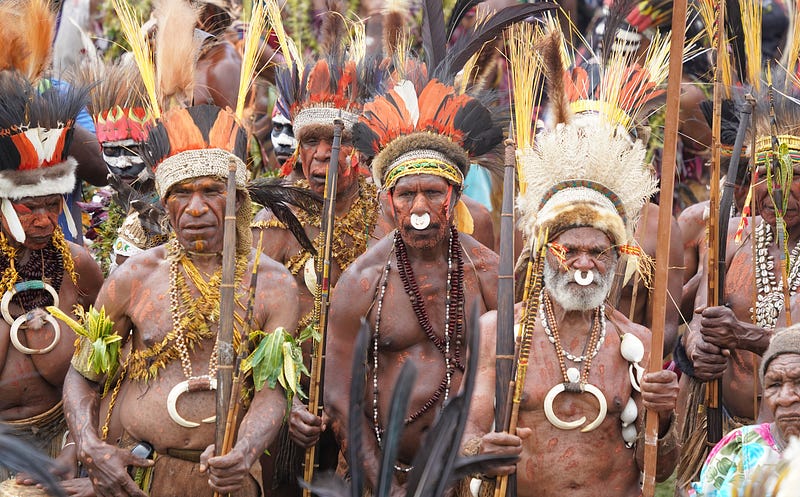
In these cultures, a man without his penis sheath or a woman without her grass skirt is considered naked and in a state of indecent exposure, something we find bizarre because in our cultures, a topless woman or a man exposing his buttocks or his testicles no matter how covered up his penis is, is just plain indecent. In fact, highland Papuan men usually removed their penis sheaths only for urination and sex.
And here we can see the spectrum of human cultural hangups regarding nudity. Almost all human cultures have a concept of shame and indecency but which exposed body parts that trigger those emotions is entirely culture-specific.
In South America, among groups like the Huaorani, adults wear nothing except a thin belt made from vegetable fibers around their waists. Men will tuck the tips of their foreskins under it to hold the penis closed and ensure the penis is always tucked upwards, which in their culture is a sign of decency. NOT wearing the belt would mean that an individual is naked and exposing himself or herself indecently!
In Polynesia, the traditional dress for women in ancient times was simple skirts woven from grass or bark cloth. Toplessness was normal but girls were taught not to expose their thighs, which their men considered to be erotic parts of the body.
Bedouin women in tribal regions of the Arabian peninsula are often fully veiled from head to toe. However, a veiled woman might open the top of her dress to expose her breast to feed her baby in public and this would not be considered indecent at all unlike say, in many parts of the US today! This is because in traditional Bedouin culture a woman’s breasts are not sexualized, rather they are considered to be purely functional, meant for nursing babies and not for titillation.
So yes, different parts of the body are sexualized in different ways in diverse cultures!
Freikörperkultur
In the late 19th century, when Queen Victoria’s reign over the British Empire would be remembered for its strict morality and sexual repression, Germans (at least the urban intellectuals) were going the opposite way.
In 1898 the first official Freikörperkultur (free body culture) association was founded in Essen, Germany which promoted, what else, naturism and the right to exercise and sunbathe in the nude for both men and women from all walks of life. Nude bathing quickly became popular in the region around Berlin area and the Baltic coast around 1900. Another term for this was Nacktkultur or “naked culture” and by the early 20th century there were over 200 private clubs dedicated to this movement.
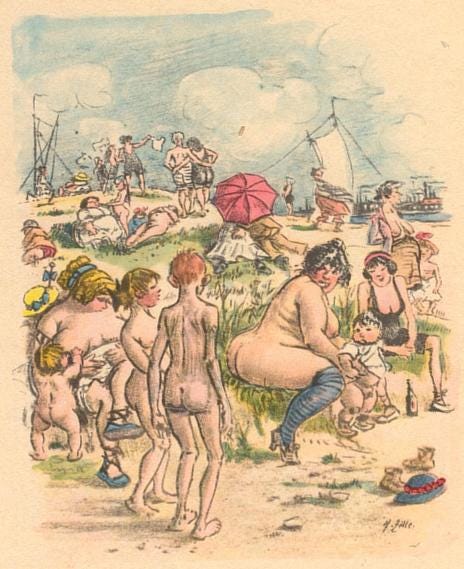
Unlike general British and American society at large, Germans who participated in the naturism movement were careful to de-eroticise the naked body. They regarded the body as something not sexually provocative in itself. Instead it was believed that Western civilisation (with its heavy Judaeo-Christian religious structures) had taught us to look upon nudity as sexual. The goal was to connect the individual back to nature, not unlike the Adamites of earlier centuries.
Similar movements were also taking place in Scandinavia.
The world’s first official nudist beach was established in 1920 on Sylt Island, Germany, not far from the German-Danish border.
Imagine what would happen if Americans in the 1920s were to start a nudist beach somewhere in the US? Imagine the uproar from that era’s conservatives and clergy!
Today public nudity is accepted in specific designated areas in Germany and Northern Europe. Many parks and beaches allow nude sunbathing and German saunas are often mixed gender, continuing the original Freikörperkultur concept of intrinsically linking health and nudity.
Where we go from here
A lot of the hangups that Western culture — especially Anglo-Saxon culture — has regarding nudity are really relics from the Victorian age and from the time when there was no separation of Church and State.
British culture was in fact quite liberal until the early 19th century, the start of the Victorian age.
As the lines between religion and governance become even more distinct, society will eventually become even more secular, and perhaps public nudity will eventually become more commonplace.
But this is just an assumption as human cultures are in a constant state of flux and evolution. Who knows what society will be like 50 years from now?
References:
Barcan, Ruth (2015). “Nudism”. In Patricia Whelehan; Anne Bolin (eds.). The International Encyclopedia of Human Sexuality. Wiley-Blackwell. pp. 819–830.
Hile, Jennifer (July 21, 2004). “The Skinny on Nudism in the U.S.”National Geographic News.
Loxton, Richard (2019). “Why Germany’s nudist culture remains refreshing”. Bonn: Deutsche Welle.


_-_1897_-_Freilicht_-_vmp_01.jpg)

