
Why Medium Wants To Ban Your Story From Google
Medium‘s changes might target affiliates but affect everyone
If you’re using Medium because of its awesome domain authority and powerful SEO to get your work ranked highly on Google… think again…
It’s long been known — among those in the know — that publishing on Medium gives you a great chance of ranking on the first page of Google, if you use keywords carefully.
Medium has a domain authority of 95/100, which means an article posted here is far more likely to rank highly on Google and other search engines, than if it is published elsewhere — including on your own website.
This has led to many marketers using — some would say abusing — the power of Medium.
They have been writing articles on this platform solely to promote products and services and generate sales and income.
Now, Medium has grown wise to this. And Medium doesn’t like it.
You may not have noticed it hidden away on Medium’s Help Center, but changes are coming…. and they could actually affect us all.

What is a domain authority anyway?
A website’s domain authority is one of the most important factors to get ranked on search engines.
It’s all about quality and it’s all about content.
If you can show Google that you provide informative content of the highest quality about a specific subject, your site will be given a good domain authority — a measure of reliability and trust.
A high domain authority means that Google will boost your content’s rankings.
On the flip side, poor quality content will lead to a bad domain authority and Google won’t rank your content.
You may want to check out your own website’s domain authority here.
Domain authority is scored out of 100, and new blogs and websites will start off at zero. So it will take a great effort, lots of SEO optimization, gaining backlinks and building an archive of genuinely helpful articles, to raise that score.
Unless, that is, you publish on a site like Medium, which has already put the hard work in and has worked its way up to a domain authority of 95. Which, you may have noticed, helps enormously when it comes to ranking content.
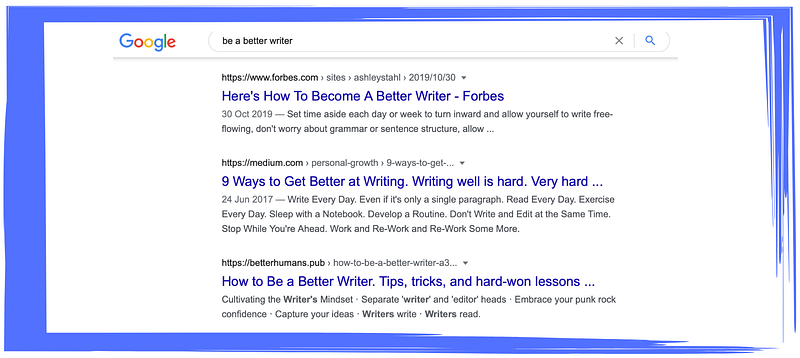
How many times have you searched for a subject on Google and noticed that an article published on Medium has been on the first page? It happens a lot.
So why has Medium got a problem with this?
Medium positions itself as a platform of quality, of reliable information. As its domain authority demands.
But as more and more people use Medium as a mere marketing tool, that means there is more and more content of lower quality on here.
That’s what Medium doesn't like. Especially as poor writers are hijacking the platform just to make a quick buck.
I’ll go into detail soon about what Medium is hinting will happen in the future — and how it could affect you — but first take a look at this video to get a sense of what this is all about.
The guy calling himself ‘Caffeinated Blogger’ on YouTube is, to be absolutely fair to him, someone who often shares original money-making ideas through affiliate marketing, often thinking outside of the box and never treading the same path as all the others posting similar videos.
He has 158,000 subscribers.
This recent video encourages affiliate marketers to post online reviews and make a few hundred dollars a day doing it.
Success comes because the reviews are posted on Medium, so there is a good chance of a high ranking on Google — watch the video to see the technique.
As for writing the reviews, there is a blatant suggestion just to read as many other reviews as you can about the same thing on the internet, and then cobble them together to make a new article.
Effectively, copy and paste, with a few tweaks.
Now that’s what Medium is talking about. Low quality content.
Anyway, have a quick look at the video…
What is Medium going to do about it, and how is that going to affect all writers?
This bit is intriguing. I’ll post the text from the Medium Help Center under the heading ‘About SEO and Medium’, then look at the details…
The heart of Medium’s mission is to deepen understanding, and we believe the best way to accomplish that mission is to be an open platform — a place where anyone can have a voice, regardless of background, affiliation, or expertise.
To protect that mission, it is imperative that we have systems in place to support the success of creators who are here to share ideas and connect with readers, and discourage creators who are solely leveraging Medium for search engine optimization (in plainer words: spam and self-serving clickbait).
Medium is currently in the process of slowly rolling out a change that limits what Medium content is made available to third-party search engines, as well as Medium’s native search and tag pages. The overwhelming majority of content that Medium will no longer be allowing to be indexed is what most people would consider spam, and the net effect will be more traffic to quality content long-term.
This new system, similar to Google’s Page Rank, is based on a number of internal signals that help us determine if your use of Medium is above board. As the new system is being rolled out, it may take a little bit of time for you as a creator to become a trusted part of the Medium network and meet the threshold for being indexed, but if your stories meet our basic quality threshold, they will end up in external and native search indexes. We encourage you to continue publishing your best writing on Medium, engaging with other users by clapping, following, and responding, and becoming a part of the Medium community.
Over time, this change will greatly benefit the SEO for Medium creators who are publishing stories that align with our mission. Medium will be sharing less of the content that we don’t want on Medium with Google, so Medium’s Google Page Rank will continuously improve as click-through rates from search queries increase, and this will result in legitimate Medium creators ranking higher across all Google searches. This will lead to even more discovery of the stories and ideas that you publish on Medium.

Let’s dive deeper…
The Medium statement (you’ll find it here) raises far more questions than it gives answers.
Not many of us can have too many problems with the first couple of paragraphs. But then it gets interesting…
Medium is currently in the process of slowly rolling out a change that limits what Medium content is made available to third-party search engines…
So, Medium is not going to index all of its content. Not all articles will appear on search engines.
Ok… but we have been assured that: The overwhelming majority of content that Medium will no longer be allowing to be indexed is what most people would consider spam.
That’s a subjective one, isn’t it? Do we all consider spam and clickbait to be of a universal standard? More importantly, what does Medium consider to be spam? Could it be anything we are writing ourselves?
Now for the really troubling part for all writers…
As the new system is being rolled out, it may take a little bit of time for you as a creator to become a trusted part of the Medium network and meet the threshold for being indexed.
That sounds like a warning that none of us can guarantee that our articles are going to be indexed by Medium, and therefore be found on Google and other search engines. Perhaps also because the new system will encounter teething problems, who knows?
Medium assures us: If your stories meet our basic quality threshold, they will end up in external and native search indexes.
But what exactly is Medium’s ‘basic quality threshold’ these days? Is this solely about the quality of our writing?
The next sentence tells us: We encourage you to continue publishing your best writing on Medium, engaging with other users by clapping, following, and responding, and becoming a part of the Medium community.
So, are clapping, following and responding now key factors in achieving the ‘basic quality threshold’? That much is not clear.
Here’s another bombshell:
Medium will be sharing less of the content that we don’t want on Medium with Google.
OK, ok… but what content don’t you want, Medium?! We need to be told so we don’t waste our time writing it!
Especially when you tell us: This will result in legitimate Medium creators ranking higher across all Google searches.
I mean, that’s great news — but only if we can class ourselves as ‘legitimate Medium creators’.

So what happens now?
The headline of this story pointed to us looking at reasons ‘Why Medium Wants To Ban Your Article From Google.’
We’ve done this, and you can take your own view on the findings, but personally, I’m a little concerned, reading between the lines, that Medium might target affiliate links in articles.
This would affect a great many writers on Medium. I mean, how often do you read a story telling you how good Grammarly is at helping you to improve your writing?
That’s not all for your own good — many writers here are affiliates of Grammarly and will earn a commission fee if you sign up through their link.
I’m not a Grammarly affiliate myself, but if you want to read about the Grammarly Affiliate Scheme, out of interest, you can find it here.
I personally have embarked on a new journey to help people live a more eco friendly lifestyle, through my Medium publication and website greengreengreen.
I tackle serious issues like the climate emergency and plastic pollution but also encourage people to take action in their own lives towards a more sustainable existence.
And yes, there are occasional affiliate links, because I want to help people make important changes, but if I can get a small commission here and there to cover the costs of my website, I think that’s a fair deal.
But what will Medium make of this? Will that meet the ‘basic quality threshold’?
You may have similar issues, or you may be looking to make money purely from Medium’s Partner Program. If so, external views won’t make you any cash at all, so perhaps it’s not a big deal if your story doesn’t get indexed for Google.
Then again, Medium readers search on Google too, y’know…
Others are here to write for as large an audience as possible, so external views from people sent here by search engines are vitally important.
I think this is one to watch. Medium is going through big changes at the moment and the Google indexing matter seems to be a key part of the future strategy.
I’d be genuinely interested to hear your own views…


