
Why Measurement Improves Performance
In a recent seminar I watched, Brian Tracy said: “ there’s a rule in psychology,the more you focus on a particular number the more that number improves.”
- If it’s revenue it grows
- If it’s weight you lose it
- If it’s how fast you run the mile, you’ll run it faster.
This is one of the many things that business school fails to teach you about running a business. When our team got into a habit of religiously measuring our metrics, we made a gargantuan leap in a really short amount of time. When we stopped things fell apart. Needless to say, we’re now quite religious about looking at our metrics every week.
Heightened Awareness
Why does this work? It heightens awareness.
- If you’re aware of your weight every single day, you’re more likely to be motivated to do something if it’s not to your liking.
- If you’re aware of where you are in relation to your revenue goals for a company, you’re more likely to do something about it.
- The same goes for nearly every other metric in our lives. It’s why people wear a Fitbit, athletes know their stats, and the quantified self is such a popular phenomenon.
If we have a heightened awareness about a particular metric, we’re much more likely to do things that improve it.
Leveraging Success Accelerants
If the gap between where you are and where you want to be is massive, it will seem impossible and you will sabotage your actions. The way you avoid this is by tapping into what Shawn Achor refers to as success accelerants. According to his research, the closer your brain thinks you are to achieving a goal, the faster the progress towards it.
The brain releases its accelerants, not just when a runner sees the finish line, but as soon as the runner realizes the probability that he or she is going to succeed. What that means for all of us in the working world is that we don’t need to be at the end of the race to reap the cognitive rewards of the X-Spot. By changing our perceptions of the distance to the finish line, we can prime our brains to release those chemicals earlier to accelerate our success — Shawn Achor, Before Happiness
This is why I’ll often put a passage or a quote in my writing software the night before. It puts me closer to the goal of 1000 words before I even start writing. Let’s say we’re measuring something (email subscribers, revenue, etc). If you’re at 100 to make the jump to 10,000 is a massive leap. On the other hand, if you want to get from 100 to 125, you’re likely to tap into the power of success accelerants. Then you reset where you want to get to next based on where you are today.
The Power of a North Star Metric
In the How to Start a Startup Podcast, that Sam Altman and has team at Ycombinator made available via iTunes, one of the lectures discusses the concept of a “Northstar Metric.”
Side Note: Whether you’re a startup founder of running a lifestyle business, the content in this podcast is phenomenal. It’s led to many changes in our company that directly resulted in revenue. H/T Sam Altman for making it available.
It’s a metric that every member of a team agrees on and works towards. What that metric actually is will be different for every company. When an entire team can rally around that one metric, it results in momentum.
Vanity metrics such as likes, comments, fans, and followers are not very good North Star metrics.
- First, you don’t down have complete control or ownership over the channels on which these metrics are measured.
- Second it’s often hard to tie these metrics to a tangible outcome.
- Finally even if you do manage to achieve a North Star metric through one of these channels (i.e. a million Facebook fans), one change in the algorithm and you’re hosed. Not only that many of these metrics can be gamed, and as said in my piece about what we’ve learned from building a podcast with over 450 5-star reviews on iTunes, gaming the system is for hacks.
At the beginning of this year, I submitted a manuscript to my publisher for a book that comes out in August. I also enrolled in my friend Tim Grahl’s book marketing course. Tim has helped many of his client’s books become New York Times Best-Selling Authors. The one metric that consistently made it possible was email subscribers.
- In his interview with Chase Jarvis, Ramith Sethi said you could obliterate his social presence and he’d be fine because so much of the revenue he generates is driven by email.
- The Skimm which has over 1.5 million subscribers is an email newsletter
- Nextdraft by Dave Pell is one of the most read email newsletters people receive on a daily basis
As my business partner Brian said, “as content becomes more infinite, curation becomes more valuable.”
Because of our book launch, as a team, we decided that our biggest priority, our north star metric would be the number of email subscribers. From that point forward, nearly every decision we made about content strategy was run through the filter of “will this lead to more email subscribers? If not, why are we doing it?” Once you know what your North Star metric is, it becomes easy to focus on the 20% of things that create 80% of the value.
Somewhere along the way we started to figure out just how much power our presence here on Medium had. It eventually became our third largest traffic source and the number one driver of email subscribers. Because of that, writing content for Medium became the highest priority in our marketing efforts each week. And given that my next book is all about writing and creative habits, it complements that effort perfectly. Below you can see a graph of what happens when you focus on one metric.
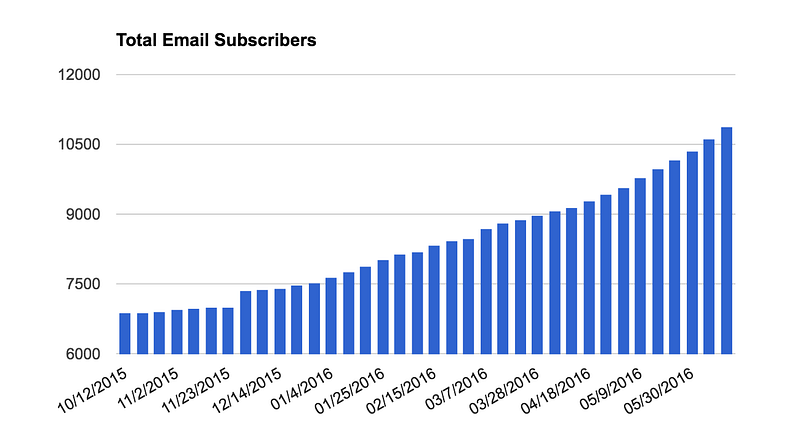
I check this number every day. Once a week I go into Keynote, create a slide with the number in the biggest font possible and tape it to the wall so I can see it. I got this idea from The 4 Disciplines of Execution, which said the following:
If the measures aren’t captured on a highly visible scoreboard and regularly updated, the WIG (Wildly Important Goal) will disappear into the distraction of the whirlwind. Simply put, people disengage when they don’t know the score
The idea of a north star metric isn’t just something that applies to running a business.
- It can be applied to your exercise and weight loss goals.
- It can be applied to your personal finance goals.
The idea that measurement improves performance is nothing new. It’s an idea that has informed the sports world for decades. If you don’t know where you’re at in relation to where you want to be, how can you possibly get there? When we focus on one thing to the exclusion of everything else we will consistently notice opportunities to improve that thing. Not only that we’ll be able to selectively filter out anything that doesn’t move us in the direction of our Northstar
I’m the host and founder of The Unmistakable Creative Podcast. Every Sunday we share the most unmistakable parts of the internet that we have discovered in The Sunday Quiver. Receive our next issue by signing up here