
Why Living in Paradise Would Be Hell on Earth…
…according to research. But should we seriously believe that?

Who doesn’t want to live in Paradise on earth?
Imagine a utopia where you don’t have to worry about anything. You can relax all day long. There is unlimited food to fill your belly. No sickness, no reason to fear anything. It’s always warm and cozy, and you can even have sex whenever you want. All your needs and appetites are satisfied.
Sounds like the ideal place to be? Then let me tell you about the shocking research on what could happen if this fantasy comes true. And why I believe it is heavily flawed.
Of man and mice
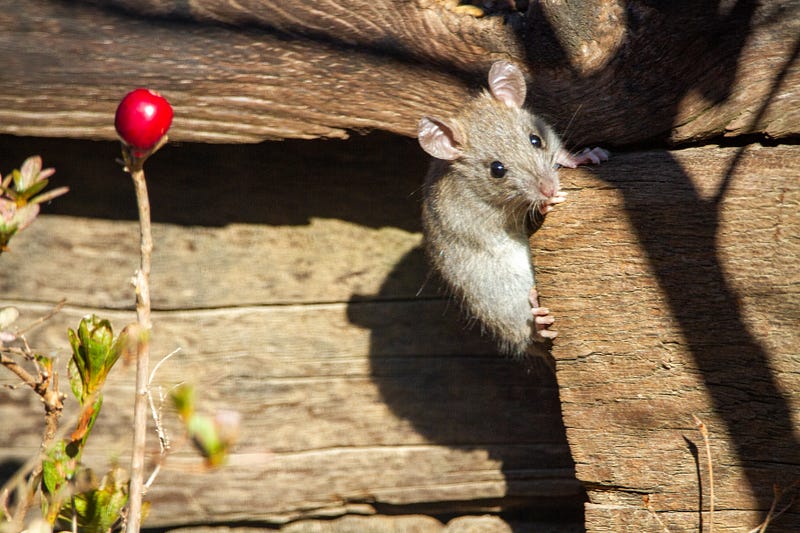
In the 1970s a man named John Calhoun decided to study exactly that. What happens when all our needs are satisfied? And he chose mice to be the perfect subject to study. The most known experiment was his “Universe 25”.
Some cornerstones of the experiment were:
- Four pairs of mice were placed inside a utopia to reproduce.
- The experimental setup provided perfect conditions for them. Ideal temperature, unlimited food, no predators, and no diseases.
- The maximum population limit inside the utopia was over 3000 mice.
But it wouldn’t come to be that many. The population already peaked at 2200 mice. Many of them would stop breeding, becoming depressive and apathetic. Some others would start to get violent, form gangs, and cannibalize other groups as well as their own. From there on, the population began to dwindle. If the experiment hadn’t ended before, they most likely would have gone extinct.
Calhoun concluded the same terrible fate could strike humanity. And if you think about it, humankind does tend to go from good times to grave ones. It’s just that we, up until now, always recovered.
Humans and animals: The big difference
Some people rightfully criticize the experiment. Even though the effects on mice are astonishing and shocking, it is argued that human behavior is far more complex and not comparable to that of mice.
I believe this to be true.
After all, one major factor separates us from these cute little rodents: Humans are always striving for more.
It lies deep within our human nature to always want more. What does a lion do after feeding on a delicious gazelle? It walks to the next tree and sleeps in its shade. Simple as that.
What does a human do after eating a good meal? Some slackers might go to sleep, sure. But many would still strive for other things. Be it improving skills, accumulating more wealth, or gathering more knowledge.
We are actively searching for purpose, and everyone has their own aspirations. Even if circumstances change, we will often just change our purpose. After all, humans can quickly adapt to all sorts of conditions, even the worst ones. Physically thanks to technology and psychologically thanks to the way our brains work. Animals can’t do that.
And the good news is:
Because of human ingenuity, there will always be new things to strive for.
And we will always hope to achieve them.
Hope: a curse or a blessing?
Let me tell you about the greek tale of pandora’s box. It is said that a woman called Pandora, out of curiosity, opened a container that was given into the care of her husband. Out of it came every emotional and physical scourge that plagues humanity today. She really f’ed sh*t up for us, didn’t she?
Most interesting is the last thing that came out of Pandora’s box. A feeling called hope. Some even argue that hope is the greatest of all curses. It lets us endure all the hardships of life without resignation. And therefore keeps us alive to an existence of constant suffering. But in the context of this article, isn’t hope just what may save humanity?
History teaches us even if the state of things is catastrophic, we always find a way to keep on going. We always find ways to improve our lives for ourselves and our fellow human beings. Even after big catastrophes we somehow flourish anew.
Do we flourish again just to keep on suffering? Is hope not a blessing but our biggest curse?
I will let you answer the question yourself.
Feel free to let me know your thoughts in the comments.
Thank‘s for reading my article. I hope you enjoyed it.
Follow for more.
Cheers!


