
Why K-Fold Cross-Validation Fails with Time Series
While K-Fold Cross-Validation is almost a standard in general machine learning tasks, its application often stumbles when introduced to financial data.
Before we dive into the problems with traditional K-Fold Cross-Validation in finance, it’s crucial to understand the idiosyncrasies of financial data. Financial time-series data are often plagued with seasonality, volatility clustering, and economic cycle impacts. These characteristics make financial data behave in ways that are fundamentally different from, say, image or text data.
The Problem with Traditional K-Fold CV in Finance
- Non-IID Observations: A basic assumption behind K-Fold Cross-Validation is that the data points are Independent and Identically Distributed (IID). In most financial scenarios, this is far from the truth. Financial data points often exhibit temporal dependencies and structural breaks, making them non-IID. When we ignore this, we risk introducing look-ahead bias, effectively contaminating our validation process.
- The Pandora’s Box of Multiple Testing and Selection Bias: When we use the same test set repeatedly to fine-tune our models, we inadvertently fall into the trap of multiple testing. This recurrent ‘peeping’ into the test set creates a selection bias. As a result, the model may perform exceptionally well on the test set but fail miserably when exposed to new, unseen data.
- The Subtle Yet Dangerous Leakage: Data leakage is akin to unintentionally having the answers to a test before taking it. In the context of financial machine learning, leakage usually happens when our training set contains information that would not realistically be available at the time of prediction. This is especially problematic in finance, where variables can be highly correlated through time, leading to overly optimistic performance estimates.
The Silver Lining: Purged K-Fold CV
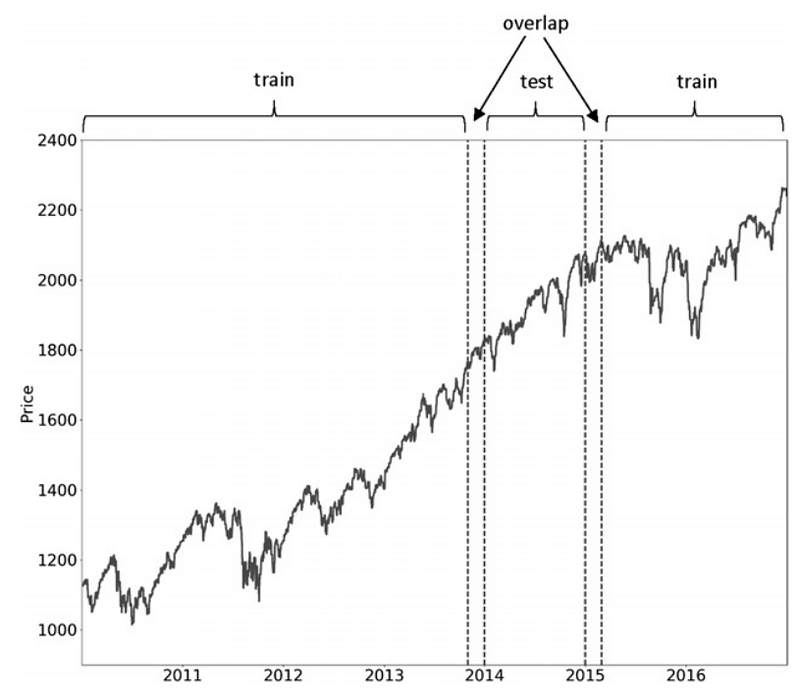
Purging the Training Set for Purity: Purging is essentially the act of sanitizing the training set by removing any data that overlaps with the test set in time. This simple yet effective technique can be a lifesaver when trying to create a model that generalizes well to new data.
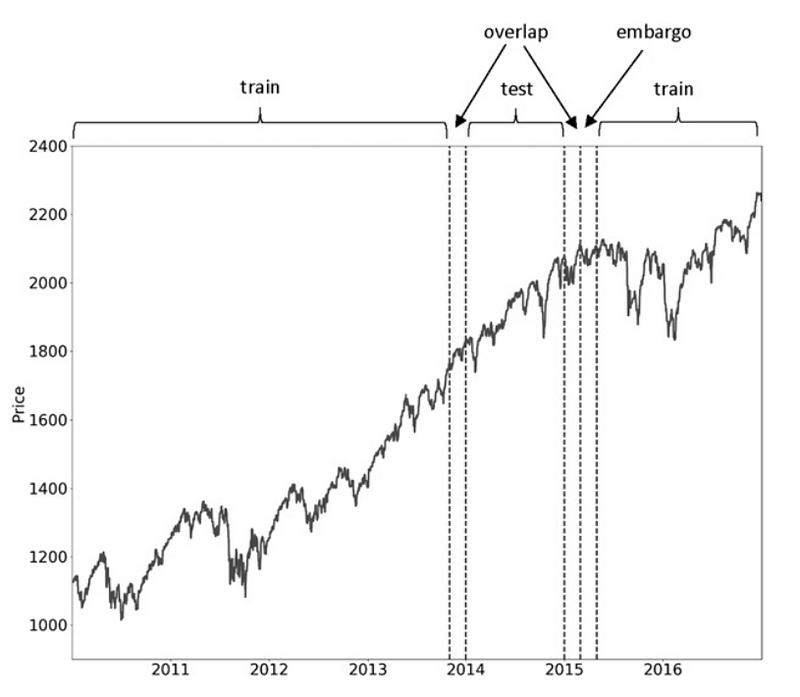
The Embargo Technique: Even after rigorous purging, some level of data leakage may still persist. To further insulate our model, we can implement an “embargo” period. During this embargo, we exclude any data from the training set that occurs immediately after the data in the test set, thereby reducing the possibility of future leakage.
Strengths of Purged K-Fold CV:
- Reduced Look-Ahead Bias: By purging the training set, the technique aims to reduce or eliminate look-ahead bias, which is a major issue in financial time-series modeling.
- Data Leakage Minimization: The “Embargo” technique addresses the residual data leakage problem by excluding data that is temporally close to the test set.
- Model Robustness: Purged K-Fold CV aims to make the model more robust to new, unseen data by simulating a more realistic trading environment in the validation stage.
Potential Weaknesses or Unaddressed Issues:
- Computational Overhead: Both purging and embargo add computational complexity. This can be a concern when dealing with large datasets.
- Effect on Model Training: Removing too much data for the sake of purging and embargo might result in training sets that are too sparse, which can impact the model’s ability to generalize.
- Dynamic Market Conditions: While the article touches upon the dynamic nature of financial markets, it doesn’t elaborate on how to adapt the model validation techniques to these changing conditions. For example, volatility regimes can change, impacting the model’s performance.
- Risk of Overfitting: The purging technique focuses on a very narrow time window, which could result in models that overfit to specific market conditions.
- Time Horizon: The article doesn’t specify which time horizon the strategies are suitable for, e.g., high-frequency, daily, or long-term trading.
While Purged K-Fold CV and the Embargo technique show promise, it’s essential to continuously question and assess our model validation techniques. The dynamism of financial markets requires that we adopt equally dynamic validation strategies.
Subscribe to my newsletter to get access to all the content I’ll be publishing in the future.


