
Why It’s So Hard to Build New Habits and How to Succeed in Doing So
‘’Successful people are simply those with successful habits.’’ — Brian Tracy

‘’We are what we repeatedly do. Excellence then, is not an act, but a habit’’ — Aristotle
Analyzing the most successful people, I quickly realized that they all have one thing in common: Habits. Positive habits that make their everyday lives more comfortable.
Success and the achievement of goals are no coincidence and for sure no luck. It’s your daily actions that determine whether you will achieve your goals or not.
Routines are the ultimate must-have when it comes to long-term progress and making significant achievements. Just as you don’t get fit by eating a single salad per month, isolated, irregular actions won’t lead to the accomplishment of your goals either.
Great outcomes are the result of continuous work over a long period of time. Success is an ongoing marathon.
The Power of Habit
Routines allow you to ensure regularity and achieve your goals as quickly and efficiently as possible. The more routines you have, the easier it will be to make unexpected decisions and cope with new challenges. Apart from achieving goals, habits give us security and stability.
Accounting to researchers of Duke University, our habits comprise up to 40% of our everyday lives and ensure that we do not have to think about every single action we take throughout our days. Through habits, we can guarantee to accomplish daily tasks even if a lot of things are going on or when we are stressed.
However, the excessive amount of information we receive every day makes it hard for us to build new habits and stick to them as we get distracted all the time. And yet, ironically, habits can actually help us to save time and energy.
Just imagine having habits that support your goals and push you towards achievements every day. You wake up and instantly do the right things without spending time thinking about it. Sounds great, right?
The goal is to build habits that support our big visions and goals — but how does one start, and what measures do we need to take to build sustainable habits?
How Habits Are Created
First, we have to understand how habits are created. The whole process of building and maintaining habits relates to a principle called the 3R’s of habit change.
Reminder, Routine, Reward
Among others, Charles Duhigg explains this structure in his book “The Power of Habit.”
Regardless of whether the habit is a harmful addiction or a positive routine, he says, you will always find the three R’s: Reminder, Routine, and Reward.
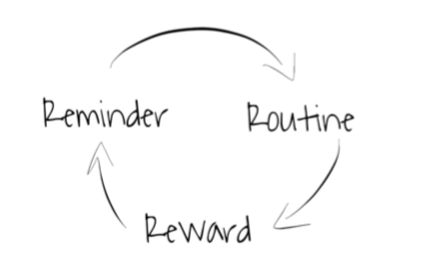
Each habit starts with a reminder. A negative example would be the desire for a cigarette — in that case, the pure desire for nicotine is the reminder to take action and repeat the habit of smoking.
If, on the other hand, you have built up a routine that brings you closer to your goals, your reminder may be a particular time of day. For example, waking up in the morning will remind you to practice your morning routine.
In short: Every routine starts with an impulse, something that reminds you to take action.
Once you understand the principle of the reminder, you can use it to make habit-building much easier for yourself. No matter which habit you want to build, you can ensure to remember it by specifying a clear reminder.
For example, if you want to start stretching for 10 minutes every day, you can use another existing habit (for example, brushing your teeth) as a reminder to stretch your body.
Or, if you want to drink more water throughout your day, you could use your phone as a reminder by changing your screensaver into a picture that is saying ‘drink more water.’ In doing that, you’ll be prompted to drink water every time you look at your phone.
The second R describes the habit itself, the routine. After the reminder, you do exactly what you were reminded of.
The last step, the reward, is about the advantage you gain from practising the habit. An immediate reward, like an endorphin hit after a 5K run, is often the reason why maintain our habits at all.
In the case of a cigarette, the reward is the immediate satisfaction of nicotine. In most cases, the reward is the satisfaction of desire and not physical. But you can also create your own empowering rewards. For example, you can put a bell on your desk and let it ring every time you have completed a task or routine. Or you can work with a habit tracker and cross out a box every time you complete a habit.
Once you understand the three R’s of habits, you can use them to build new routines quickly.
Why Forming New Habits is So Difficult
The integration of new patterns into our daily lives often comes with hurdles and is rarely an easy endeavour. This is mainly because we like to adhere to familiar structures, and breaking through them is usually associated with extra effort, which we generally try to avoid.
However, a habit is only powerful once it is integrated into your day-to-day life. The only way habits make sense and make your life easier is when you perform them without thinking about it.
Start Small
If you try to change too much at once and implement several new routines in different areas of your life at the same time, you will probably fail very quickly.
It’s much better if you work on one habit at a time.
First, do some reflection and get clear about which routines you want to implement. What small steps can you take every day to come closer to your goals?
Once you figured out those small everyday steps, you can start building one habit after the other. When it comes to building habits, it’s best to start so small that you can’t say no.
As said before, habit building is a marathon. It might be difficult to persevere. Hence, it is best to start with tiny goals.
For example, if you want to read daily, start by reading one page per day. This may sound very little, but it’s enough to build the habit of reading. Once you read one page per day, you can increase the amount and raise the number of pages or minutes to the next level.
The hard part is not reading itself. It’s taking the time to sit down with a book and open it up.
Once you start reading, you will probably read much more than one page.
Routines only work when they make your life easier. Do yourself a favour by starting small and making things as simplistic as possible.
Jerry Seinfeld Method
Another way to strengthen your stamina and build long-term routines is by using the so-called Jerry Seinfeld method, coined by the US comedian Jerry Seinfeld.
Seinfeld had planned to write a joke every day, and he put an annual calendar on his wall. On each day that he wrote a joke, he crossed the day out on his calendar. Over time, a chain of crosses was created. Once he didn’t feel like writing, he saw the chain of crosses and wondered if he wanted to interrupt it. The longer the chain was, the less he wanted to interrupt it.
Get Back On Track Quickly
In addition to the countless tips and tricks for building habits, patience and stamina are the factors that really matter. Even if you have built up a habit, setbacks can always occur.
A variety of reasons can prevent you from following your routine as usual and lead you to falling off track. What’s important is that you stick to your commitments and do not allow your routine to be destroyed.
Studies show that few relapses have little impact on long-term success. Even if you ever have to give up your routine, try to get back to it as soon as possible and carry on.
The best way to improve your self-control is by understanding why you skipped your habit and lost control in the first place.
Missing the mark once might not have a significant impact on your long-term progress — as long as you get back on track as fast as possible.
Get away from that all-or-nothing mentality and always get back on track. You need to be consistent, not perfect.
Mind Cafe in Your Inbox
Want to stay up to date with our top-performing posts each week? Sign up for email updates by following this link.