
Why It’s So Hard to Break Free From The Pack
Dare to be different and create the life you want

We are not all the same — if we were, there would be no conflict. We’d be in complete agreement and everything would be fine.
Owning up to being different isn’t easy — after all, everyone wants to fit in.
But if you want to be true to yourself and create the life you desire, the first thing you need to do is to accept that you are different.
We think, ‘If I’m myself and stand out from the crowd, I’ll be all alone and no one will ever love me.’
This is not true, what it might mean, however, is that if you decide to get to know yourself better, you might discover that you don’t really have as much in common with the people you hang around with, as you thought you did.
Being different doesn’t mean you have to live in total seclusion for the rest of your life and never connect with anyone ever again. It just means speaking up when you see things differently.
Do you like all the people you spend your time with?
Maybe secretly, you don’t like some of your friends? That’s not easy to say, but what if it’s true?
And what about your family? “Blood is thicker than water,” and all that.
Try this — even though you care about them, do you think you share the same beliefs and values as them? I mean, really — at the core level?
Think about it. You can be part of a group and share the same beliefs, yet choose to live them out in a different way.
If you go along with the group to fit in, you may have to give up an essential part of yourself.
The problem with fitting in is that usually the majority rule, and so if you don’t conform, you may be pushed out, ignored, rejected, reprimanded, or even ostracised — because to stay in the group (the pack) you have to play by the rules.
So being different is not easy, which is why many choose to follow the crowd.
Don’t sell your soul to fit in
You are unique, we all are, but when we deny this truth about ourselves, we give up who we are and what we are called to do.
As children, we learned herd behavior as that’s how society is set up. It works to some degree as it keeps order and everyone feels safe, with a sense of belonging.
But, did you know that this deep need to feel connected is a survival instinct? and because it’s such a primitive need in all of us, we rarely think to question it.
We are hardwired to conform.
This is what’s known as the “heard mentality”
What is the herd mentality?
The herd mentality is basically a behavior where people copy what the majority are doing around them to fit in and feel safe and secure.
“Herd behavior is the behavior of individuals in a group acting collectively without centralized direction. Herd behavior occurs in animals, in herds, packs, bird flocks, fish schools, and so on, as well as in humans. Demonstrations, riots, general strikes, sporting events, religious gatherings, everyday decision-making, judgment, and opinion-forming, are all forms of human-based herd behavior.” — — Wikipedia
The brain and the herd mentality
Margie Meacham writes in the article ‘The Brain and The Herd Mentality’ that the “herd mentality” is an aspect of the leader-follower relationship that is illuminated by neuroscience.
She says this desire to belong is based on a survival need where we find safety in numbers. The need to belong is a herd instinct that produces a feel-good factor, known as the “bliss response.”
The Release of Oxytocin (“The Bliss Response”)
This “herd mentality” is present in both animals and humans. When we are in the pack, engaging in social behavior — a neurochemical in the brain called, oxytocin is released which triggers a “bliss response.”
“The brain is an incredibly effective survival machine, and one of our most successful survival techniques is our desire to find safety in numbers.”
— Margie Meacham
When we belong to a group, this “bliss response” makes us feel warm, safe, and content. And when we don’t have a connection with a group, our brain triggers behavior that will compel us to seek new connections.
The danger with this, of course, is that this need for the “high” that comes from gathering in groups can become addictive, and for people who don’t know the science behind it, they may be afraid of falling into deep loneliness or depression.
Society reinforces this fear making it extremely difficult to break away. The pressures to stay within the pack can be challenging as manipulative games are often played out to keep people from leaving.
For example, you could be made to feel extremely guilty for wanting to carve out your own path or express yourself in a new and different way.
In unhealthy groups, the pack works together to maintain the status quo, making it hard for one member to leave and form new affinities.
Even now with Covid-19, there’s so much fear around self-isolation because separation from the pack can feel like death to some, and without the release of oxytocin to make them feel good — it can be a terrifying experience.
But, others who are quite comfortable not being closely knit to a group, are okay with the social distancing, even though they miss their connections.
I’ve recently returned to Europe after more than 3 years in S.E. Asia and to be honest, I found the Vietnamese culture a little difficult in the end, because to do anything alone was seen as a bit odd, and not empowering, as we see it in the West.
Many Asians would find it amusing to see Westerners eat or travel alone — they can’t understand why we would even want to break away from the pack.
As a solo traveler, I found this quite challenging because being different is not valued in most Eastern cultures. They often frown upon the individualism that we enjoy in the West.
But to be fair, it’s probably because they don’t understand it, but that’s beginning to change now.
Some of the younger people travel more and seek some distance from the family. Of course, it doesn’t just come down to culture, there are financial constraints too. It’s usually the middle to upper-class Asian families that travel abroad.
When I was traveling, I would teach English, volunteer, join church groups, go on tours, stay in homestays, apartments, etc, but when I felt it was time for me to move on and explore new things, I would sense this strong pull from the groups to get me to stay.
Because I’m aware of this ‘herd instinct,’ I would leave sooner than I was comfortable with, as I knew an attachment would form, making it more difficult to leave and complete my trip.
Many were surprised and would say “but, we thought you were going to stay?,” but, it had always been my intention to move on at some point as I wanted to see and do more.
The more I traveled the stronger my desire to separate became because I was getting more in touch with my true nature and less worried about needing to belong to a tribe.
But, I struggle with the herd mentality too, as I do like connection, but I am learning to wait more and to appreciate that I do not have to chase the oxytocin fix or the “bliss response” — I can over-ride this desire and find peace and contentment in solitude.
This is why, getting to know who you are is a spiritual journey because it requires transcending our primitive urges and reaching for our higher purpose — which is what separates us from animals in the first place.
Fight the herd instinct in yourself
If you feel you’d like things to be different in your life, maybe this quote is for you:
“If you want things to be different, perhaps the answer is to be different yourself.”
— Norman Vincent Peale
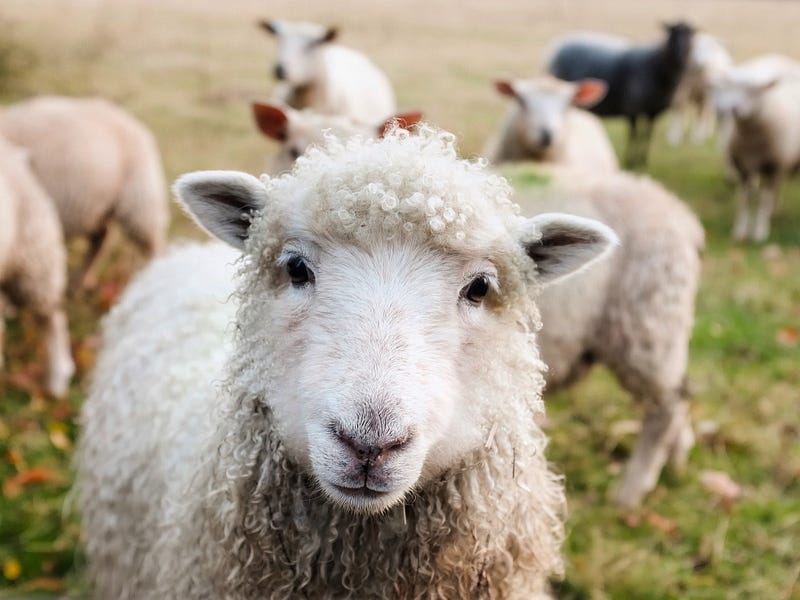
Dare to be different
Being different isn’t about trying to be different because you already are. It’s more about daring to be authentic.
Some people feel their uniqueness early in life and remain true to themselves, but others (the majority) are pulled along by the crowd, because of the “high” they get from being close to the pack.
“To thine own self be true” — William Shakespeare
By being yourself, you are choosing to be the leader of your own life. You are choosing to carve out your own destiny, but you don’t have to do it alone. It is the plan of God that you would find your unique purpose and walk in it daily.
The herd behavior is deeply ingrained in all social and political systems, such as governments, families, friendships, clubs, religious groups, teams, business networks, football teams, social class systems, etc.
But, the good news is …
“The herd mentality can be broken”
— Margie Meachan (2013)
How?
Research shows that ‘conscious choices will make physical changes in the brain, breaking establishing neural pathways and making it easier to form new ones.’
In other words, we can form new pathways in the brain that can help us to reach our fullest potential. According to Meacham, by understanding what happens in the brain we can become better leaders, teachers, parents, and employees.
But, for leaders, she says — they have to change 2 brains:
- Their own
- Their followers
If you are a leader, it will be more difficult for you because you do not get to enjoy the oxytocin high, for you need to be watching out that you do not slip back into the herd mentality.
So, if you want people to follow you, ‘their brains must be able to recognize that they are part of a group of followers’ (M. Meacham). This will make them feel safe.
Dare to be different, and trust that separating from the pack does not mean you don’t love the people in your life — you are simply showing them who you are.
You can have both — you can be free and still enjoy connection, but this time on your terms.


