
Why It’s Better to Be Minimalist With Kids
Less is more

Pretending doesn’t require expensive toys. ~Fred Rogers
Sometimes when my kids get new toys, my heart sinks.
What if they were able to let go of all of them? They’d eventually adjust. But that’s not what I’m suggesting. I’m open to having a few fun things to pass the time. Perhaps there’s a middle ground.
Is it realistic for me to expect that no one, including myself, will ever buy them anything new? No. Do I still see that as my ideal for all of us? Absolutely.
Why? You might ask.
Acquiring material things is overrated.
More stuff doesn’t lead to overall happiness. Countless studies illustrate we don’t feel better after we acquire something. In fact, we tend to feel worse.
After the shimmer and shine wear off, we’re left with this thing that doesn’t deliver what was promised. The pleasure is fleeting.
I’ve watched the cycle with my daughters. My oldest gets attached to the idea of a particular item before she brings it home. Once received, it takes between 3 days and 2 weeks for said item to lose its luster. She’s already worried about not getting it. Then she gets it and she’s eventually unsatisfied or disenchanted.
Disenchantment is a big factor in my decision to buy something. If I don’t need it to perform a service, like wash a dish or sweep a floor, why would I consider bringing it home? If my kids are only entertained for a finite amount of time, what’s the point?
Long-term happiness matters more to me than anything.
I want to see my kids thrive and grow. I want them to enjoy themselves without the angst of lack or the anxiety of having useless things take up space.
Most of all, I want pure joy. Anyone can access it without purchasing anything.
Children can create ideas and games from their imagination. They can make an entire civilization out of baby dolls and stuffed animals. They don’t need much to entertain themselves.
My kids have a blast doing free activities in the community. They love to go to the library. They don’t need to keep the books to develop a love affair with reading. They’re on Cloud 9 feeding shelter bunnies. They don’t need to have a pet of their own to enjoy being with animals. When we keep it simple, they have fun and retain their sense of wonder.
Life is deep and simple, and what our society gives us is shallow and complicated.~Fred Rogers
Making and buying more stuff is unkind to our environment.
We don’t need most of what we think we do. American culture is notorious for its insistence on acquiring more. Our media dictates what’s supposedly important for our children. Ads convince us that we need the latest and greatest of everything, regardless of its impact. It’s all about the money.
Youngsters need to go play outside and move their bodies. We’ve begun to see health issues arise from lack of outdoor play. Rates of depression and anxiety are unusually high. Problems with sustained attention and focus are worsening.
Yet, toy companies still sell electronic games proclaiming they’re educational and fun. Not only do they produce annoying sounds, but they’re also not recyclable and typically can’t be repurposed. They keep kids glued to a screen instead of looking out into the world. Electronic games can’t deliver their promise to educate, either. I’ll get into that later.
We have a plethora of plastic-wrapped shiny objects to meet our every desire.
We generate so much unnecessary plastic from packaging alone. The toys themselves are often non-recyclable plastic. My parents once bought my kids LOL dolls. I was astonished by the sheer volume of plastic from two packages. It filled their entire 13-gallon recycle can.
My silence doesn’t work either. If I’m passionate about preserving our planet, my choices need to reflect that. The next step is to write the company to ask them to consider eco-friendly options. I can request that family members offer experiences instead. If they insist on new toys, I need to ask them to be mindful of things like excess plastic.
Unfortunately, a few family members ignored my past requests. Many of these trinkets and gadgets fall by the wayside. They eventually end up regifted to a thrift store or charity.
While I can’t control what other people gift my children, I can use my purchasing power.
I’m a smart consumer most of the time. I lean toward companies that use sustainable materials, shop at thrift stores, or refrain from buying much of anything.
Toys don’t educate your children on their own.
Toys won’t make your children smarter. Your kids are brilliant creators, tiny engineers eager to learn everything. We’re born with an ability to figure things out through explorative play. Humans are naturally curious. Give us a stick and we’ll make it into just about anything.
So why do we buy things to “enhance” learning? Again, media is does a fine job at selling us ideas. They’ve marketed these toys to new parents who worry their children need additional help to keep up.
But everyone’s right on time, learning in their own way and pace.
I worked with disabled folks of all ages for years. Some are autistic, some have Downs’ Syndrome, and none of them truly need any extra device to help them learn. Incidentally, IQ has nothing to do with smarts. All of those friends are brilliant creators.
Children of all ages can go outdoors and find everything they need to know. Sure, communication tools are immensely helpful for those who don’t speak with words. But toys that claim to accelerate learning can be frustrating and cause undue pressure, especially in neurodivergent folks.
Minimalism for kids is possible.
Can you imagine what life was like a few hundred years ago? Most of these shiny toys didn’t exist. Neither did the word “minimalism.”
My dad’s generation, in the 1940s-50s, they played kick the can and made go-carts from found wood. They found things to do using their imagination.
Now my dad invents things that make life more convenient. He made an air pump for blowing up rafts and air mattresses, for example. He fixes electric motors and creates new parts. He has an innate talent that was fostered by imaginative play. He went outside all day, until he was called in for dinner.
He never had an iPad quiz him about engineering. He had uninterrupted time and space to expand his knowledge.
I’m in favor of having some toys that bring joy and are worthy of our attention.
As long as we’re mindful of its purpose and intent, we can find wonderful activities and toys.
Lincoln logs, blocks, dolls and stuffed animals, all lend themselves to creativity. Strategic games like Jenga and tiddlywinks are a lot of fun. I like card games, and books will never go out of style.
But please, stop buying so much junk. We can all benefit from re-examining our role in consumerism. We’re part of the solution when we refuse to buy useless, unsustainable products that clog up our earth and ultimately stress us out. Who wants to have a bunch of junk lying around that our kids don’t like after a few weeks?
Let your kids frolic at the park or take a nature hike. Watch them come alive when they dig in the sand or make-believe they’re fairies in a forest. They’re pure magic.
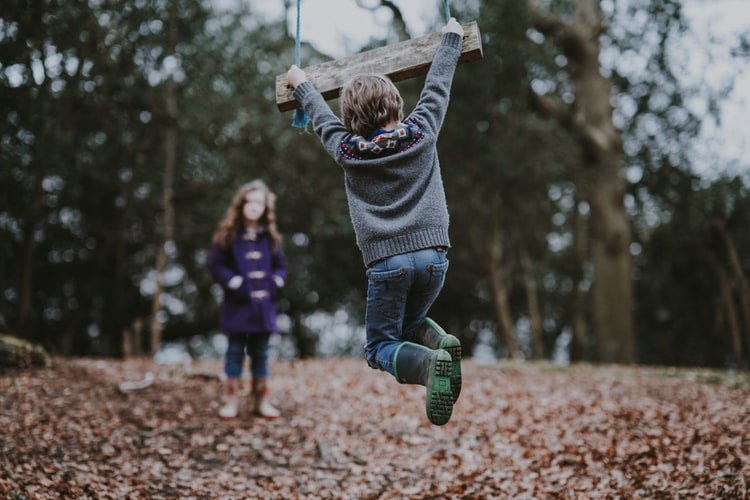
We could all use a little free imagination time of our own.
I spend an average of 7–8 hours on my phone per day. At least 2 hours are spent mindlessly scrolling on Facebook on most days.
What if we all rolled in the grass, went for a swing, read a book, and played tag once a day? Imagine what fun we’d have, how relaxed we’d become, what healthy humans we’d be.
Let’s take action to shift our paradigm. We’ve headed there anyway. Might as well start the process of acceleration.
Less is more. Begin at home and watch how your life changes for the better.
Let’s stay in touch. You can find me on Facebook, Twitter, Instagram, and LinkedIn, or my personal blog at gratefulx365.wordpress.com. Submit your amazing stories to my Medium publication, Gratefully Yours.


