
Why It Took 7 Years to Study the Bible with My Wife
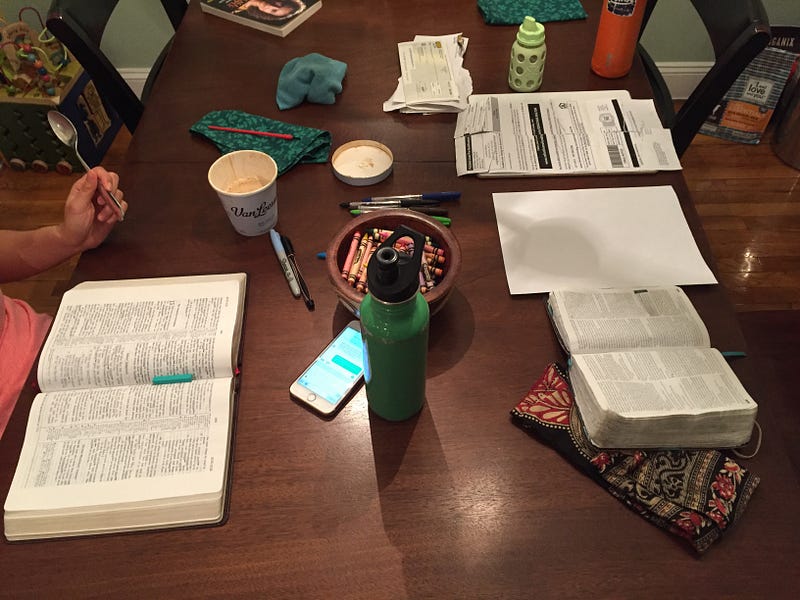
A few weeks ago, I asked my wife if she’d like to study the Bible. The unique thing about this invitation was that there was no one else in our apartment. There was no small group of people gathered with pens and pencils around their notebooks or journals. There was no discussion planned with snacks laid out for when things got boring or folks got stuck. There was just us at 9 o’clock on a Sunday night looking at scripture together.
Now you should know I’m on staff with InterVarsity Christian Fellowship and lead Bible Study like it’s my job, because it is…my job. I love scripture and enjoy digging into the meaning of each word and examining its real life implications. This is partly because I grew up in a Black Baptist Church in the South and scripture study and memorization is essential; but the practices were more solitary and cultural than communal and biblical. So when I became a follower of Jesus I longed for integrity and justice and found Christ held them both.
My wife is also a long-time follower of Jesus and the conservative Chinese church that developed her as well as InterVarsity also gave her a high value for scripture. The truest statement about her faith is that she will not make any significant change in her life without a word from the Lord. She must hear a “yes” from God in prayer, a vision or committed discernment.
So why did it take so long to study the Bible together?
My initial reasons whenever she would complain to me that we didn’t pray or read were about time and tiredness. But after a recent fight I realized that the issues are much deeper. I didn’t pray with my Mom outside of the church services we attended unless we were blessing the food until I was 21 years old. In my household, I regularly ate alone and I never studied the Bible with the rest of my family. It was expected that we were doing it on our own. We went to Church but I don’t know if church came home with us. I was taught that Christianity was private. It’s only in the last few years that my family of origin discussed faith, prayed together, and sought to hear from God. My mother’s cancer was the emergency that led us to all pull out the God we worshipped separately that somehow we would now call on together.
Moreover, as a campus minister with InterVarsity my interactions with scripture were from a place of work and power, not of learning and vulnerability. I only talked about problems that were solved and shared emotions that I was comfortable with. I didn’t care to be heard, felt or understood. I wanted to be respected, honored, and thought of as knowledgeable. This complimented my cultural background where Black males, especially Black male preachers were honored for strength, resilience and devotion. I learned from culture that leaders are honored for a strength that gave no space to weakness or pain. The Christian faith as I knew it defined resilience in such a way that left me unable to connect emotionally with God and other people; and unwilling to enter into the pain and struggles of other people UNLESS it was my role and responsibility.
So sitting across from my girlfriend, fiancé, wife and now mother of my child I regularly felt inadequate and insecure but projected strength and confidence. And because I wasn’t making space for my own pain, fear, and uncertainty I was unable to make space for the pain, fear and complaints of those closest to me — even my wife.
I realized that the reason I didn’t want to study scripture with Priscilla was not because I didn’t love God’s word or my wife. It was because I didn’t feel safe enough to reveal my own questions, my own weaknesses, my own complaints and problems.
I believe in my heart and think in my brain that everyone is valuable. But I believe in my bones that people who show weakness, complain about every little thing, and share their problems and questions are less valuable. People that complain, especially those who are close to me, I believe something is wrong with them. In some cases at my core I even think I’m
better than them and that they have nothing to offer me.
The truth is of course that what I believe about others is actually what I believe about myself. The internal frustrations with my own limits along with the self attacking that comes with it is turned outwards and projected onto those around me. I learned early on that if I have complaints, problems and was bothered by happenings and circumstances in life that I am weak and have nothing to offer people. I also learned that if I am not perfect and don’t have it all together that no one could learn from me. Additionally, I inferred that I am not worthy of being heard or felt. My feelings were dismissed and minimized as a child and being emotionally unavailable was praised. I was rewarded when I pressed through alone naming grit and determination as the reasons. And now I perpetuate that cycle when I don’t make space for my emotions or those of others. Thus, closeness is not possible with Priscilla or Maia (my daughter) as any area where I could be seen as vulnerable or weak is avoided at all costs.
So with these unprocessed issues firmly in place studying the Bible and praying with my wife has been a mountain I am unwilling in some ways and unable in others to climb. Lack of skills or material or busyness was not the reason I didn’t study scripture or pray regularly with Priscilla. Not experiencing Jesus with her in this way was an unconscious submission to the way that faith and family had been modeled for me. And it was a choice not to embrace the discipline of reflection and change in this area. Now that they’ve come to the surface I am working to make it a regular practice to show my emotions, share my weaknesses, and bring my questions to scripture in community — not just at work when I have to but with my wife as well.