
Why Is There a Connection Between Pi, the Gravitational Field, and the Meter?
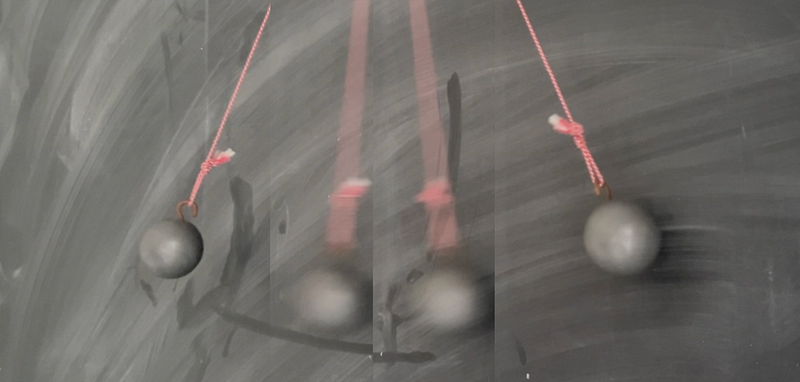
Here’s a fun one to try. Take out your calculator. Now use it to take the square root of 9.8 (remember that g = 9.8 Newtons per kilogram). What do you get? SPOILER ALERT — it’s 3.13 something. Yes, that’s pretty close to the value of pi. Is it a coincidence? NOPE.
But why? Why is the square root of g approximately pi? Let’s start with g. Although it’s often called “the acceleration due to gravity”, it’s actually the magnitude of the local gravitational field. It has a value of 9.8 Newtons per kilogram, but this is the same as 9.8 meters per second². The important thing in this unit is the meter. Yes, it’s the meter’s fault.
The Meter and the Seconds Pendulum
Humans need to measure distance — how else could you build stuff? In the very early days, different groups of humans had different standards for measuring length. That’s how we get silly units like “feet” and “inches” — which are sadly still used today.
However, in 1660 the Royal Society wanted to define the length of a meter using a seconds pendulum. The idea is to make a pendulum (a mass on the end of a swinging string) such that it swings from one side to the other in 1 second or back and forth in 2 seconds (so it has a period of oscillation of 2 seconds). The length of this seconds pendulum would then be the standard distance unit of 1 meter.
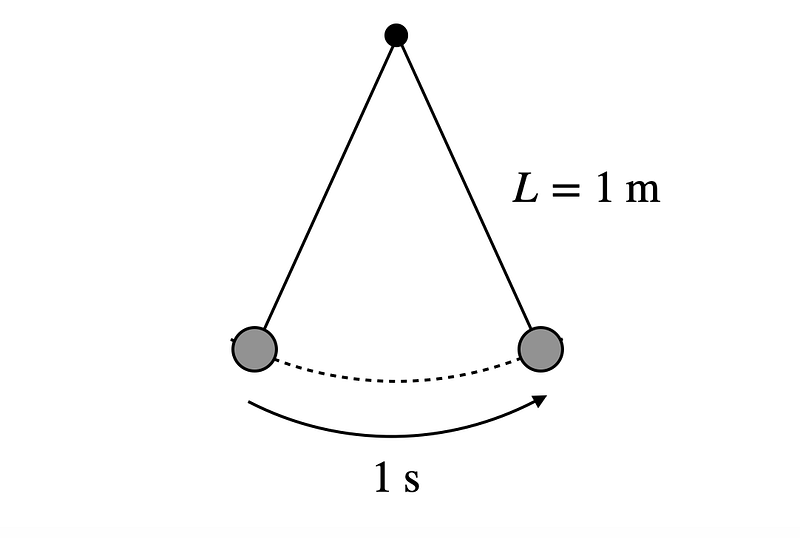
This is way more difficult than you could imagine. Why? Because how do you know the length of time that is 1 second? Oh, that’s easy — right? Just take 1 day and divide by 24 hours then divide by 60 minutes then divide by 60 seconds — boom, 1 second. Well, that seems nice but there’s a problem. All days don’t have the same length. So, it’s not so easy to get one second.
Fine. Let’s just say that we have the approximate length of 1 second. Now we could adjust the length of a pendulum until it takes 1 second to get from one side to the other. This length is defined as a meter. Does this tell us why the square root of g is pi? It’s part of the story.
Period of a Pendulum
Let’s say that you have a mass hanging on a string of length L. If you pull this off to the side (just a little bit) and let it swing it will go back and forth. Actually, if the initial displacement angle is small (like less than 15 degrees) then the motion of this swinging mass is almost exactly like a mass connected to a spring. We call this — simple harmonic motion.
The key to any simple harmonic motion is that there is a force pulling the object back towards the equilibrium position AND that the magnitude of this force is proportional to the displacement. This would be true for both the mass on a spring and the small angle pendulum. However, the awesome thing about simple harmonic motion is that we can describe it with the following equation of motion:
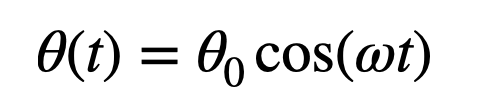
Where ω is the angular frequency of oscillation. If we know the restoring force (we do) then we get the following expression for ω and the period (T).
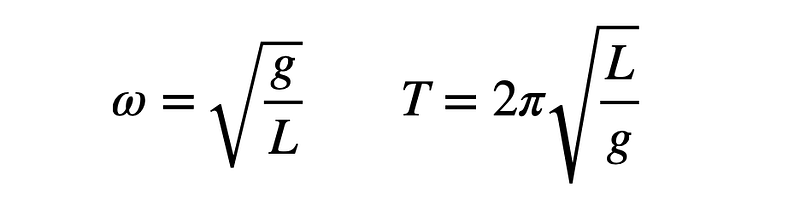
Oh, if you want ALL the details to derive these expressions — here’s a video for you.
The Answer to Everything
OK, back to the 1 meter long pendulum. If L is equal to 1 meter and and T is equal to 2 seconds, then we can solve for the value of g.
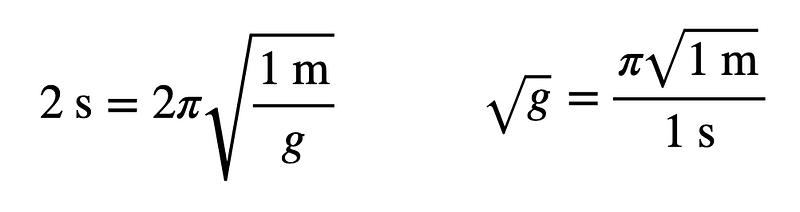
There you have it. The square root of g is pi.
What’s Wrong with the Seconds Pendulum?
Of course, this method for defining a meter isn’t the best. Just imagine being at the equator of the Earth. In this case, the effective gravitational field is smaller than 9.8 N/kg because of the rotation of the Earth. This adds an extra (fake) outward pushing force from the centrifugal effect. As you move closer to the poles, this effect is minimized because you would be closer to the axis of rotation.
There’s another problem — the non-uniform density of the Earth. Since the Earth isn’t a perfectly uniform sphere, the gravitational field varies due to changes in material in the Earth’s crust and even due to near by mountains. So, the seconds pendulum doesn’t give the same value of a meter for everyone on Earth.
Another definition of the meter was using the actual Earth — since everyone (in theory) is on the same planet. This says that the distance from the equator to the North Pole is 10 million meters. So, you can get the value of single meter by running a string from the equator to the North pole and then cutting that into 10 million equal sized pieces. I’m joking — don’t do this.
Of course, our current definition of the meter doesn’t even depend on the Earth. Right now, it’s the distance that light travels in 1/299792458 seconds where 1 second is the time it takes a cesium -133 atom to oscillate 9,192,631,770 times. That way anyone, anywhere in the universe can make their own meter stick.


