
Why is the USA so interested in India?
How does the rivalry between India and China benefit India?
Today, we are witnessing a global economic battle not only for dominance but also for the survival of major players. This struggle was ignited by the economic recession triggered by the COVID-19 pandemic and exacerbated by the Ukraine war. The USA views China as a future challenger to its global dominance, while India aspires to become a prominent international player. India is engaged in intense competition with China in both economic and military realms. In this rivalry with China, India benefits from the Western world’s support, driven by their concern about China, similar to the way they were fixated on the USSR during the Cold War era.
Factors propelling India’s remarkable progress in both military and economic spheres.
There are three key factors propelling India’s remarkable progress in both military and economic spheres:
- Western support, including investments and technological assistance, due to their China containment policy.
- India’s status as a democracy.
- India’s abundant, skilled, and cost-effective young workforce, particularly in the IT sector, along with its substantial consumer market, making it an attractive destination for Foreign Direct Investment (FDI).
India’s population of 1.4 billion people now rivals China’s, and its GDP is projected to grow more rapidly than China’s. This is attributed to India’s favorable age-to-fertility rate ratio when compared to competitors like China, Japan, the USA, and the Eurozone. India is expected to maintain a better ratio of working-age population to the elderly in the coming years, with an anticipated increase in women’s participation in the workforce.
Goldman Sachs Research predicts that India, leveraging its demographic advantages, could become the world’s second-largest economy by 2075, surpassing the USA, Japan, and Germany. This projection is supported by India’s economy being driven by domestic consumer demand, accounting for approximately 55–60% of its overall economic activity, as stated in the article titled “How India could rise to the world’s second-biggest economy,” published by Goldman Sachs Research on July 6, 2023.
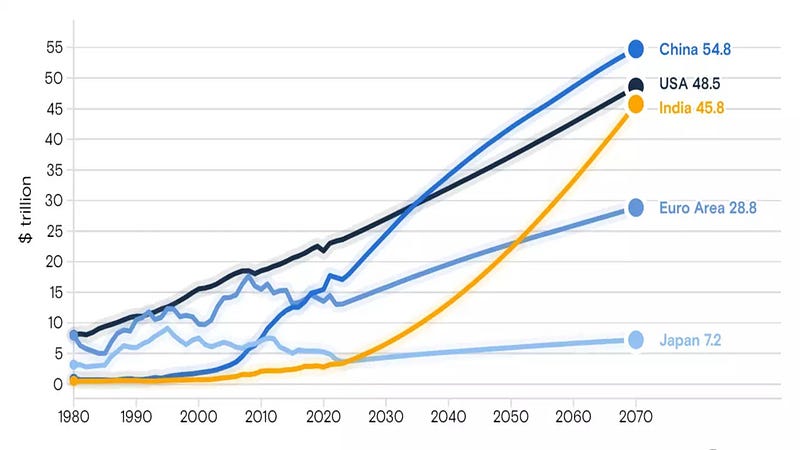
Global future investment trends and India
However, there is a higher likelihood that India may reach a saturation point and start experiencing demographic challenges as per capita income increases. This could lead people to adopt smaller family norms, similar to what has happened in Japan, Europe, and China, resulting in a rise in labor costs. Investors may then prefer to shift their focus to ASEAN countries and eventually Africa, where the birth rate per woman is currently the highest. Many analysts believe that Africa will emerge as the next attractive investment destination, and Latin America may follow suit.
Therefore, there is a significant chance that India may become the third-largest economy by around 2035 and is expected to maintain this position throughout the remainder of the 21st century. China and the USA are projected to hold the first and second positions, respectively. This is partly because the USA is not expected to face severe fertility rate issues due to its diverse population, which includes nationalities with higher fertility rates than those of European origin. Additionally, the USA has a history of inviting skilled immigrants from abroad when needed, as it did in the past to develop its IT industry.
Future USA -India relations
While China is expected to surpass the USA in economic worth by 2035, India could also be on the cusp of becoming the world’s third-largest economy, moving up from its current fifth position behind Japan and Germany. India’s historic ties with Russia, spanning weaponry purchases and now oil, are significant. India seeks Russia’s support for its entry into international bodies under the UN, including its aspiration to become a permanent member of the Security Council. India’s foreign policy of nonalignment has played a crucial role in its current international stature. Although it leaned towards the USSR during the Cold War era, it benefited from American support after its 1962 conflict with China in Sikkim. Similarly, despite the USA’s demand for India to condemn Russia’s invasion of Ukraine, India is establishing comfortable relations with the USA, especially since China has become a major concern for the US.
Conclusion
Nevertheless, it is essential to acknowledge that international relations are influenced by political realism, where alliances and enmities are not permanent. National interests remain paramount and enduring. It is possible that India’s relations with the USA could become strained in the future as India’s economy approaches that of the USA and its trade balance becomes unfavorable to the USA, as previously occurred with Japan and now in the trade tensions between the USA and China. However, currently, it appears unlikely that relations between India and China will become amicable in the near future due to serious territorial disputes along their 3,488-kilometer-long border.