
Why is the te-form of Japanese verbs so complicated?
One of the biggest obstacles to learning Japanese is verb conjugation. Most learners of Japanese first learn that verbs are divided into three groups, and then learn the Masu-form of each verb.
Next, they learn the te-form, assuming that they have learned the Masu-form. This conjugation of verbs into the te-form is a source of difficulty for many learners.
The difficulty with conjugating verbs in the te form is that they are taught that there are no rules and they have to learn them just by heart.
In practice, there are rules for conjugating the te-form, but using these rules requires a knowledge of phonetics.
It is not practical to think about each conjugation, so many teachers tell students to learn the verb conjugations by heart.
However, some of them may be curious to know the rules for conjugating the te-form and why this is done.
Therefore, this article introduces the reasons the the te-form has irregular conjugation and the rules of conjugation.
The reason te-form has complex conjugation.
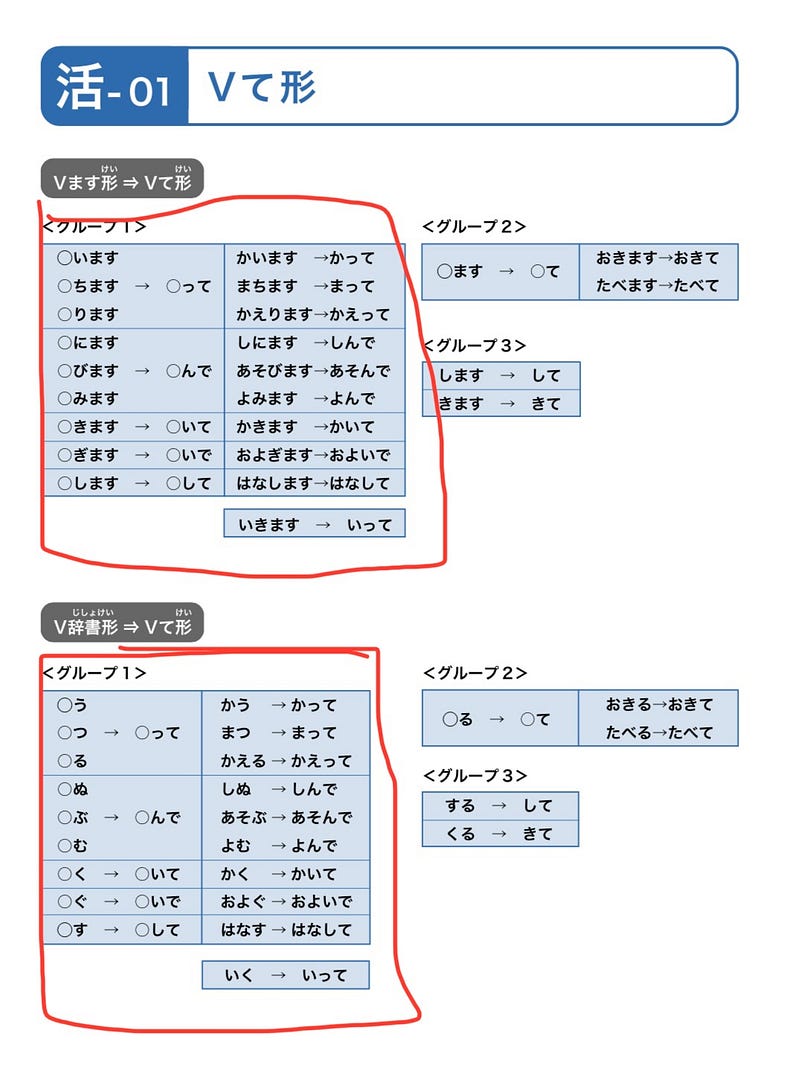
This is a page from a Japanese language textbook.
This is that many learners of Japanese hate. Even though the verbs belong to the same Group I, there are five different patterns of change.
The reason why the change to te-form of the verbs in this group I seems irregular is that all these verbs are euphonic changed.
A euphonic change means that the sound was in fact different, but that it was changed to a different sound because it was difficult to pronounce.
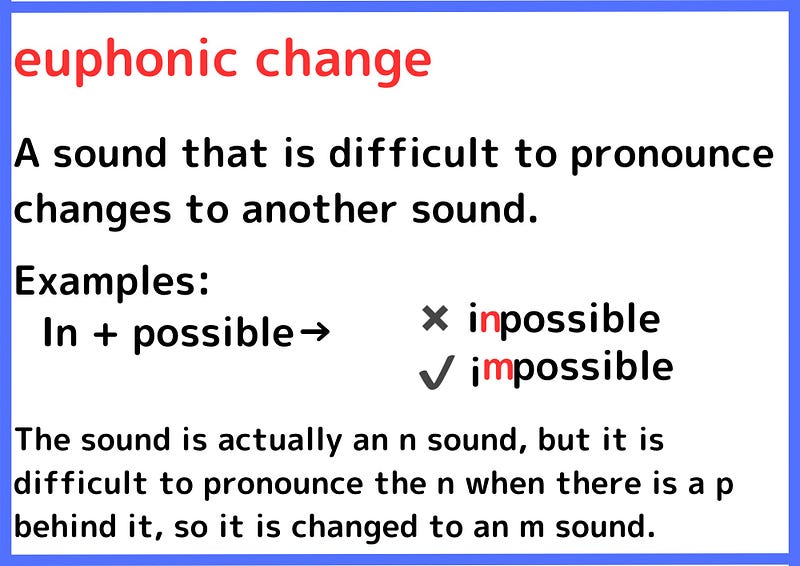
There are three types of Japanese euphonic changes ; those that change to an ‘i’ sound, those that change to an ‘n’ sound and those that change to a double consonant.
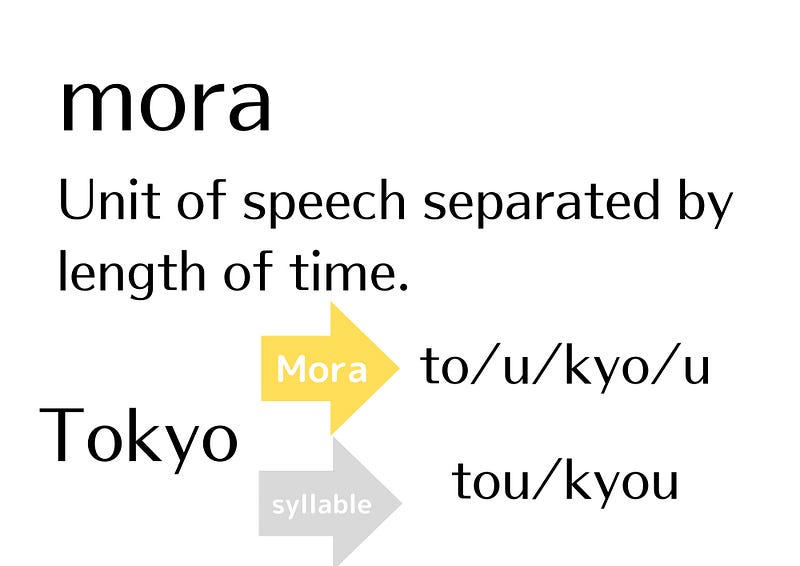
While maintaining the number of moras, euphoric changes reduce locomotion by reducing two closures to one.
Reduce the momentum while maintaining the number of moras. This is why euphoric changes occurs.
What happens when euphoric change occurs in te-form?
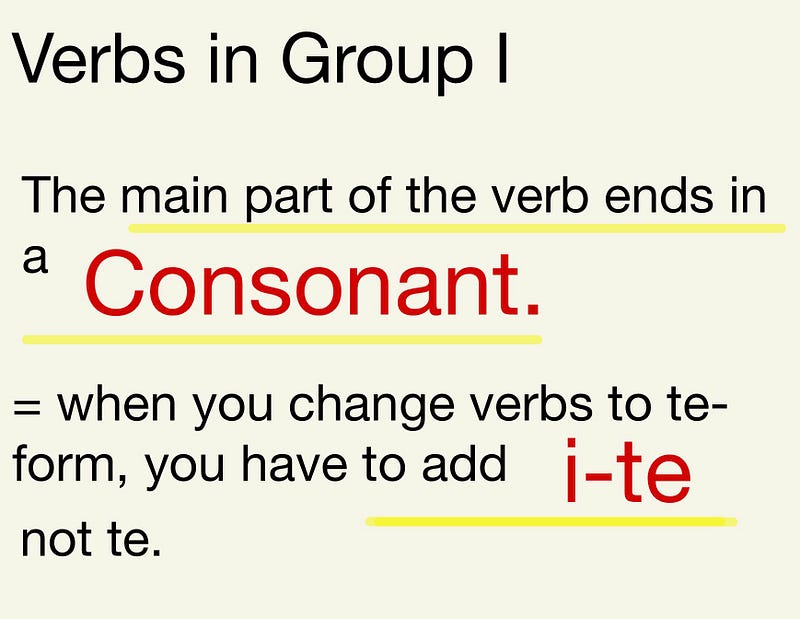
Euphoric changes of the te-form depends on the consonant immediately preceding it.
See the following slides for the corresponding consonants and euphoric change’s rules.
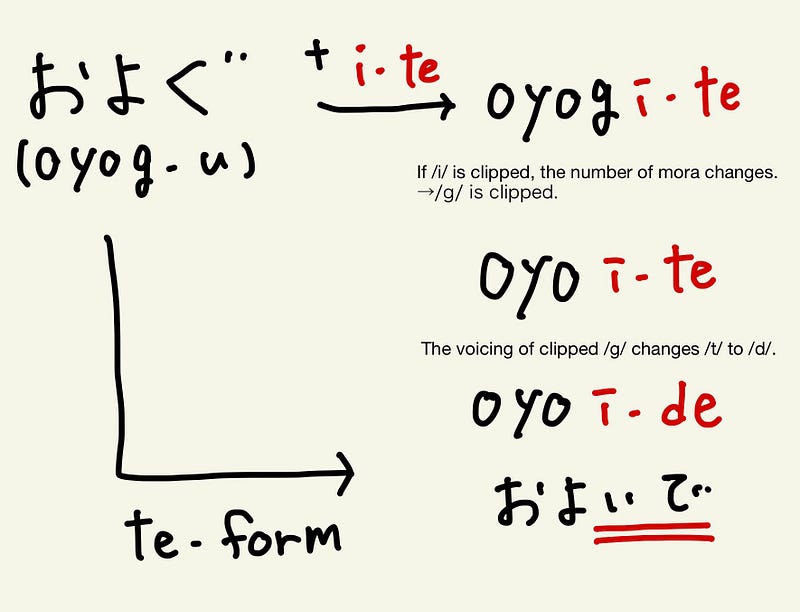
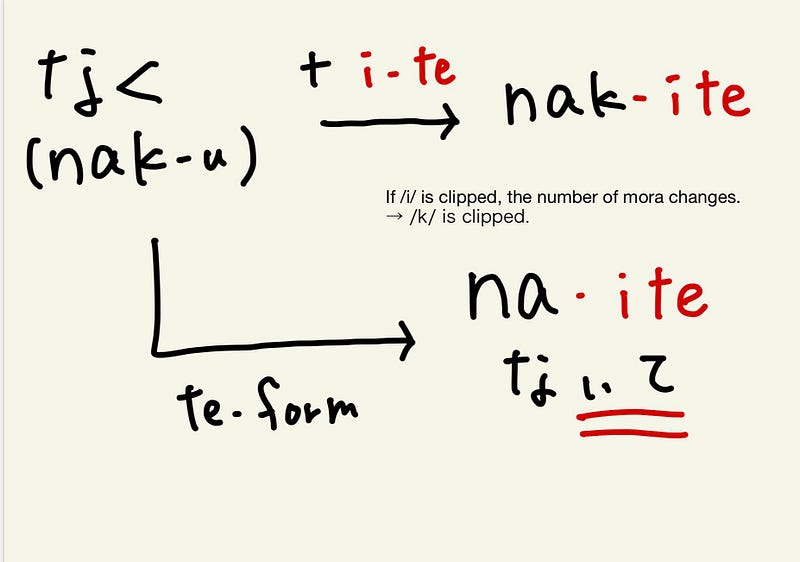
When the main part of the verb ends in /g/,it is followed by the -ide form, and when it ends in /k/,it is followed by -ite.
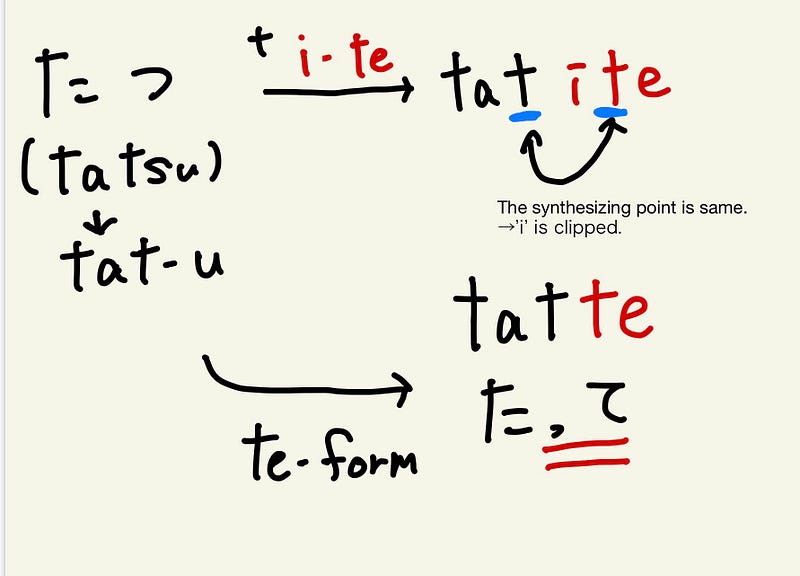
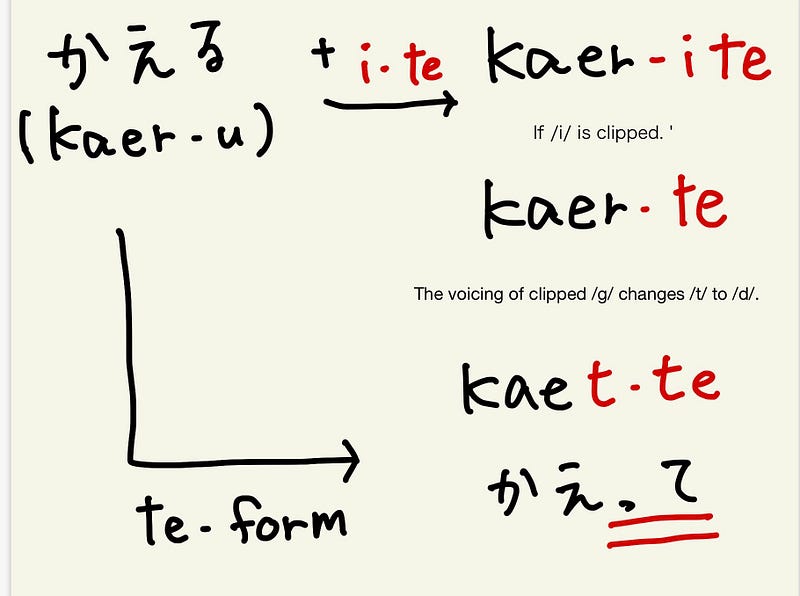
When the main part of the verb ends in /t/or /r/, -tte is attached.
Note that in the past, ち(chi) and つ(tsu) were /ti/ and /tu/ respectively.
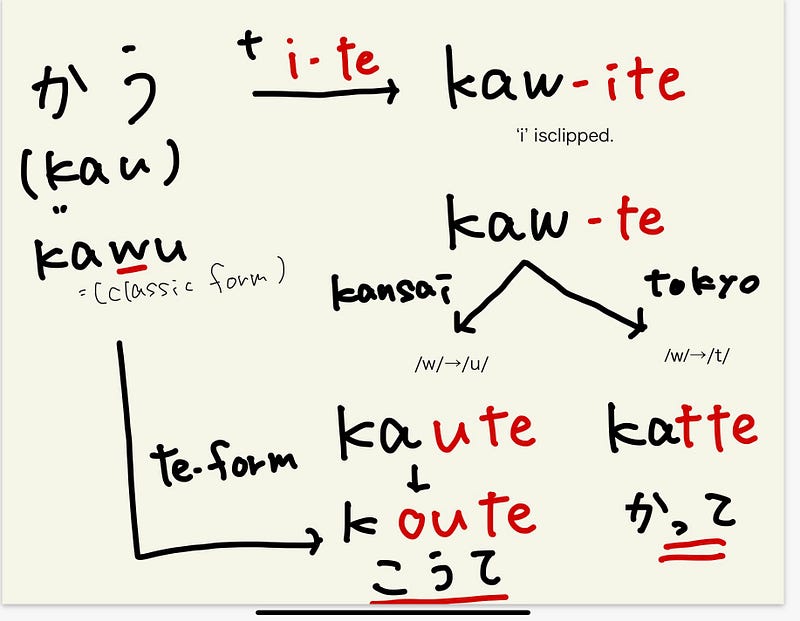
Verbs ending in ‘u’ used to be /wu/.This causes a change in sound as shown in the slide above.
The te form of such verbs has a different form in the Kansai dialect.
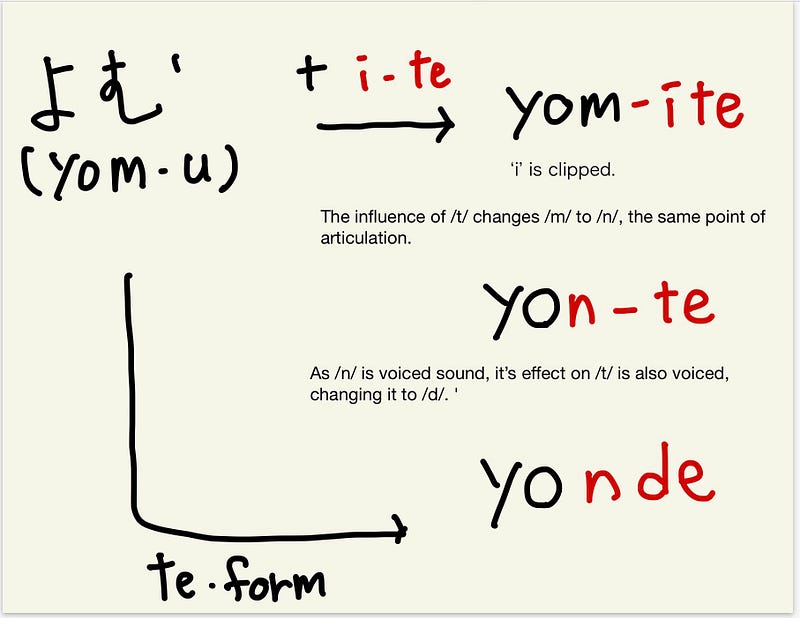
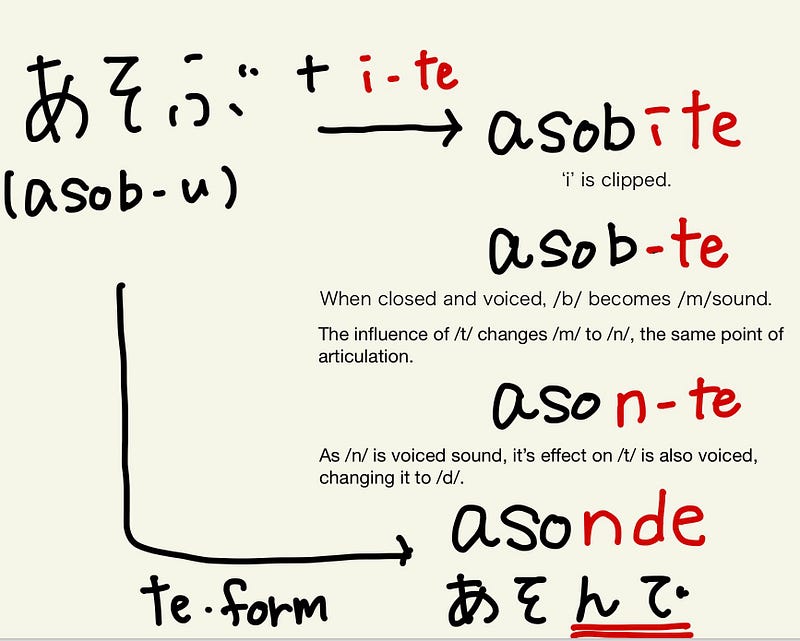
Verbs whose main part ends in /b/, /m/, /n/, have their consonants disappear and -nde is added.
That is what happened when you change to te-form!!
Have fun and don’t give up on your Japanese language learning!


