
Why is the MBA Program Losing its Edge with Each Passing Year
Reasons highlighting the drawbacks of an MBA

“The difference between school and life? In school, you’re taught a lesson and then given a test. In life, you’re given a test that teaches you a lesson.” — Tom Boded
The MBA Program has been gaining prominence since it was first introduced as a management course by the Harvard Business School in the year 1908¹ and today is offered as a program by universities globally. The reason for this program was and still is to prepare students for the ever-changing business environment and provide a scientific approach to understanding the management aspects of the business.
With time the degree has not only gained significant goodwill and popularity amongst parents and children, but it has also evolved to be the Gold Standard of Education globally. That is probably one of the reasons even I chose to pursue an MBA.
Its been over three years that I have completed my degree, and in hindsight, my education still feels incomplete to a great extent. I don’t blame the institute I studied as that was my choice as the overall experience was one to cherish, but I wish my education were more related to the career I am pursuing. This thought made me realise that maybe an MBA is not always the answer, and it certainly isn’t enough to rely on.
Some of the reasons that an MBA is simply not enough are:
Education Relevance vs Career Opportunities
While MBA programs have evolved with time to include specialisations such as Entrepreneurship, Marketing, Finance, etc., the programs are still not well equipped to prepare students for a wide range of profiles that each industry offers. Simply put, you have one or two years to learn as much as you can about one field of study. The fact that the process of learning is time-bound shows you the limitations of the scope of the study.
False Sense of Security
The notion of pursuing an MBA is so exciting and filled with so much promise that most of us believe it is the answer to all our future professional problems. Most people believe that an MBA is your gateway to getting a job, good pay and a work-life balance.
An article in 2020 indicated that only 35% of the MBA graduates land up getting jobs². The sheer global supply of MBA graduates in the job market has led to the program losing its value over the years and proving to be a disadvantage for the majority of the students who choose this path. Therefore, thinking of pursuing a degree which has no competitive advantage or distinct value in an industry is not the solution to your problems.
The Program is Commercialised as if its the next James Bond Movie
Try and google ‘Reasons to pursue an MBA’. You will notice that the results you get from the first few websites are so tempting to go ahead with pursuing the degree that you would hardly bother thinking about the downside. Here is an example of the first result I got when I googled it.
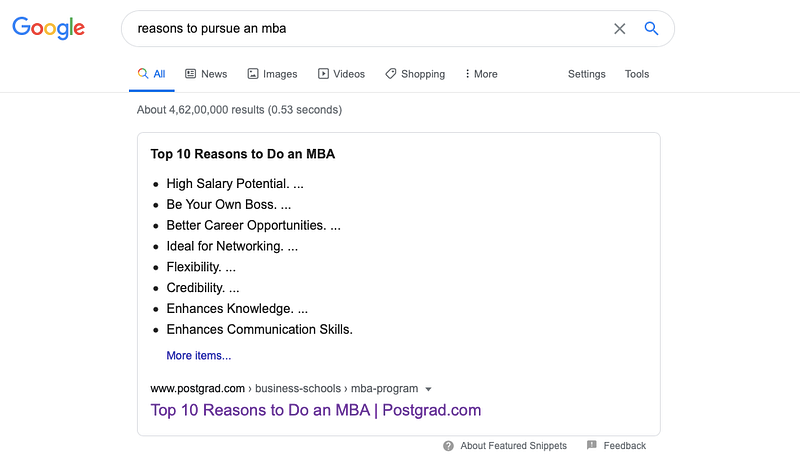
Our decision to educate ourselves is highly influenced by the way our education is marketed. That marketing today happens to be via the internet, the newspapers, our friends and even our parents. When so many different sources are telling you to make one decision, it gets difficult for us to process the pros and cons of that decision and make an informed choice on what would be the best course of action.
Expectations vs Reality
Before we embark on our journey of pursuing an MBA degree, almost everybody we know will tell us how we are making a great decision in securing our future or how the education is going to help us in a significant way in our lives, etc. What this does is it starts creating a bubble around us and distances us from the reality of events. This bubble then begins to inflate when we start believing what we hear, and we build on to it with our aspirations of buying a house, a car, living a comfortable life, etc.
Then comes the day when you are to get placed along with the rest of your class and for reasons that are not always in your control, you land up in the 65% category of people who do not have jobs. This leads to your gigantic bubble bursting and giving you a jolt of reality. Most of us then are unable to accept this reality which then leads to issues such as Stress, Anxiety, Lack of Self Confidence and Inferiority Complex, to name a few.
At that moment, you forget how qualified you are or what you are capable of achieving. All that you remember is that you do not have a job. And just like that, your degree which is a mark of your knowledge and learning experiences is now only a reminder of being unemployed because all your expectations are pinned onto one event playing out right in your life.
The Debt Restricts You from Exploring Career Opportunities
Not everybody is going to be able to pay fees worth USD 45,000 to a USD 100,000 for the program. Therefore, they choose to take on the debt to finance their education. The problem with debt is that it haunts you till its paid off and is always your number one priority. Whereas when you are in your late twenties or early thirties, your preferences should be to explore different job opportunities, take a bit of risk in making unconventional decisions and not stress about the amount that is deducted the minute you get your salary at the beginning of every month.
To summarise, the value of an MBA does not last forever, or even five years after you have completed it. This is because MBAs focus on standard business skills. In contrast, companies today are looking for people with specialised expertise in each field. Hence, even if you are an MBA graduate, you are expected to learn the current business practices to stay up to date with the developments of the industry and its environment.
Even today, companies that recruit MBAs often talk about how they value problem-solving and analytical skills the most in employees. So working on those aspects while specialising in one field of work will be more helpful than just a general management program.
Here is one final thought to leave you with on this topic. According to a Forbes article published in 2016, around one-third of the MBA curriculum is available online for free³. So why do you want to spend your time, money and resources on a course that is getting diluted by the day in its ability to teach you and add any value?
References:
- https://www.mbacentral.org/history-of-the-mba/
- https://www.deccanherald.com/opinion/panorama/why-so-many-mba-grads-are-unemployed-795309.html
- https://www.forbes.com/sites/ashleystahl/2016/02/02/ten-reasons-you-dont-need-an-mba/#6186d06447d6
The Mini Post-Grad Survival Guide
A 5-day email course with amazing tips on budgeting, investing, and productivity for 20-somethings. Sign up for free.


