avatarMs Aerin

Summary

The dot product of orthogonal vectors is zero due to the algebraic and geometric definitions of the dot product, which agree with each other through the Pythagorean theorem.

Abstract

The article explains why the dot product of orthogonal vectors is zero by providing both algebraic and geometric definitions of the dot product. The algebraic definition is given as the sum of the products of corresponding entries of the vectors, while the geometric definition is the product of the magnitudes of the vectors and the cosine of the angle between them. The article then demonstrates how these two definitions agree with each other through the Pythagorean theorem and provides an example using two vectors. The article concludes with a pop quiz asking the reader to prove that vectors that are orthogonal to each other are linearly independent.

Bullet points

  • The dot product of orthogonal vectors is zero by definition.
  • Two non-zero vectors are orthogonal if and only if their dot product is zero.
  • The algebraic definition of the dot product is the sum of the products of corresponding entries of the vectors.
  • The geometric definition of the dot product is the product of the magnitudes of the vectors and the cosine of the angle between them.
  • The algebraic and geometric definitions of the dot product agree with each other through the Pythagorean theorem.
  • The article provides an example using two vectors to demonstrate the agreement between the algebraic and geometric definitions.
  • The article concludes with a pop quiz asking the reader to prove that vectors that are orthogonal to each other are linearly independent.

Why is the dot product of orthogonal vectors zero?

The answer is simple. It is “by definition”.

Two non-zero vectors are said to be orthogonal when (if and only if) their dot product is zero.

Ok, now I have a follow-up question. Why did we define the orthogonality this way?

Algebraic and Geometric Definitions of Dot Products

Algebraically, the dot product of two vectors is defined as:

The algebraic definition

Yet, there is a geometric definition of the dot product as well:

a • b = ‖a‖ * ‖b‖ * cosø

which is multiplying the length of the first vector by the length of the second vector by the cosine of the angle between the two vectors.

What is the angle formed by the two perpendicular vectors? 90°.

What is the cosine of 90°? The answer is ZERO.

As a result, a•b equals to zero.

I’m looking for more than a definition. Can you show me something real?

Alright… then here is how those two definitions (geometric and algebraic) agree with each other through the Pythagorean theorem.

This is the definition of the vector norm. I’m reminding you of this because this definition will be used to extend Pythagoras’ theorem to n-dimensional spaces.
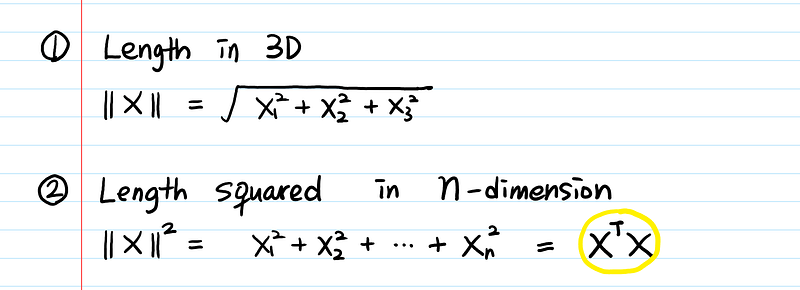
The length of n-dimensional vectors

Now, think about two vectors: [-1, 2] and [4, 2].

Algebraically, [-1, 2] • [4, 2] = -4 + 4 = 0.

Using the Pythagorean theorem and the vector length formula ②, we can say:
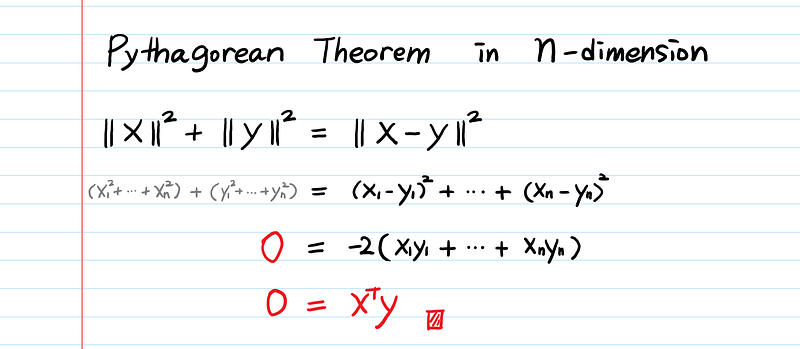
We can extend the Pythagorean theorem to n-space.

You can verify that they are geometrically perpendicular as well.
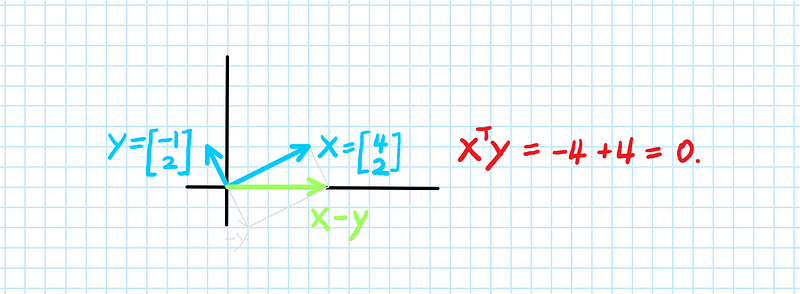
Orthogonality is shown algebraically and geometrically.

The geometric definition matches with the algebraic definition!

Let’s wrap up this blog post with a pop quiz.

Vectors that are orthogonal to each other are linearly independent. This seems obvious, but can you prove it mathematically?

Hint: You can use the two definitions.

1) The algebraic definition of vector orthogonality 2) The definition of linear Independence: The vectors {V1, V2, … , Vn} are linearly independent if the equation a₁ * V1 + a * V2 + … + an * Vn = 0 can only be satisfied by ai = 0 for all i.

Machine Learning
Linear Algebra
Mathematics
Recommended from ReadMedium
avatarChelsea Zou
Maximum Likelihood Estimation

6 min read