
Why Is Successful Learning Full of Paradoxes?
You can’t learn successfully without being both subjective and objective.
We, humans, and our lives are full of paradoxes. It seems to me that for us to exist and to live a balanced life, we need to maintain those paradoxes. Maybe balance equals paradox? Who knows?
The paradoxical nature of learning
Also, successful learning is full of paradoxes.
We turn our focus on what we want or committed to learning. That is a subjective aspect of self-learning.
Subjective = “influenced by or based on personal beliefs or feelings, rather than based on facts.” — Cambridge Dictionary
But to learn something new, we need to step outside of what we know and be willing to stop comparing what we learn to what we already know. In such a way, we will be able to see what we heard of already in a new light. Thus, true — that is, successful — learning is directly connected to objectivity.
Objective = “based on real facts and not influenced by personal beliefs or feelings.” — Cambridge Dictionary
That was the first “wave” of the paradox of learning. Both subjective and objective processes are vital for us to grow.
The subjectiveness of assimilation
Here comes the next paradox. And it happens during the assimilation of what we learn.
To grasp anything we learn and to assimilate it, we need to do that with the terms that are natural to us. Thus, we compare, build analogies, and label that new information either as “known” or “unknown,” “good” (preferable) or “bad” (undesired), “understandable” or “too complex,” and other in such manner.
You could say we need our subjectiveness to process what we learn.
And it makes sense. Just like with food, also the information we receive is digested by each person differently. No wonder we often call new and surprising information, “food for thought.”
Balanced out through objectiveness
However, objectiveness is not far away here because the assimilation of what we learn is a learning process too. We don’t digest what we learn in a dark room and complete isolation.
Just like with dinner with friends and dishes we never tasted before, so much occurs where we are and around us. We will enjoy the dinner and the new dish more if we put our automatic judgments aside. We might acknowledge them because they can signal, “Hey, this is something completely new!”. But if we are open to learning something new, we won’t take them as the only right option for the food to taste.
The same thing happens when we consume and assimilate new information, whichever format it might be. The assimilation happens, while the world around us evolves further. While we evolve further.
Interpreting the world
Here is another analogy that might help to grasp this process. When we learn, we are all doing the job of a simultaneous interpreter.
“Simultaneous interpreting is a mode of interpreting in which the speaker makes a speech and the interpreter reformulates the speech into a language his audience understands at the same time (or simultaneously).” — European Commission
This simultaneous translation means that the interpreter processes and interprets the received information to the listeners while receiving the next bit of information from the speaker.
What asks for our attention
We have a lot of “speakers” around us — those we choose to listen to and those who compete for our attention.
“Information everywhere competes constantly for your brain’s attention — sights, sounds, tastes, smells, thoughts, and physical sensations.”
— Jane McGonigal, SuperBetter: How a gameful life can make you stronger, happier, braver and more resilient
How to make the best job as an interpreter
It’s not easy to be a simultaneous interpreter. I tried it one day in my life as a paid job and vowed never to do it again. I interpreted later for my mother on occasion in a foreign for her land. Still, since that one attempt of doing it as a paid job, and after I experienced being the interpreted speaker and asked many times to slow down, I never attempted the task again.
But we are all the interpreters of multiple flows of information around us and for ourselves, and just as professional interpreters, we misinterpret one or more bits of incoming messages.
I once learned that the best way to interpret — as with anything else — is to be in the flow of translation, not to think about the interpretation process. If you start thinking about it, you will lose the thread and stop translating.
Stumbling over a compliment
I experienced something similar at an international conference in the United States. I was representing one of the Faculties of the Technical University Darmstadt, Germany, there.
I met many exciting people with whom I spoke four different languages: English (the language of the conference), German (with scientists from the country I lived then), Romanian (my mother tongue with a fellow researcher from Romania), Russian (with immigrants who moved from the former Soviet Union to Israel).
The communication in these four languages flew seamlessly for me until someone complimented me on my ability to switch between them with ease.
I was delighted to get such a compliment, but when I started to say, “Thank you,” I opened my mouth, and no sound came out. I was at a loss of words, and I didn’t know which language to use. I was confused, and instead of saying “Thank you” in the language the compliment was made, I said “sorry” or something else in two or three other languages in quick succession.
Riding a bike
You might have noticed that I love analogies. Here is another one in the conclusion. Some might even consider it being a cliche. But it’s an evergreen one, and, therefore, worth making.
Like in everything else, in learning, you need to maintain the balance between recognizing your genuine interests and being open-minded and curious.
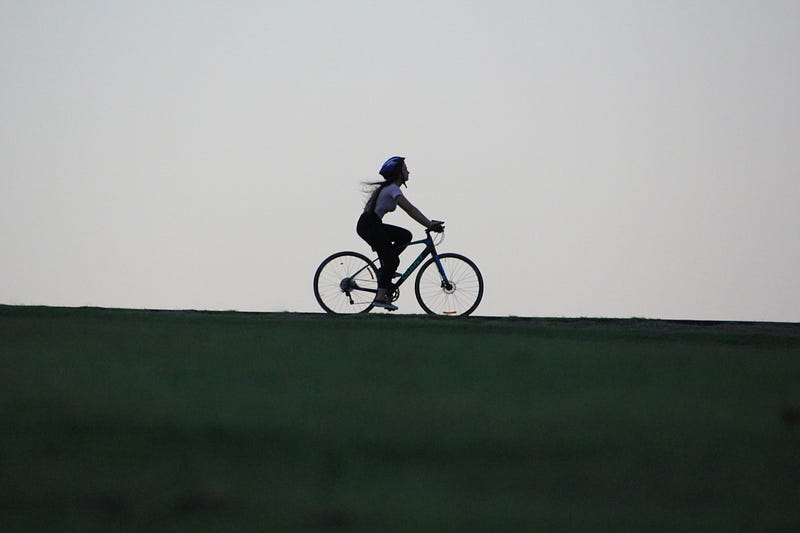
Thus, like so many other processes in our lives, learning is also like riding a bicycle.
Full disclosure, I don’t ride a bike. I learned to do it in my mid-twenties. So when I attempted to ride the bike then, I was overthinking about falling. I watched my feet stepping on pedals instead of looking ahead of me. The twenty or so (maybe less) rides in total never included riding away from a path in a field or forest. Riding a bike in a city scared so much.
Now, my eye condition and slight balance problems might contribute to the reasons for not attempting to learn riding a bicycle again, but if I am honest, the main reason is that: I am overthinking riding a bike. Even without riding it! Every time, I have to share the fact that I don’t ride a bike, I overthink the activity…and the answer.
What’s that good for?
“What’s that good for?” you might ask.
“Why are you telling me about paradoxes of learning when in the end you say, ‘Don’t overthink it!’”
I have no idea.
All I know, I started writing another article about a gameful art of studying something and found myself writing about paradoxes. Then the word “balance” came out and finally led me to the analogy of the bicycle and my experience of riding one. Maybe my stumbling over a more-than-twenty-years -old picture of one of my very first riding attempts a week ago rekindled those fun but tumultuous memories.
What I know for sure, this article was an adventure. A learning adventure. The thoughts appearing on the screen surprised me, prompted to do quick searches for definitions and quotes, take a break to contemplate an unfinished thought, and in the end, it simply delighted me to write it.
Maybe this is what learning is all about. About delight, about fun.
If,
“Fun is another word for learning.” — Raph Koster, Theory of Fun for Game Design
Then the real and successful learning happens when we feel joy and experience fun, just like when we glide over the landscape riding a bike or are in the flow of interpreting the words of someone else to their and our eager listeners.
Thank you for reading this article! I thoroughly enjoyed writing it. If you liked what you read, then you might also enjoy these:
P.S. To stay in touch, join my e-mail list, Optimist Writer.


